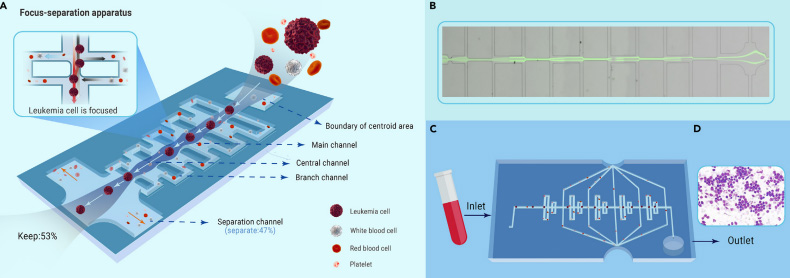
Novel microfluidic device for measurable residual disease detection in acute leukemia


Principle and methodology of utilizing CTC enrichment chips in MRD detection
Relapse is the most important cause of treatment failure in acute leukemia (AL). Thus, how to predict relapse is critical for improving the survival of patients with AL. Measurable residual diseases (MRDs; previously termed minimal residual diseases), referring to the presence of remaining leukemia cells after the declaration of complete remission (CR) detected by morphological analysis, is the most important biomarker for relapse prediction.1 Several methods, including multiparameter flow cytometry (MFC), real-time quantitative polymerase chain reaction (qPCR), digital PCR (dPCR), and next-generation sequencing (NGS), are used to monitor MRD after treatment, reaching a sensitivity of 10−4 to 10−6.