
Shedding light on gene therapy of Parkinson's disease in non-human primates
-

-
REFERENCES
[1] Poewe, W., Seppi, K., Tanner, C.M., et al. (2017). Parkinson disease. Nat. Rev. Dis. Primers 3: 17013. https://doi.org/10.1038/nrdp.2017.13. [2] Chen, Y., Hong, Z., Wang, J., et al. (2023). Circuit-specific gene therapy reverses core symptoms in a primate Parkinson's disease model. Cell 186: 5394–5410.e18. https://doi.org/10.1016/j.cell.2023.10.004. [3] Kravitz, A.V., Freeze, B.S., Parker, P.R.L., et al. (2010). Regulation of parkinsonian motor behaviours by optogenetic control of basal ganglia circuitry. Nature 466: 622–626. https://doi.org/10.1038/nature09159. [4] Li, H., and Jin, X. (2023). Multiple dynamic interactions from basal ganglia direct and indirect pathways mediate action selection. Elife 12: RP87644. https://doi.org/10.7554/eLife.87644. [5] Hammond, C., Bergman, H., and Brown, P. (2007). Pathological synchronization in Parkinson's disease: networks, models and treatments. Trends Neurosci. 30: 357–364. https://doi.org/10.1016/j.tins.2007.05.004. -
ABOUT THIS ARTICLE
Cite this article:
Xunyi Yan, Xin Jin. Shedding light on gene therapy of Parkinson's disease in non-human primates[J]. The Innovation, 2024, 5(2). https://doi.org/10.1016/j.xinn.2024.100581
Welcome!
To request copyright permission to republish or share portions of our works, please visit Copyright Clearance Center's (CCC) Marketplace website at marketplace.copyright.com.
Export File
Citation
Xunyi Yan, Xin Jin. Shedding light on gene therapy of Parkinson's disease in non-human primates[J]. The Innovation, 2024, 5(2). https://doi.org/10.1016/j.xinn.2024.100581

Format
Content
 DownLoad:
-
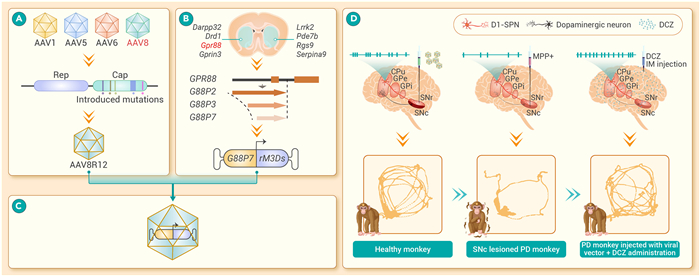
Figure 1.
The development of a new circuit-based gene therapy for Parkinson's disease
