
Respiratory protein-driven selectivity during the Permian-Triassic mass extinction
-
GRAPHICAL ABSTRACT
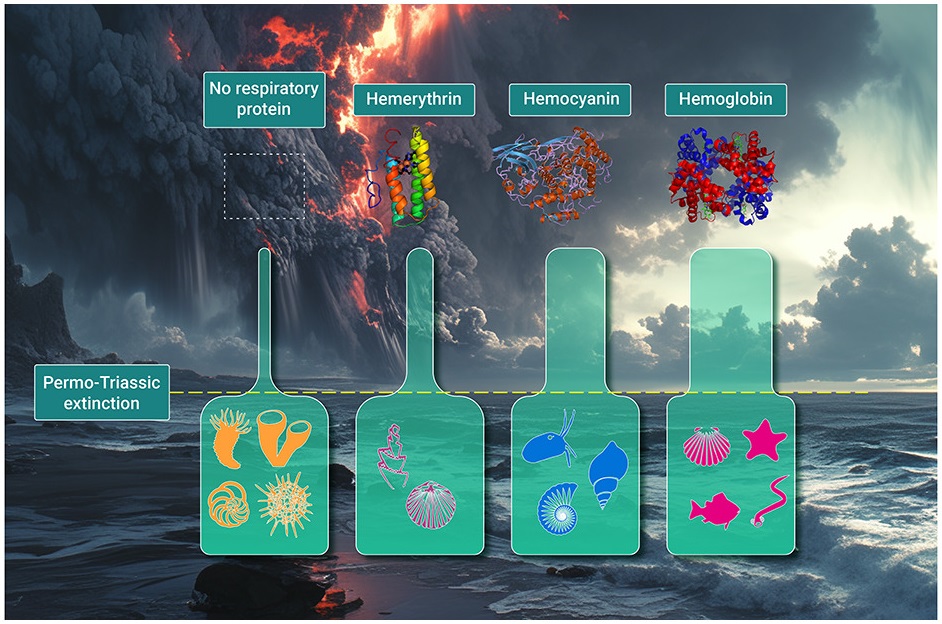
 DownLoad:
Full size image
DownLoad:
Full size image
-
PUBLIC SUMMARY
- ■ Physiological traits were key in determining species' survival during the Permian-Triassic mass extinction.
- ■ Clades with hemoglobin and hemocyanin exhibited high survival rates during the mass extinction.
- ■ Clades with lower O2-carrying capacity experienced a significant reduction in body size during anoxic events.
-
ABSTRACT
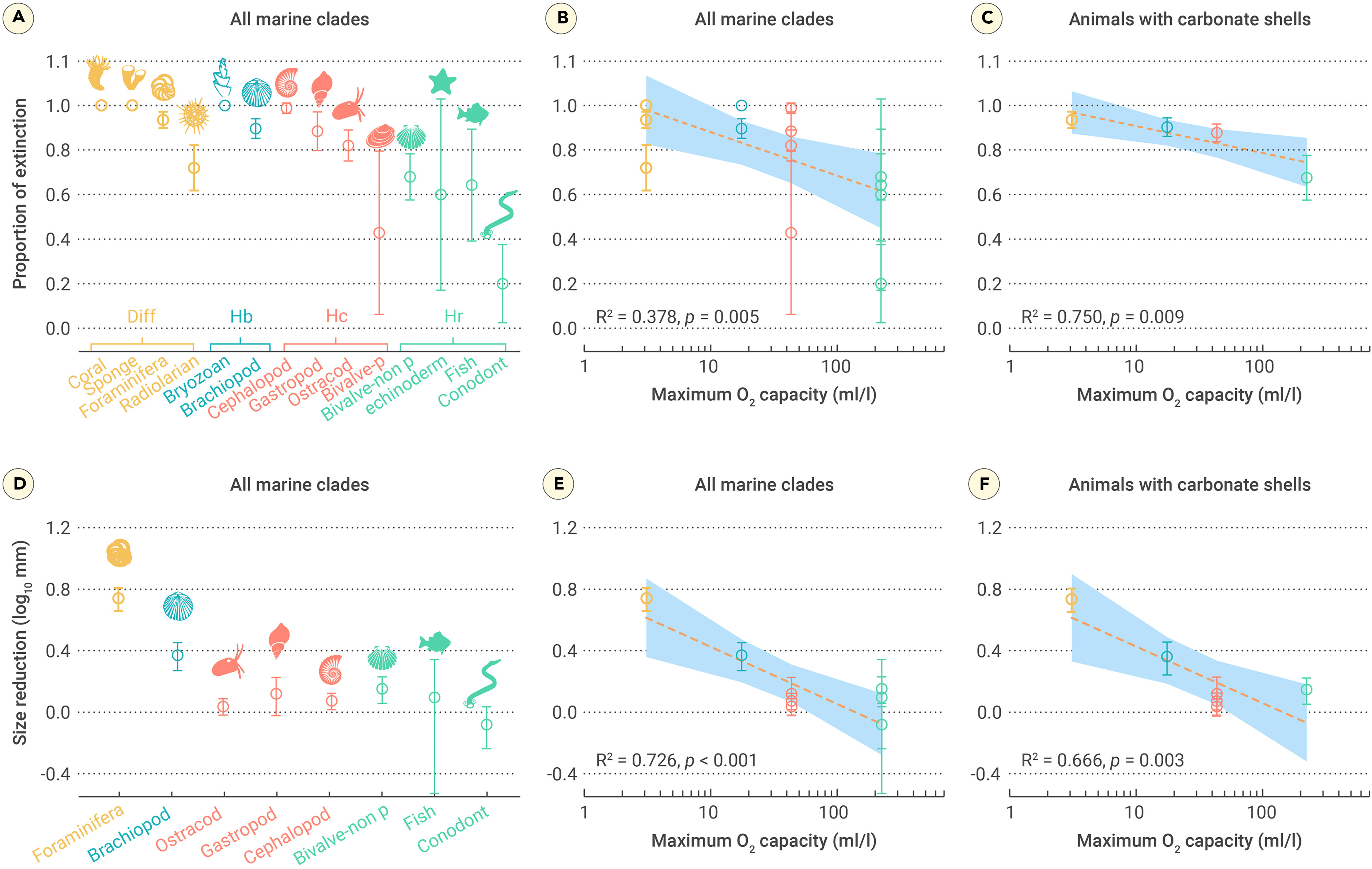
Extinction selectivity determines the direction of macroevolution, especially during mass extinction; however, its driving mechanisms remain poorly understood. By investigating the physiological selectivity of marine animals during the Permian-Triassic mass extinction, we found that marine clades with lower O2-carrying capacity hemerythrin proteins and those relying on O2 diffusion experienced significantly greater extinction intensity and body-size reduction than those with higher O2-carrying capacity hemoglobin or hemocyanin proteins. Our findings suggest that animals with high O2-carrying capacity obtained the necessary O2 even under hypoxia and compensated for the increased energy requirements caused by ocean acidification, which enabled their survival during the PermianTriassic mass extinction. Thus, high O2-carrying capacity may have been crucial for the transition from the Paleozoic to the Modern Evolutionary Fauna. -

-
REFERENCES
[1] Raup, D.M., and Sepkoski, J.J.J. (1982). Mass extinctions in the marine fossil record. Science 215: 1501-1503. https://doi.org/10.1126/science.215.4539.1501. [2] Song, H., Kemp, D.B., Tian, L., et al. (2021). Thresholds of temperature change for mass extinctions. Nat. Commun. 12(1): 4694. https://doi.org/10.1038/s41467-021-25019-2. [3] Knoll, A.H., Bambach, R.K., Payne, J.L., et al. (2007). Paleophysiology and end-Permian mass extinction. Earth Planet Sci. Lett. 256(3–4): 295-313. https://doi.org/10.1016/j.epsl.2007.02.018. [4] Dal Corso, J., Song, H., Callegaro, S., et al. (2022). Environmental crises at the Permian–Triassic mass extinction. Nat. Rev. Earth Environ. 3(3): 197-214. https://doi.org/10.1038/s43017-021-00259-4. [5] Jablonski, D. (1986). Background and mass extinctions: the alternation of macroevolutionary regimes. Science 231: 129-133. https://doi.org/10.1126/science.231.4734.129. [6] Payne, J.L., Bush, A.M., Chang, E.T., et al. (2016). Extinction intensity, selectivity and their combined macroevolutionary influence in the fossil record. Biol. Lett. 12(10): 20160202. https://doi.org/10.1098/rsbl.2016.0202. [7] Stanley, S.M. (2016). Estimates of the magnitudes of major marine mass extinctions in earth history. Proc. Natl. Acad. Sci. USA 113(42): E6325-E6334. https://doi.org/10.1073/pnas.1613094113. [8] Song, H., Wignall, P.B., Tong, J., et al. (2013). Two pulses of extinction during the Permian-Triassic crisis. Nat. Geosci. 6(1): 52-56. https://doi.org/10.1038/ngeo1649. [9] Sepkoski, J.J., Jr. (1984). A kinetic model of Phanerozoic taxonomic diversity, Ⅲ. Post-Paleozoic families and mass extinctions. Paleobiology 10(2): 246-267. https://doi.org/10.1017/S0094837300008186. [10] Dai, X., Davies, J.H.F.L., Yuan, Z., et al. (2023). A Mesozoic fossil lagerstätte from 250.8 million years ago shows a modern-type marine ecosystem. Science 379(6632): 567-572. https://doi.org/10.1126/science.adf1622. [11] Muscente, A.D., Prabhu, A., Zhong, H., et al. (2018). Quantifying ecological impacts of mass extinctions with network analysis of fossil communities. Proc. Natl. Acad. Sci. USA 115(20): 5217-5222. https://doi.org/10.1073/pnas.1719976115. [12] Rojas, A., Calatayud, J., Kowalewski, M., et al. (2021). A multiscale view of the Phanerozoic fossil record reveals the three major biotic transitions. Commun. Biol. 4(1): 309. https://doi.org/10.1038/s42003-021-01805-y. [13] Clapham, M.E., and Payne, J.L. (2011). Acidification, anoxia, and extinction: A multiple logistic regression analysis of extinction selectivity during the Middle and Late Permian. Geology 39(11): 1059-1062. https://doi.org/10.1130/g32230.1. [14] Kiessling, W., and Simpson, C. (2011). On the potential for ocean acidification to be a general cause of ancient reef crises. Glob. Chang. Biol. 17(1): 56-67. https://doi.org/10.1111/j.1365-2486.2010.02204.x. [15] Foster, W.J., Ayzel, G., Münchmeyer, J., et al. (2022). Machine learning identifies ecological selectivity patterns across the end-Permian mass extinction. Paleobiology 48(3): 357-371. https://doi.org/10.1017/pab.2022.1. [16] Brayard, A., Meier, M., Escarguel, G., et al. (2015). Early Triassic Gulliver gastropods: Spatio-temporal distribution and significance for biotic recovery after the end-Permian mass extinction. Earth Sci. Rev. 146: 31-64. https://doi.org/10.1016/j.earscirev.2015.03.005. [17] Romano, C., Koot, M.B., Kogan, I., et al. (2016). Permian–Triassic Osteichthyes (bony fishes): diversity dynamics and body size evolution. Biol. Rev. 91(1): 106-147. https://doi.org/10.1111/brv.12161. [18] Schaal, E.K., Clapham, M.E., Rego, B.L., et al. (2016). Comparative size evolution of marine clades from the Late Permian through Middle Triassic. Paleobiology 42(1): 127-142. https://doi.org/10.1017/pab.2015.36. [19] He, W.H., Shi, G., Twitchett, R., et al. (2015). Late Permian marine ecosystem collapse began in deeper waters: evidence from brachiopod diversity and body size changes. Geobiology 13(2): 123-138. https://doi.org/10.1111/gbi.12119. [20] Jablonski, D., and Raup, D.M. (1995). Selectivity of end-Cretaceous marine bivalve extinctions. Science 268(5209): 389-391. https://doi.org/10.1126/science.11536722. [21] Payne, J.L., and Finnegan, S. (2007). The effect of geographic range on extinction risk during background and mass extinction. Proc. Natl. Acad. Sci. USA 104(25): 10506-10511. https://doi.org/10.1073/pnas.0701257104. [22] Suzuki, T., and Imai, K. (1998). Evolution of myoglobin. Cell. Mol. Life Sci. 54(9): 979-1004. https://doi.org/10.1007/s000180050227. [23] Terwilliger, N.B. (1998). Functional adaptations of oxygen-transport proteins. J. Exp. Biol. 201(8): 1085-1098. https://doi.org/10.1242/jeb.201.8.1085. [24] Song, H., Wignall, P.B., and Dunhill, A.M. (2018). Decoupled taxonomic and ecological recoveries from the Permo-Triassic extinction. Sci. Adv. 4(10): eaat5091. https://doi.org/10.1126/sciadv.aat5091. [25] Payne, J.L., Bush, A.M., Heim, N.A., et al. (2016). Ecological selectivity of the emerging mass extinction in the oceans. Science 353(6305): 1284-1286. https://doi.org/10.1126/science.aaf2416. [26] Song, S., Starunov, V., Bailly, X., et al. (2020). Globins in the marine annelid Platynereis dumerilii shed new light on hemoglobin evolution in bilaterians. BMC Evol. Biol. 20(1): 165. https://doi.org/10.1186/s12862-020-01714-4. [27] Mangum, C.P. (2011). Invertebrate blood oxygen carriers. Compr. Physiol. : 1097-1135. https://doi.org/10.1002/cphy.cp130215. [28] Heim, N.A., Bakshi, S.H., Buu, L., et al. (2020). Respiratory medium and circulatory anatomy constrain size evolution in marine macrofauna. Paleobiology 46(3): 288-303. https://doi.org/10.1017/pab.2020.16. [29] Lau, K.V., Maher, K., Altiner, D., et al. (2016). Marine anoxia and delayed Earth system recovery after the end-Permian extinction. Proc. Natl. Acad. Sci. USA 113(9): 2360-2365. https://doi.org/10.1073/pnas.1515080113. [30] Zhang, F., Romaniello, S.J., Algeo, T.J., et al. (2018). Multiple episodes of extensive marine anoxia linked to global warming and continental weathering following the latest Permian mass extinction. Sci. Adv. 4(4): e1602921. https://doi.org/10.1126/sciadv.1602921. [31] Pimentel-Galvan, M., Lau, K.V., Maher, K., et al. (2022). Duration and intensity of end-Permian marine anoxia. Geochem. Geophys. Geosyst. 23(1): e2021GC010130. https://doi.org/10.1029/2021GC010130. [32] Deutsch, C., Ferrel, A., Seibel, B., et al. (2015). Climate change tightens a metabolic constraint on marine habitats. Science 348(6239): 1132-1135. https://doi.org/10.1126/science.aaa1605. [33] Penn, J.L., Deutsch, C., Payne, J.L., et al. (2018). Temperature-dependent hypoxia explains biogeography and severity of end-Permian marine mass extinction. Science 362(6419): eaat1327. https://doi.org/10.1126/science.aat1327. [34] Hülse, D., Lau, K.V., van de Velde, S.J., et al. (2021). End-Permian marine extinction due to temperature-driven nutrient recycling and euxinia. Nat. Geosci. 14(11): 862-867. https://doi.org/10.1038/s41561-021-00829-7. [35] Song, H., Wignall, P.B., Chu, D., et al. (2014). Anoxia/high temperature double whammy during the Permian-Triassic marine crisis and its aftermath. Sci. Rep. 4: 4132. https://doi.org/10.1038/srep04132. [36] Dabruzzi, T.F., and Bennett, W.A. (2014). Hypoxia effects on gill surface area and blood oxygen-carrying capacity of the Atlantic stingray, Dasyatis sabina. Fish Physiol. Biochem. 40(4): 1011-1020. https://doi.org/10.1007/s10695-013-9901-8. [37] Rubalcaba, J.G., Verberk, W.C.E.P., Hendriks, J., et al. (2020). Oxygen limitation may affect the temperature and size dependence of metabolism in aquatic ectotherms. Proc. Natl. Acad. Sci. USA 117(50): 31963-31968. https://doi.org/10.1073/pnas.2003292117. [38] Feng, Y., Song, H., and Bond, D.P.G. (2020). Size variations in foraminifers from the early Permian to the Late Triassic: implications for the Guadalupian–Lopingian and the Permian–Triassic mass extinctions. Paleobiology 46(4): 511-532. https://doi.org/10.1017/pab.2020.37. [39] Wu, Y., Chu, D., Tong, J., et al. (2021). Six-fold increase of atmospheric pCO2 during the Permian–Triassic mass extinction. Nat. Commun. 12(1): 2137. https://doi.org/10.1038/s41467-021-22298-7. [40] Wu, Y., Cui, Y., Chu, D., et al. (2023). Volcanic CO2 degassing postdates thermogenic carbon emission during the end-Permian mass extinction. Sci. Adv. 9(7): eabq4082. https://doi.org/10.1126/sciadv.abq4082. [41] Orr, J.C., Fabry, V.J., Aumont, O., et al. (2005). Anthropogenic ocean acidification over the twenty-first century and its impact on calcifying organisms. Nature 437(7059): 681-686. https://doi.org/10.1038/nature04095. [42] Watson, S. -A., Morley, S.A., and Peck, L.S. (2017). Latitudinal trends in shell production cost from the tropics to the poles. Sci. Adv. 3(9): e1701362. https://doi.org/10.1126/sciadv.1701362. [43] Jurikova, H., Gutjahr, M., Wallmann, K., et al. (2020). Permian–Triassic mass extinction pulses driven by major marine carbon cycle perturbations. Nat. Geosci. 13(11): 745-750. https://doi.org/10.1038/s41561-020-00646-4. [44] Pörtner, H.O., Langenbuch, M., and Michaelidis, B. (2005). Synergistic effects of temperature extremes, hypoxia, and increases in CO2 on marine animals: From Earth history to global change. J. Geophys. Res. Oceans 110: C09S10. https://doi.org/10.1029/2004JC002561. [45] Stumpp, M., Hu, M.Y., Melzner, F., et al. (2012). Acidified seawater impacts sea urchin larvae pH regulatory systems relevant for calcification. Proc. Natl. Acad. Sci. USA 109(44): 18192-18197. https://doi.org/10.1073/pnas.1209174109. [46] Pan, T. -C.F., Applebaum, S.L., and Manahan, D.T. (2015). Experimental ocean acidification alters the allocation of metabolic energy. Proc. Natl. Acad. Sci. USA 112(15): 4696-4701. https://doi.org/10.1073/pnas.1416967112. [47] Manwell, C. (1960). Oxygen equilibrium of brachiopod Lingula hemerythrin. Science 132(3426): 550-551. https://doi.org/10.1126/science.132.3426.550. [48] Isozaki, Y. (1997). Permo-Triassic boundary superanoxia and stratified superocean: records from lost deep sea. Science 276: 235-238. https://doi.org/10.1126/science.276.5310.235. [49] Racki, G. (1999). Silica-secreting biota and mass extinctions: survival patterns and processes. Palaeogeogr. Palaeoclimatol. Palaeoecol. 154(1–2): 107-132. https://doi.org/10.1016/S0031-0182(99)00089-9. [50] Bagarinao, T. (1992). Sulfide as an environmental factor and toxicant: tolerance and adaptations in aquatic organisms. Aquat. Toxicol. 24(1–2): 21-62. https://doi.org/10.1016/0166-445X(92)90015-F. [51] Montes-Rodríguez, I.M., Rivera, L.E., López-Garriga, J., et al. (2016). Characterization and expression of the Lucina pectinata oxygen and sulfide binding hemoglobin genes. PLoS One 11(1): e0147977. https://doi.org/10.1371/journal.pone.0147977. [52] Martín-Durán, J.M., de Mendoza, A., Sebé-Pedrós, A., et al. (2013). A broad genomic survey reveals multiple origins and frequent losses in the evolution of respiratory hemerythrins and hemocyanins. Genome Biol. Evol. 5(7): 1435-1442. https://doi.org/10.1093/gbe/evt102. [53] Pushie, M.J., Pratt, B.R., Macdonald, T.C., et al. (2014). Evidence for biogenic copper (hemocyanin) in the middle Cambrian arthropod Marrella from the Burgess Shale. Palaios 29(10): 512-524. https://doi.org/10.2110/palo.2014.073. [54] Sun, Y., Joachimski, M.M., Wignall, P.B., et al. (2012). Lethally hot temperatures during the Early Triassic greenhouse. Science 338(6105): 366-370. https://doi.org/10.1126/science.1224126. [55] Wignall, P.B., and Twitchett, R.J. (1996). Oceanic anoxia and the end-Permian mass extinction. Science 272(5265): 1155-1158. https://doi.org/10.1126/science.272.5265.1155. [56] Yin, H., and Song, H. (2013). Mass extinction and Pangea integration during the Paleozoic-Mesozoic transition. Sci. China Earth Sci. 56(11): 1791-1803. https://doi.org/10.1007/s11430-013-4624-3. [57] Bond, D.P., and Grasby, S.E. (2017). On the causes of mass extinctions. Palaeogeogr. Palaeoclimatol. Palaeoecol. 478: 3-29. https://doi.org/10.1016/j.palaeo.2016.11.005. [58] Zhang, H., Zhang, F., Chen, J. -b., et al. (2021). Felsic volcanism as a factor driving the end-Permian mass extinction. Sci. Adv. 7(47): eabh1390. https://doi.org/10.1126/sciadv.abh1390. [59] Benton, M.J. (2018). Hyperthermal-driven mass extinctions: killing models during the Permian–Triassic mass extinction. Phil. Trans. R. Soc. A. 376(2130): 20170076. https://doi.org/10.1098/rsta.2017.0076. [60] Song, H., and Scotese, C.R. (2023). The end-Paleozoic great warming. Sci. Bull. 68(21): 2523-2526. https://doi.org/10.1016/j.scib.2023.09.009. [61] McGhee, G. (2018). Carboniferous Giants and Mass Extinction. In Carboniferous Giants and Mass Extinction, (Columbia University Press). [62] Hönisch, B., Ridgwell, A., Schmidt, D.N., et al. (2012). The geological record of ocean acidification. Science 335(6072): 1058-1063. https://doi.org/10.1126/science.1208277. [63] Alroy, J. (2010). The shifting balance of diversity among major marine animal groups. Science 329(5996): 1191-1194. https://doi.org/10.1126/science.1189910. [64] Ceballos, G., Ehrlich, P.R., Barnosky, A.D., et al. (2015). Accelerated modern human–induced species losses: Entering the sixth mass extinction. Sci. Adv. 1(5): e1400253. https://doi.org/10.1126/sciadv.1400253. [65] Wang, F., Harindintwali, J.D., Wei, K., et al. (2023). Climate change: Strategies for mitigation and adaptation. The Innovation Geoscience 1(1): 100015. https://doi.org/10.59717/j.xinn-geo.2023.100015. [66] Yin, Z., Zhou, B., Duan, M., et al. (2023). Climate extremes become increasingly fierce in China. Innovation 4(2): 100406. https://doi.org/10.1016/j.xinn.2023.100406. [67] Penn, J.L., and Deutsch, C. (2022). Avoiding ocean mass extinction from climate warming. Science 376(6592): 524-526. [68] Kwiatkowski, L., Torres, O., Bopp, L., et al. (2020). Twenty-first century ocean warming, acidification, deoxygenation, and upper-ocean nutrient and primary production decline from CMIP6 model projections. Biogeosciences 17(13): 3439-3470. https://doi.org/10.5194/bg-17-3439-2020. -
ABOUT THIS ARTICLE
Cite this article:
Song H., Wu Y., Dai X., et al., (2024). Respiratory protein-driven selectivity during the Permian-Triassic mass extinction. The Innovation 5(3), 100618. https://doi.org/10.1016/j.xinn.2024.100618
Welcome!
To request copyright permission to republish or share portions of our works, please visit Copyright Clearance Center's (CCC) Marketplace website at marketplace.copyright.com.
Export File
Citation
Song H., Wu Y., Dai X., et al., (2024). Respiratory protein-driven selectivity during the Permian-Triassic mass extinction. The Innovation 5(3), 100618. https://doi.org/10.1016/j.xinn.2024.100618

Format
Content


-
Figure 1.
Extinction and body-size reduction of marine animals at the genus level during the Permian-Triassic mass extinction
-
Figure 2.
Extinction and size reduction in different groups
-
Figure 3.
Logistic regression shows the selectivity of extinction during the Permian-Triassic crisis
-
Figure 4.
Ocean O2, H2S, and pH changes during the Permian-Triassic extinction using the cGENIE model and geological records
