Endogenous Fluorescence Carbon Dots Derived from Food Items

Graphical Abstract

Public Summary
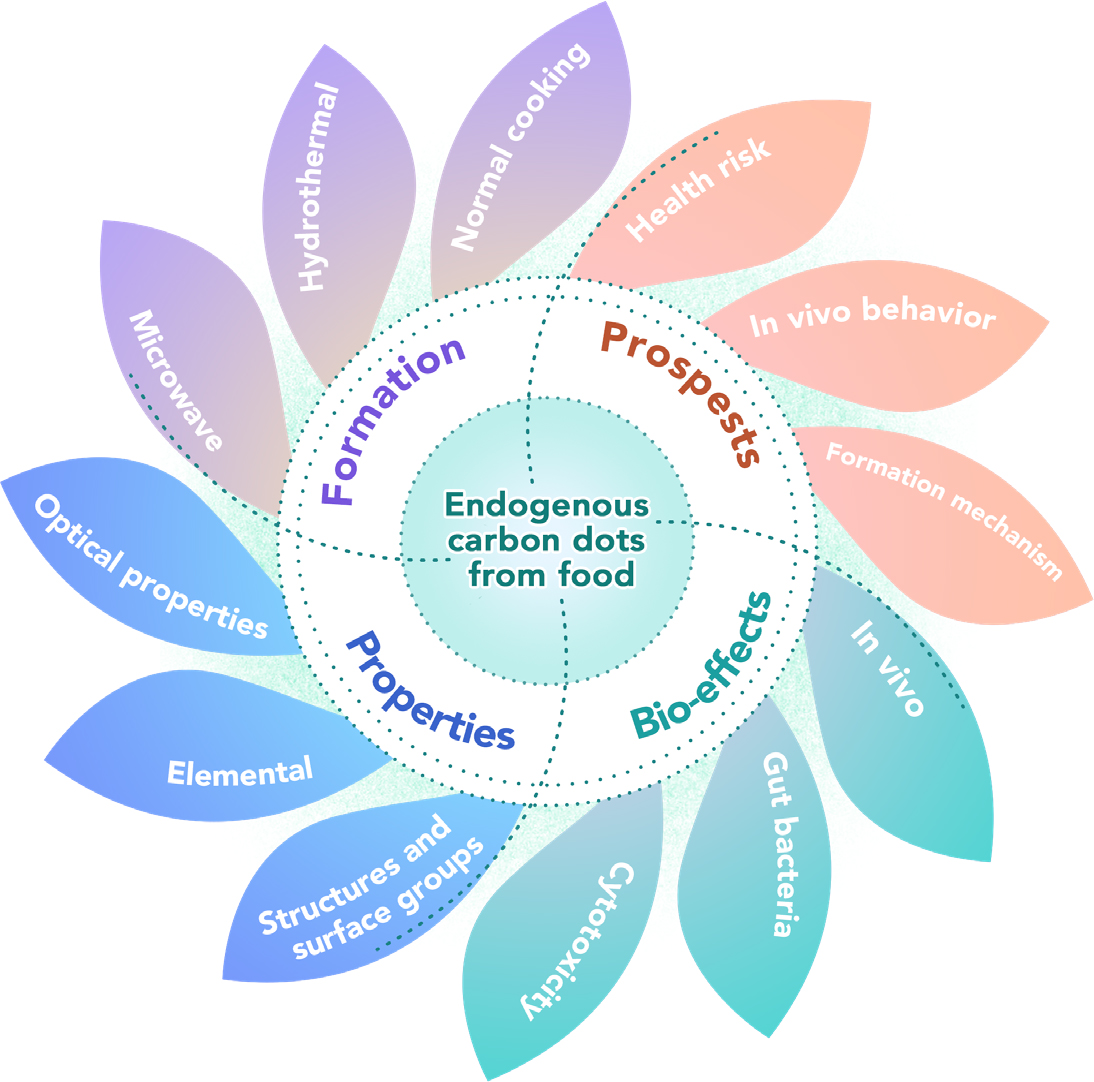
● Endogenous fluorescence carbon dots (CDs) derived from food items are ultrasmall nanoparticles with sizes below 10 nm, which typically contain carbon, oxygen, hydrogen, and/or nitrogen. The most significant features of CDs are strong and tunable fluorescence.
● Currently, the universal presence of CDs in food items has been proved. The formation of these endogenous food-borne CDs could be attributed to the complex reaction among a variety of food components during cooking process.
● The contact of these endogenous food-borne CDs is very frequent in our daily life. Therefore, our knowledge about the CDs is still in its infancy and more attention should be paid to the food-borne CDs owing to their uncertainty to human health.
● Primary results demonstrated that these food-borne CDs could accumulate in various organs and induce potential effects of the health. However, the concern of the long-term safety of food-borne CDs has not been addressed. Further research efforts should be focused on the chronic effects of these endogenous food-borne CDs.
Cite this article
Wang, H., Su, W. and Tan, M. Endogenous Fluorescence Carbon Dots Derived from Food Items. The Innovation 1 (1), 100009 (2020). doi: 10.1016/j.xinn.2020.04.009