What Can We Learn from Brazil's Health Care System ?


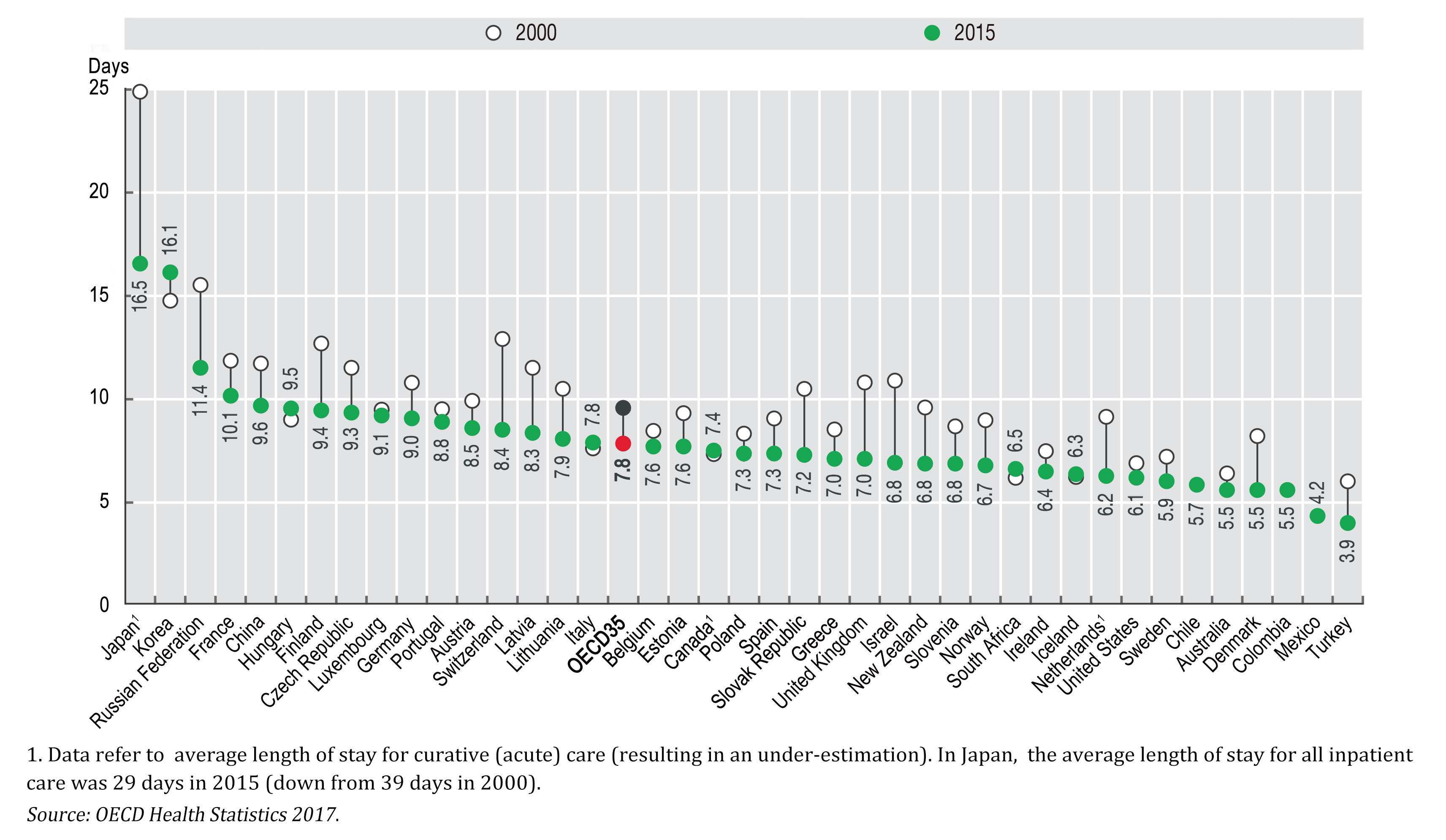
Average Length of Stay in OECD and Five Other Countries, 2000 and 2015 (Or Nearest Year)
In the current issue of The Innovation, Zhao and colleagues published results of a trend analysis on hospital admission rates for all diseases in Brazil over the periods of 2000–2015. The authors identified that both hospital admission rates and length of hospital stay (LOS) have decreased largely since 2000. However, the decrease in disease burdens was accompanied by increasing health care costs. In addition, as expected, the authors discovered that the vulnerable population, infants and the elderly, had the highest rates of hospital admissions. Surprisingly, injury and poisoning became a primary cause of hospital admissions for men aged 10–49 years. Finally, regional disparity was reported; Southern Brazil had greater disease burdens. In a recent publication in Circulation, Zou and colleagues discovered that Brazil had the greatest reduction in cardiovascular disease mortality among all BRICS (Brazil, Russia, India, China, and South Africa) countries, five emerging economies habituating half of the world population.1 Zhao and colleagues' study provided further details about Brazil's success in health care.
Cite this article
Qi, Y. and Li, C. What Can We Learn from Brazil's Health Care System? The Innovation 1 (1), 100002 (2020). doi: 10.1016/j.xinn.2020.04.002