Predicting Illness Severity and Short-term Outcomes of COVID-19: A Retrospective Cohort Study in China

Graphical Abstract

Public Summary
● Among 417 COVID-19 patients in Shenzhen, demographic characteristics, clinical manifestations and baseline laboratory tests showed significant differences between mild-moderate cohort and severe-critical cohort.
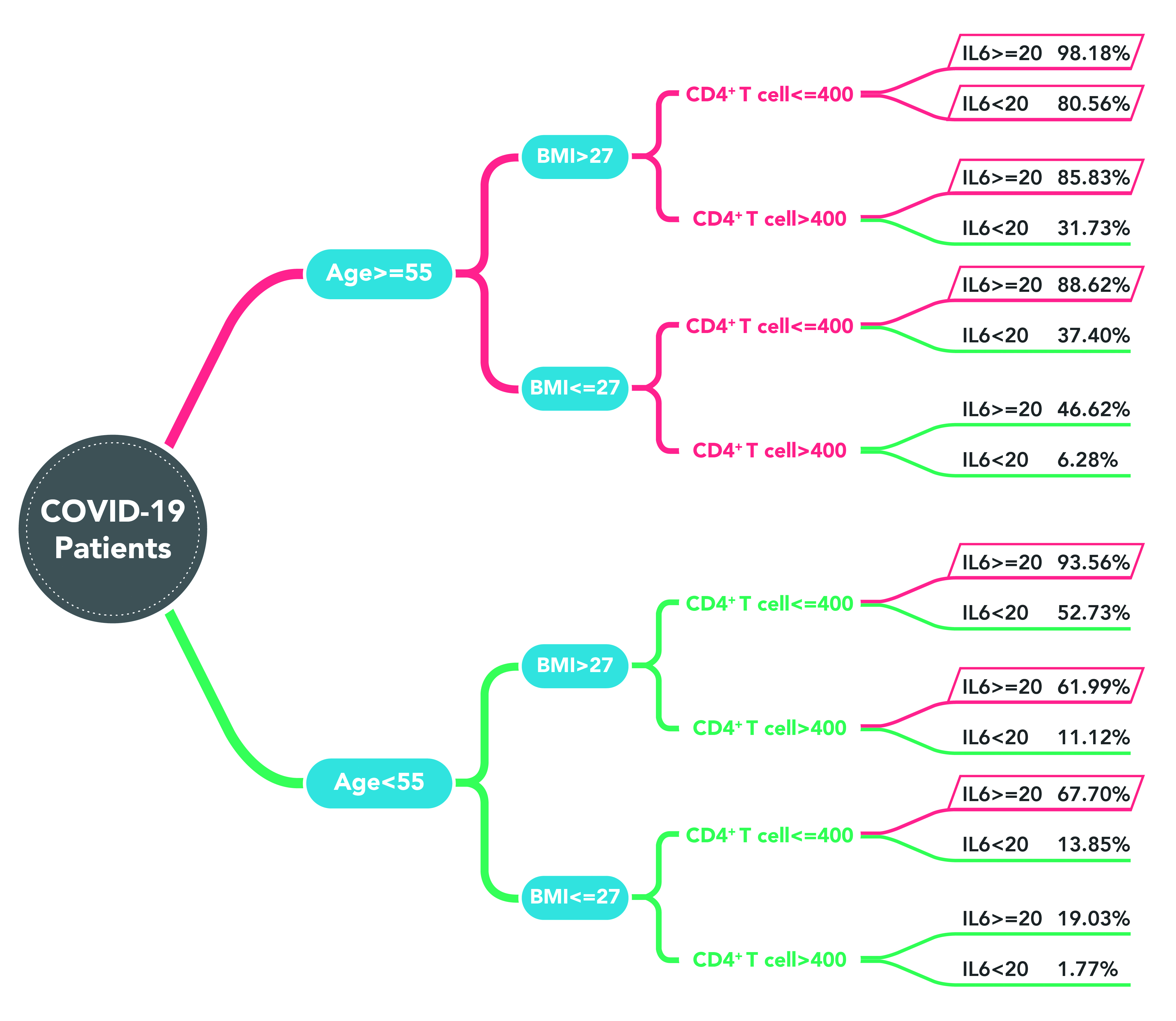
● Based on these differences, a mathematical model was established to predict the illness severity of COVID-19. The model includes four variables: age, BMI, CD4+ lymphocytes and IL-6 levels. The AUC of the model is 0.911.
● The high risk factors on developing to severe COVID-19 are: age ≥ 55 years, BMI > 27 kg / m2, IL-6 ≥ 20 pg/ml and CD4 + T cell ≤ 400 count/μ L.
● Among 249 discharged COVID-19 patients, those who recovered after 20 days had a lower platelet count, a higher level of estimated glomerular filtration rate, and a higher level of interleukin-6 and myoglobin than those who recovered within 20 days.
Cite this article
Chen, C., Wang, H., Liang, Z., Peng, L., Zhao, F., Yang, L., Cao, M., Wu, W., Jiang, X., Zhang, P., Li, Y., Chen, L., Feng, S., Li, J., Meng, L., Wu, H., Wang, F., Liu, Q. and Liu, Y. Predicting Illness Severity and Short-Term Outcomes of COVID-19: A Retrospective Cohort Study in China. The Innovation 1 (1), 100007 (2020). doi: 10.1016/j.xinn.2020.04.007