Characteristics Analysis and Implications on the COVID-19 Reopening of Victoria, Australia


The Number of Cumulative Confirmed Cases Was Calibrated to a Bi-logistic Function, Which Was Used to Model Biologic Patterns with Two Growth Phases
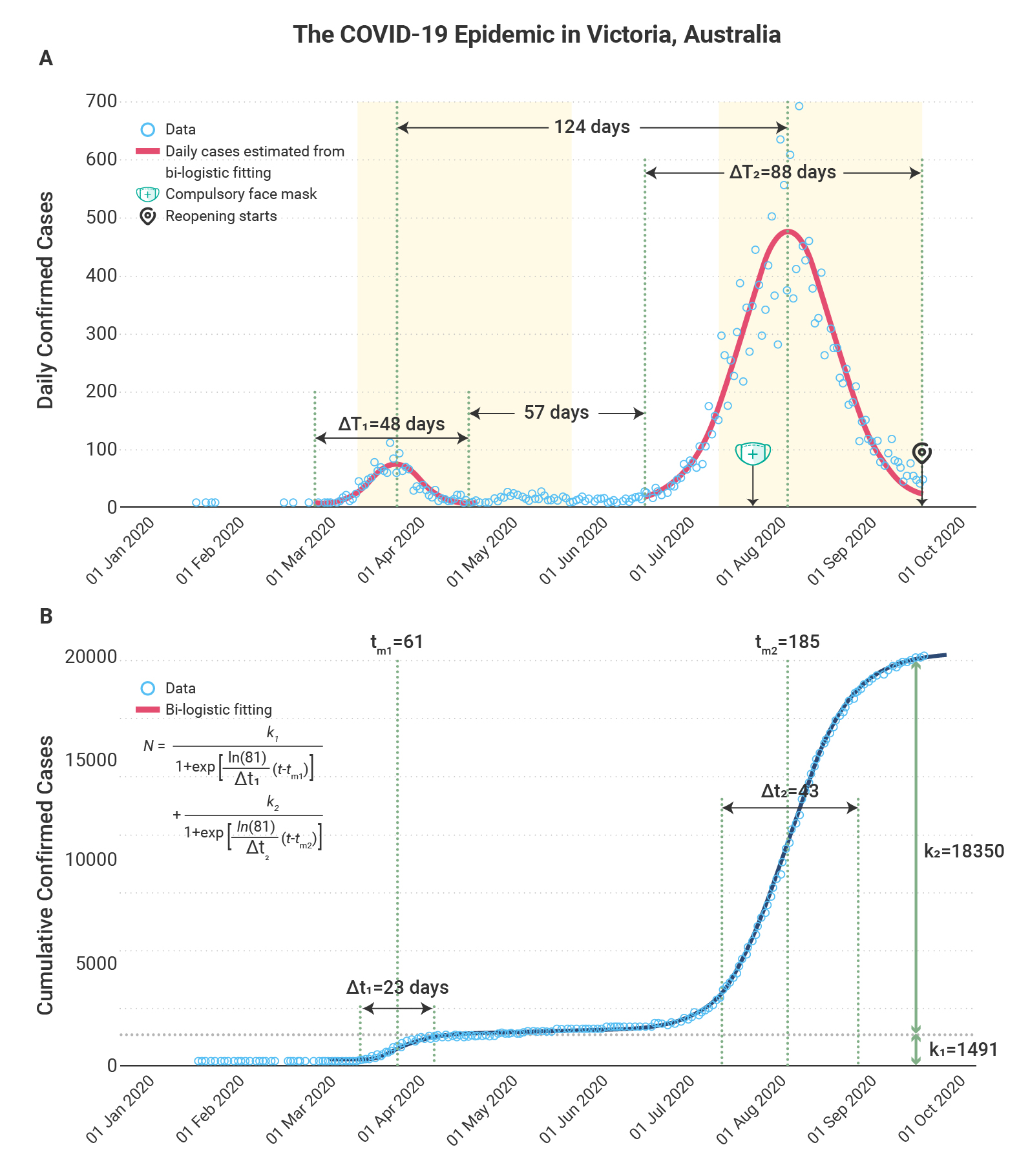
By 24 September 2020, the SARS-COV-2 epidemic had led to a total of 26,983 infections and 861 deaths in Australia, resulting in a significant disease burden on its health care system and disruption to its economy. The State of Victoria is the most severely affected Australian state and accounts for 74.5% of all infections and 89.7% deaths in Australia. Controlling the epidemic in Victoria is critical to the impact of the national epidemic. In response to the first outbreak of the epidemic, Victoria declared a state of emergency on 16 March and implemented stage 2 restrictions from 25 March to 25 May (first lockdown) with restrictions on major events, traveling, and social contacts (Figure 1A). In contrast, much stricter stage 3 and subsequent stage 4 (second lockdown) restrictions were implemented in metropolitan Melbourne and regional Victoria between the 9 July and 13 September in response to a substantially larger second outbreak since late June. The restriction measures have been effective, and the epidemic has seen a major decline from 500 to 700 cases/day in early August to 30–50 cases/day in early September. In preparation for reopening the economy, the Victorian government declared a COVID-19 roadmap for reopening on 9 September.1 In brief, the reopening plan for metro Melbourne requires the city to maintain a consistently declining trend of the epidemic, with the ease of restrictions in proportion to the number of the daily confirmed cases. The restrictions are less stringent for regional Victoria. The plan envisions complete elimination of the virus for 28 days state-wide before Victoria is allowed to return to a “COVID normal” scenario.
Cite this article
Zhang, L., Tao, Y., Zhuang, G. and Fairley, C.K. Characteristics Analysis and Implications on the COVID-19 Reopening of Victoria, Australia. The Innovation 1 (3), 100049 (2020). doi: 10.1016/j.xinn.2020.100049