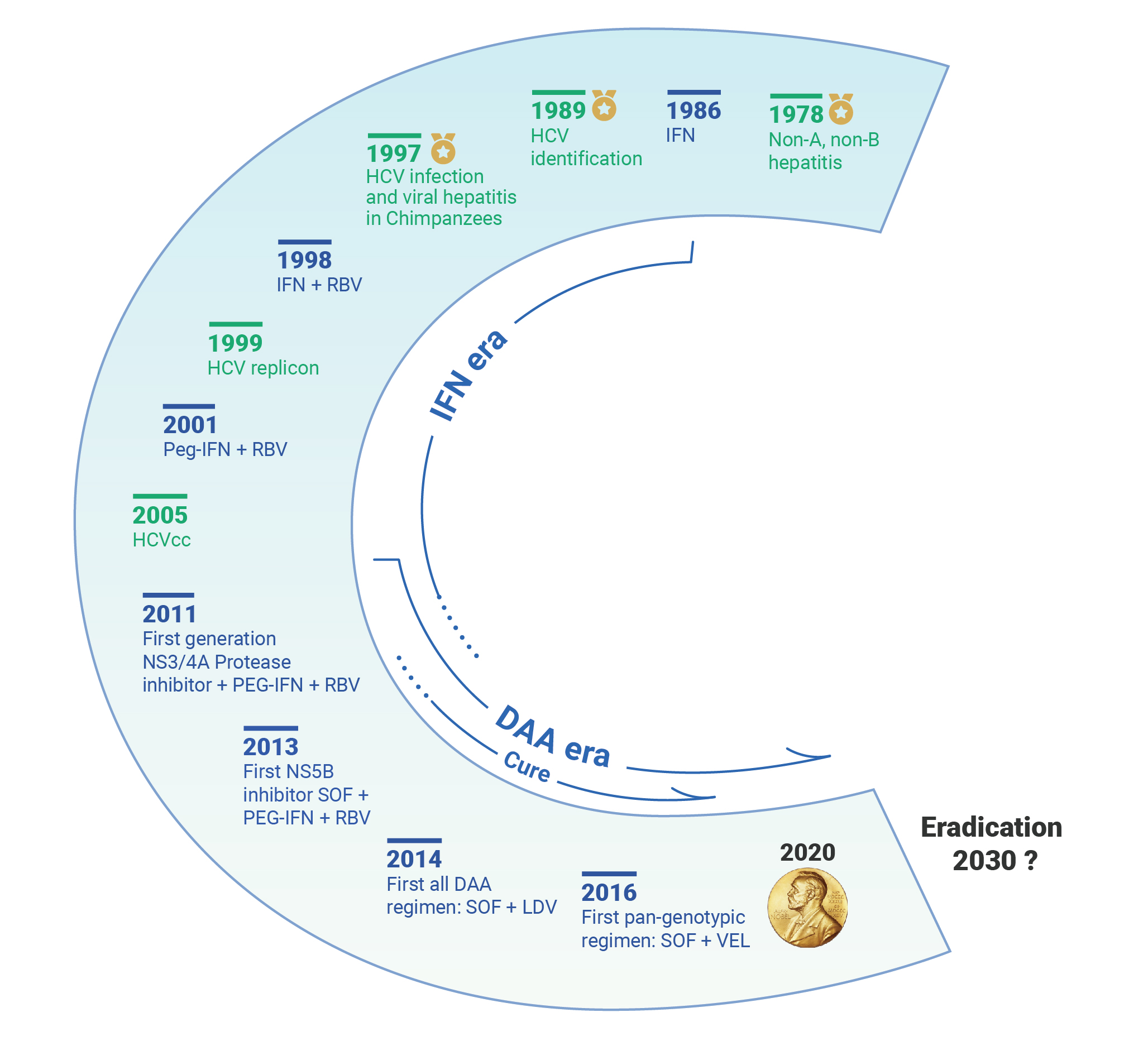
Key Milestones in HCV Discovery and Therapeutics


Milestones in HCV Research and Antiviral Treatment Development
This year's Nobel Prize in Physiology or Medicine was awarded to three scientists, each of whom played an integral role in the identification of the hepatitis C virus (HCV) and the characterization of the disease it causes, chronic hepatitis C (CHC). Initially Dr. Harvey Alter, a hematologist at the Clinical Center of the National Institutes of Health in Bethesda, Maryland recognized that there were many cases of post-transfusion hepatitis, unrelated to hepatitis A virus (HAV) or hepatitis B virus (HBV), termed non-A, non-B hepatitis. Dr. Michael Houghton, a microbiologist working at a small biotechnology company, Chiron in Emeryville, California, identified HCV as the causative agent of non-A, non-B hepatitis. After discovery of the HCV, Dr. Charles Rice, at Rockefeller University, New York worked on constructing a replication competent clone of the virus that was later used to demonstrate that the HCV alone was indeed the cause of CHC.
Cite this article
Cheng, X. and Ghany, M.G. Key Milestones in HCV Discovery and Therapeutics. The Innovation 1 (3), 100067 (2020). doi: 10.1016/j.xinn.2020.100067