3D Printing Challenges in Enabling Rapid Response to Public Health Emergencies


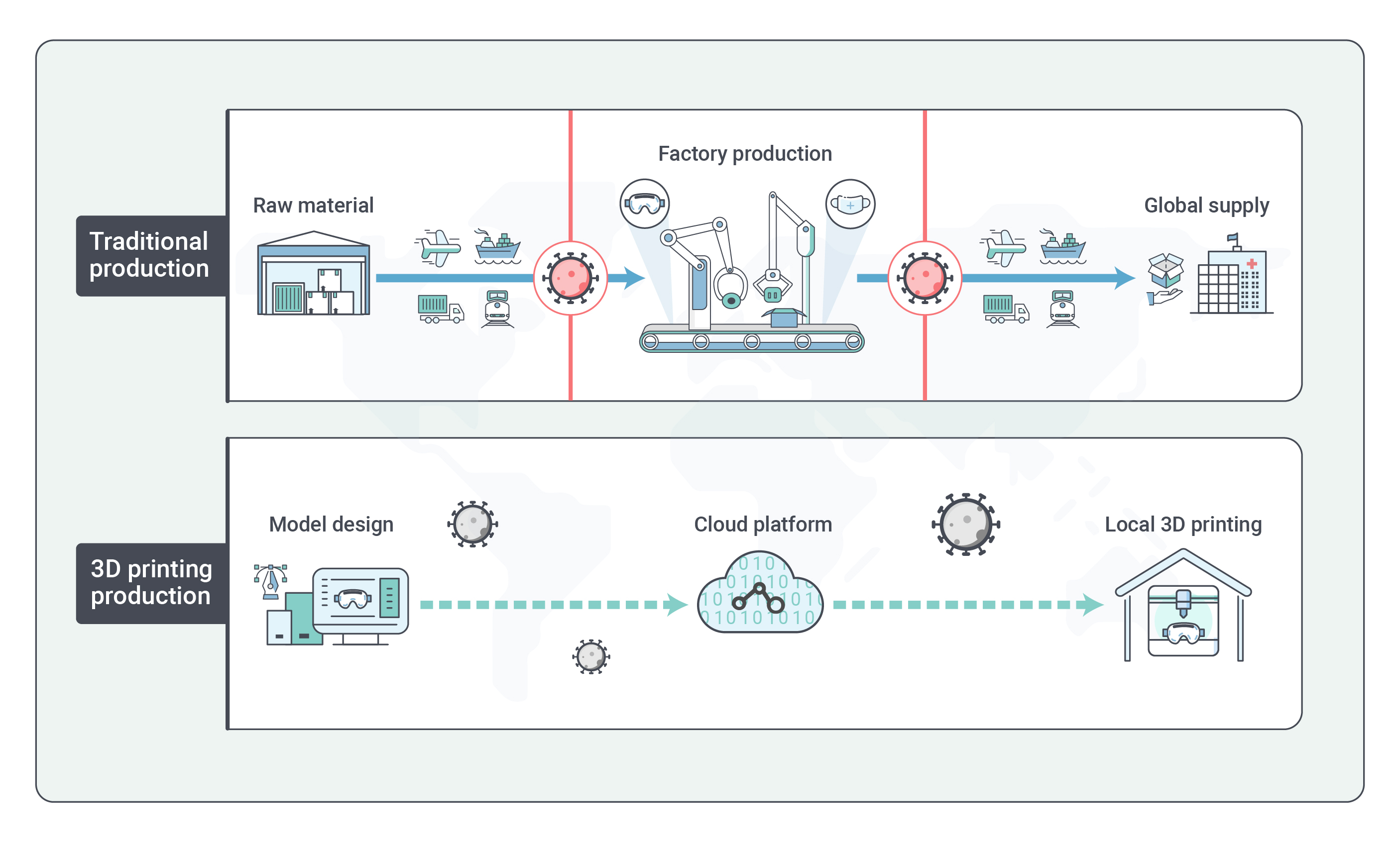
Comparison between 3D Printing Production and Traditional Production in Rapid Response to Public Health Emergencie
The coronavirus disease 2019 (COVID-19) epidemic has become a global public health emergency over last months. As of September 14th, over 28,000,000 confirmed cases and 917,000 deaths have been reported from all over the world.1 Its large-scale outbreak and pandemic cause an extreme shortage of personal protective equipment (PPE) and medical supplies such as face masks, testing kits, nasopharyngeal swabs, and medical ventilators in the early stage, which consequently leads to the collapse of local medical systems.2 It turns out that measures like lockdown and travel bans are the most effective strategies in response to an epidemic at an early stage with insufficient knowledge.3 However, those physical isolation measures will inevitably result in work stoppages and have a great impact on industrial production. The supply of raw materials and components, and the production and transportation of final products are greatly restricted under a global supply chain.4 This further aggravates the shortage of anti-epidemic supplies and so the vicious cycle begins.
Cite this article
Wang, D., Zhang, J., Liu, Q., Chen, B., Liang, Y., Hu, L. and Jiang, G. 3D Printing Challenges in Enabling Rapid Response to Public Health Emergencies. The Innovation 1 (3), 100056 (2020). doi: 10.1016/j.xinn.2020.100056