From deep earth to deep stars: A different nuclear reaction path to generate calcium in ancient stars

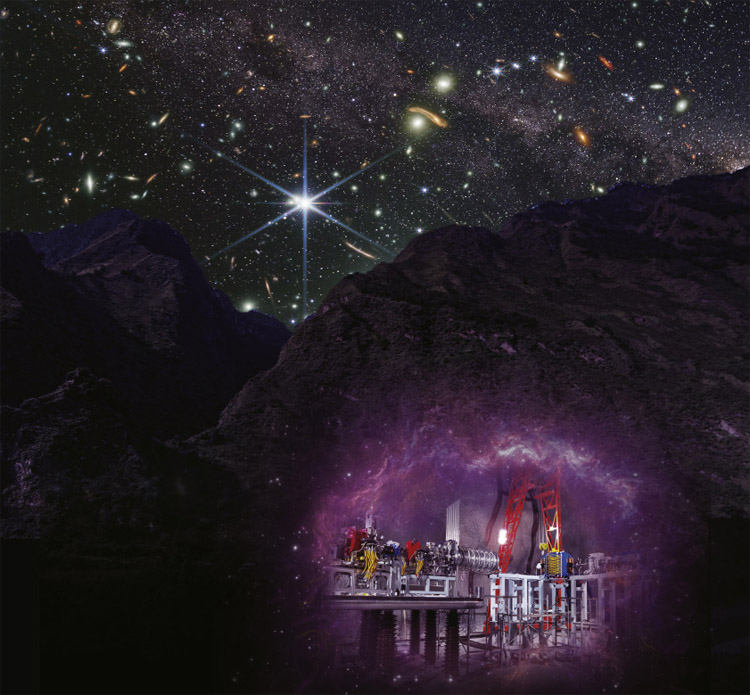
Nuclear physical experiment deeply underground provides clues of elements synthesis deeply inside ancient stars.
A recent study by Zhang et al.1 reported a successful direct measurement of the 19F(p,γ)20Ne reaction down to the very low energy point of 186 keV. This measurement is extremely challenging on the surface of the Earth due to the presence of natural radioactivity. The experiment was done in the China Jinping Underground Laboratory (CJPL), which is currently the deepest underground laboratory. Zhang et al. reported a key resonance at 225 keV for 19F(p,γ)20Ne reaction rate, which is significantly higher than the previous experimental results, making this reaction a possible nuclear path to generate more calcium (Ca) through the breakout from the carbon–nitrogen–oxygen (CNO) cycle inside stars.

