Threat of air pollution in the cleanest plateau

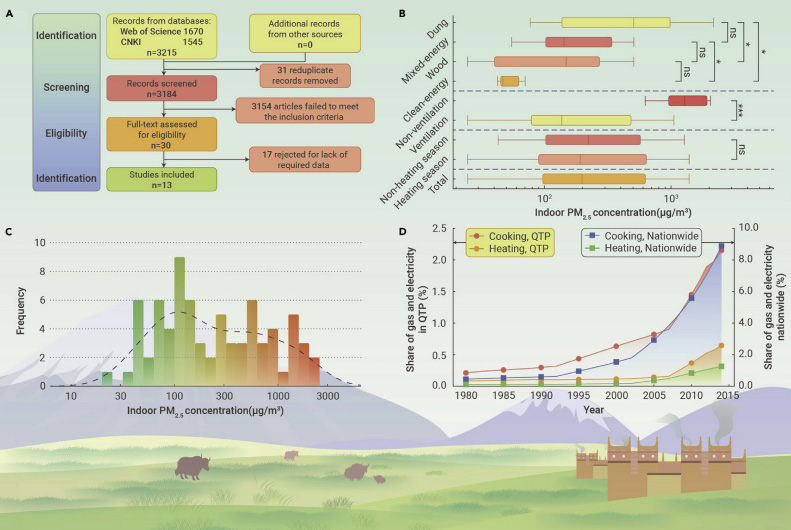
Available study results of household PM2.5 and fractions of modern household energies in the QTP
The Qinghai-Tibet Plateau (QTP), known as “the Third Pole” and “the Roof of the World,” is a region with unique geographical conditions and contains many areas exceeding 4,000 m. A major section of the plateau is in the Qinghai province and Tibet Autonomous Region, China. Although the temperature in the QTP region has been increasing at a rate slightly higher than the global average since 1979, the temperature in this region is considerably lower than those in the surrounding areas, and many parts of the QTP have annual average temperatures below 0°C. The plateau has a very low population density of ~2.97 persons/km2 compared to the Chinese national value of 148.3 persons/km2, affording low levels of human activities and limited anthropogenic impacts on the natural ecosystem. Consequently, the plateau is believed to be one of the cleanest areas in the world, as documented by many field-observation experiments and satellite-based studies. However, some studies have highlighted that the ambient concentrations of hazardous air pollutants such as volatile organic compounds, ozone, and aerosols, mostly in urban regions, may pose potential risks to the local population and should be paid more attention. Accompanied by rare local anthropogenic emissions, ambient air quality in the QTP region is strongly affected by exogenous atmospheric pollution from surrounding regions through air transport, especially under the influence of monsoon and westerlies.

.jpg)
