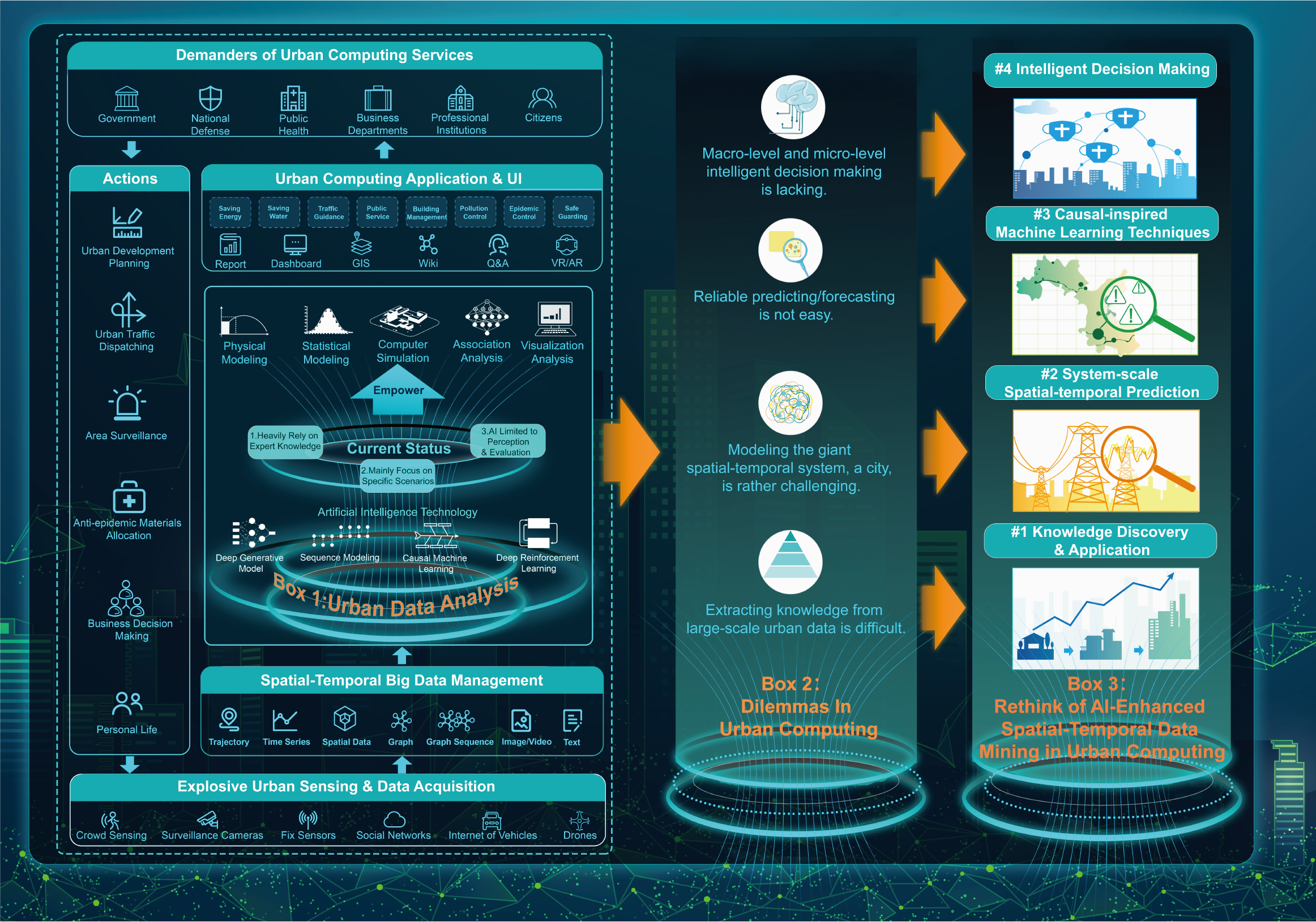
AI-enhanced spatial-temporal data-mining technology: New chance for next-generation urban computing


AI-enhanced spatial-temporal data mining in urban computing
In the previous few decades, urbanization has accelerated. In 2020, the average worldwide urbanization rate was 56.2%, suggesting that most nations are urbanized. Despite enormous gains, contemporary cities’ common resources and infrastructures cannot meet the needs of all people, resulting in undesirable consequences such as traffic congestion, food waste, water contamination, and high crime rates. To remove these impacts, urban computing, which bridges the gap between urban science and computer science, is proposed. It attempts to make wise judgments and improve the city’s resource distribution using extensively gathered spatial-temporal data. Continuously gathering and analyzing urban data yields significant benefits in many applications. The recent growth of artificial intelligence (AI) technology2 presents both new potential and obstacles for urban computing. Traditional analytical methodologies, such as physical modeling, heavily rely on empirical information or make strict assumptions that are unsuitable for complicated urban computing problems. In contrast, data-driven AI models automatically learn from data, complementing traditional methodologies.