Integrating social neuroscience into human-machine mutual behavioral understanding for autonomous driving

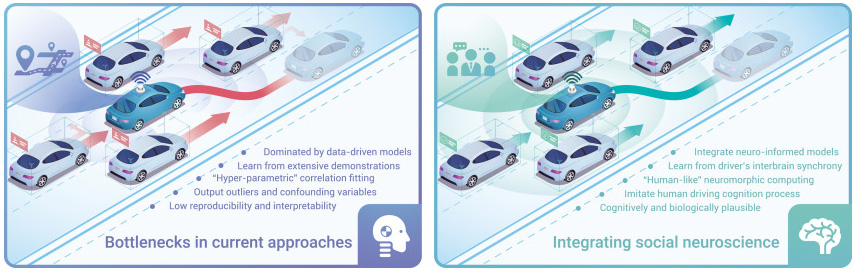
Integrating social neuroscience to break current driving understanding bottlenecks
Autonomous vehicles (AVs) are advertised to free human drivers, providing a safer and more efficient transport mode. After decades of extensive investment and invention, various types of AVs have been unveiled, but they are still restricted to limited application scenarios because of potential safety concerns. Despite rare sensing or detection failures from corner cases, one of the significant concerns primarily questions whether AVs would interact appropriately with surrounding human-driven vehicles on public roads. Particularly, the lack of approaches to human-like mutual driving understanding challenges the driving safety situation of AVs and human drivers. That is, human informal driving rules and implicit driving interactions cannot be understood explicitly by AVs, and human drivers can hardly accommodate the stilted or inconsistent driving behaviors generated by AVs because of distinctive “driving behavior understanding” mechanisms.
Due to the current small market penetration rate of AVs, they will inevitably share roads with human-driven vehicles for a long term. In other words, interactions between human-driven vehicles and AVs may challenge road safety for a prolonged period. Moreover, the opacity of AV decision-making algorithms brings psychological roadblocks to human drivers' trust, which prevents public acceptance and affects the adoption of AVs. Therefore, barriers to mutual driving understanding underline the urgent need for investigation.
Because driving interaction could be formulated as a cooperative task, both vehicle types require mutual understanding and cooperative road sharing. In this Editorial, we point out the current research bottleneck in AV driving understanding and gain insights into the integration with state-of-the-art social neuroscience research, such as interbrain synchrony or social neuromorphic computing, to achieve human-machine mutual driving understanding.

