Exploring the primate genome: Unraveling the mysteries of evolution and human disease

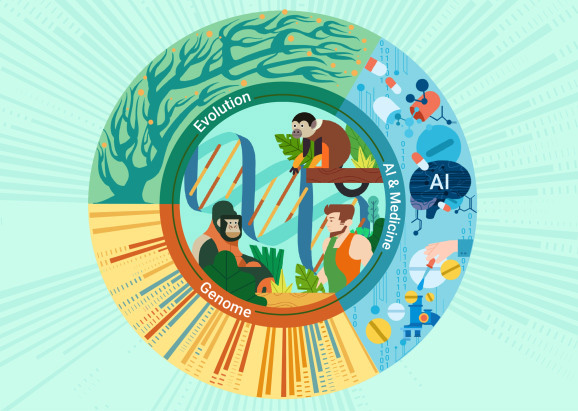
Evolution, genomics, and AI facilitate biodiversity, conservation, and precision medicine studies
Nonhuman primates (NHPs), our closest relatives, represent one of the most successful lineages of adaptive radiation in mammals. The primate order contains several hundred species living in varied ecological niches with phenotypic diversity. However, what we know about NHPs is still limited because of genome diversity.
To address this gap, the Primate Genome Project (PGP) consortium recently made a comprehensive sequencing effort.1 They sequenced 703 individuals from 233 primate species (16 families, 68 genera) with short-read sequencing technology as well as 27 primate species with long-read sequencing technologies, covering nearly half of all primate species.2 These efforts allow us to test long-standing evolutionary hypotheses, explore novel phenotypes, investigate social behavior changes, understand hybrid speciation, and refine variants associated with human disease risk. These efforts have significantly advanced our understanding of divergence, speciation, diversity, adaptation, and human disease during primate evolution, which paves the way for future breakthroughs in conservation strategies and precision medicine.

