Public aversion against ChatGPT in creative fields?

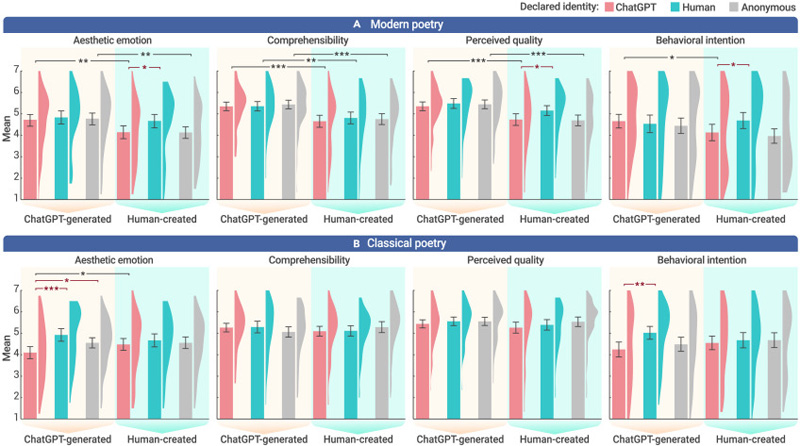
Mean values of the four factors and significant differences revealed by pre-planned contrasts analyses
Machines, powered by artificial intelligence (AI) and other innovations, are expanding the scope of tasks that they can do.1,2 They have outperformed human professionals in objective tasks such as weather forecasting and image-based disease diagnosis. They are even reaching or surpassing humans in subjective and creative tasks. In late November 2022, OpenAI released an AI chatbot named ChatGPT-3.5 (hereafter, ChatGPT) and an image generator named DALL-E2, which took the internet by storm with their excellent capabilities in understanding human intentions and performing various human tasks.2 They represent monumental leaps in large language models and image generation. Everyone can co-work with them via specific prompts to generate creative content (e.g., poetry, painting, and fiction) that can reach the proficiency level of human masters. Even before their release, a non-artist teaming with another AI beat dozens of amateur artists and won a digital arts competition.3 Although benefiting human productivity and efficiency, creative machines would yield profound and subversive influences on humanity.4 They challenge our old belief that art—a last frontier of human prerogative—is unique to humans5 and raise substantial concerns about their threat to human distinctiveness and identity.
Humans are standing at a crossroad. Someone calls for defending humankind as creative machines rise. Interestingly, people would be negatively biased toward them accomplishing specific human tasks. In algorithmic decision-making, researchers reported that people have harsher responses or more discomfort with algorithms and their decisions, called “algorithm aversion.”6 Furthermore, it shows that algorithm aversion might be domain specific: it may not exist in objective fields with low identity relevance and clear evaluative criteria (e.g., weather forecasting) but emerges in subjective and creative fields with high identity relevance and ambiguous criteria.7 For instance, machine authorship of artworks lowers people’s evaluations of their quality and artistic value.8 Therefore, people’s negative bias would play a psychological defender for humankind in creative fields.

