Physical regulation of copper catalyst with a hydrophobic promoter for enhancing CO2 hydrogenation to methanol

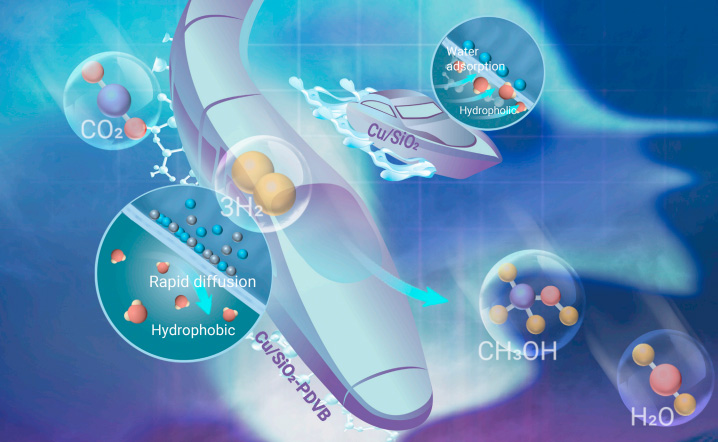
GRAPHICAL ABSTRACT
The hydrophobic water conduction channels have displayed a crucial role in enzyme catalysis, which rapidly ships the water products from the active sites to accelerate the reactions. Following enzyme catalysis, this function has been introduced to the heterogeneous catalysts by functionalizing the catalyst surface with self-assembled molecular monolayers or organosilanes. In many cases, these molecules would block the catalyst surface to partially lose the active sites and suffer from thermal instability under the stream at high temperatures. In contrast with these chemical modification methods that might change the catalyst surface, the zeolite membrane reactors3 with water conduction channels are ideal for efficiently shipping water molecules, where the catalyst surface is unscathed. However, there are still great challenges in synthesizing extensive zeolite membranes in industrial processes.
Recently, we developed an efficient strategy for rapidly removing the water product from the surface of metal carbide catalysts to accelerate the Fischer-Tropsch synthesis to olefins, which is achieved by physically mixing the catalysts with a nonporous hydrophobic polydivinylbenzene (PDVB). In this case, the catalyst was unchanged relative to the catalyst with chemical modification, which can be denoted as a physical regulation strategy. This success motivated the exploration of whether this strategy could be fabricated to promote the challenging reactions severely restricted by water both thermodynamically and kinetically, such as hydrogenation of CO2 to methanol, which is an important reaction for the production of valuable platform chemicals from CO2. Generally, the water product on the catalyst could oxidize the metal surface to partially lose the activity. Despite the fact that the approaches utilizing a zeolite membrane reactor have been successful in this process,3 a reliable method that is simple to implement and completely unaffected to the present catalysts is still urgently needed. In this work, we demonstrated that the hydrophobic promoter mixed with silica-supported copper catalyst would influence the oxidation state of the Cu catalyst, thus enhancing the performances in the hydrogenation of CO2 to methanol. Such a change in the chemical state led by physical regulation might guide the catalyst design in heterogeneous catalysis.

