Precise modification of the surface charge of antigen enhances vaccine immunogenicity

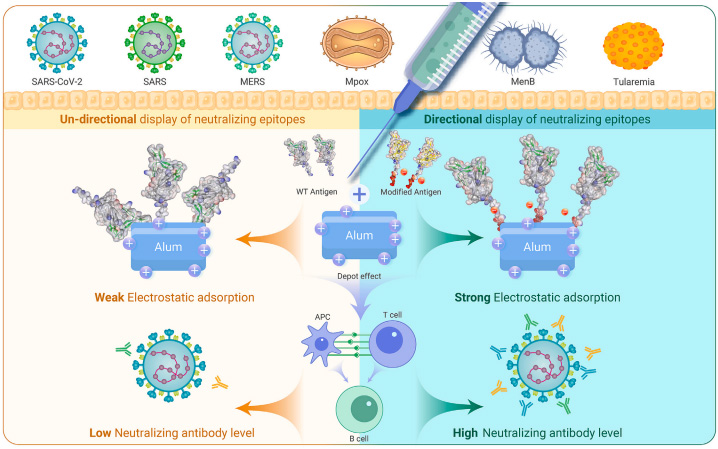
GRAPHICAL ABSTRACT
Vaccines are the surest means in the fight against infectious diseases.1 The recently emergent coronavirus pandemic has spread at an unprecedented scale and speed, creating new challenges for vaccine development. Protein subunit vaccines may play an essential role in fighting against pandemics due to their safety and effectiveness; moreover, from a practical perspective, protein vaccines can be produced rapidly and do not require ultra-low temperature storage.2 However, the efficacy of protein vaccines is highly related to the conjunction between antigen and adjuvant.3,4 Currently, the majority of approved subunit vaccines use aluminum as the main adjuvant component due to its minimal safety reactogenicity and economical manufacturing cost.4,5
Adsorption of antigen to the alum adjuvant through hydrophobic, electrostatic, or ligand exchange may directly contribute to the immune-enhancing efficacy of the antigen-adjuvant complex.5,6 Changing the particle size distribution of the alum adjuvant itself, the ratio of adjuvant-antigen, and the composition of the buffer could regulate the degree of adsorption, which in turn affects the efficacy of alum-adjuvanted vaccines.7,8,9 Recently, it has been reported that chemical modification of proteins with phosphonate linkers or phosphorylated serine (pSer) significantly enhances the binding anchorage between antigen and alum adjuvant via a ligand exchange mechanism.10,11,12
Herein, we propose an innovative strategy that dramatically improves the adsorption of antigens to the alum adjuvant. By inserting negatively charged amino acid fragments into the flexible region of the SARS-CoV-2 receptor-binding domain (RBD), we could precisely modify its surface charge, extend the bioavailability of the antigen, and directionally display the neutralizing epitopes and thus significantly enhance the humoral and cellular immunity. This strategy could also be applied to a series of representative pathogenic antigens such as SARS-RBD, MERS-RBD, Mpox-M1, MenB-fHbp, and Tularemia-Tul4. The precise charge modification of immunogen is expected to provide a simple and direct way to design novel protein subunit vaccines by enhancing antigen-adjuvant adsorption, thus driving a robust immune efficacy.

