Adaptive evolution to the natural and anthropogenic environment in a global invasive crop pest, the cotton bollworm

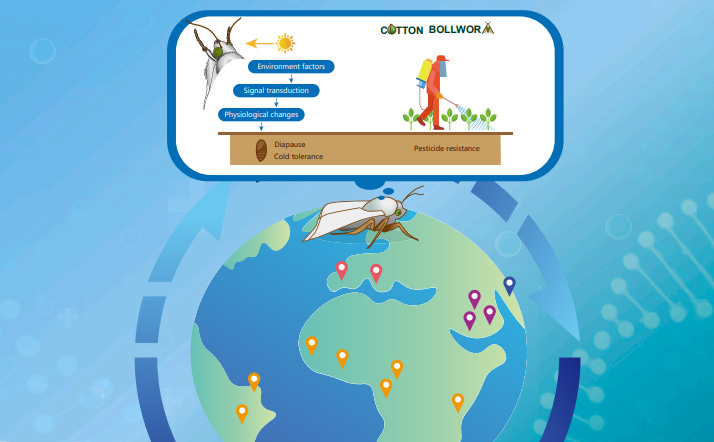
GRAPHICAL ABSTRACT
Invasive species are a threat to global biosafety, food security, and human health.1,2 Traits that increase invasiveness, such as pesticide resistance or cold tolerance, often evolve under strong selection in novel environments.3 Population genomics is a valuable tool for understanding the evolution and genetic basis of adaptations,4,5,6,7 and it is now being used to study invasive pests. By identifying the genetic basis of rapidly arising adaptations that enable population expansion using population genomics approaches, the mechanisms of invasive spread can be revealed. Management strategies can then be developed and improved. The large effective population size and high connectivity of invasive species may explain the speed at which range-expanding adaptations are fixed. An example of this is the bridgehead effect.8 Therefore, characterizing major routes of gene flow is important for managing and mitigating the effect of invasive species.9
The cotton bollworm, Helicoverpa armigera (Lepidoptera: Noctuidae), is a widespread crop pest in Afro-Eurasia and Australia, and it has recently become established in South America. Invasive H. armigera populations threaten to spread into North America by northward dispersal and through introgression with native sister species of H. armigera, Helicoverpa zea.10,11 H. armigera is polyphagous, and the larvae feed on more than 180 plant species, including cotton, maize, soy, wheat, and rice.12 H. armigera can undergo facultative pupal diapause to overwinter in non-tropical regions and avoid unfavorable winter conditions.13 Extensive use of synthetic pesticides has resulted in broad pesticide resistance in this species. H. armigera accounts for more reported cases of pesticide resistance than any other noctuid species.12,14 A key tactic for cotton bollworm management currently involves cultivation of Bt crops. However, Bt resistance has been reported, especially in Asia and Australasia.15,16 H. armigera has remarkable dispersal ability, and adults are capable of high-altitude, long-range flight.11 Therefore, despite its extensive geographic range, little population structure has been observed using genetic markers, apart from the Australasian subspecies H. armigera conferta. This has made it difficult to characterize connectivity, identify locally adapted populations, and determine the source(s) of the invasive South American population.17,18 H. armigera has readily spread through different environments from tropical plantations to dry, temperate, seasonal agroecosystems. Despite apparent panmixia, traits enabling H. armigera persistence, such as cold tolerance and diapause, known to have a genetic basis in H. armigera, show local adaptation in strains from high-versus low-latitude populations.19,20 Therefore, delineating cryptic population differentiation and identifying local adaptation are important for determining the ecological and evolutionary factors that underlie regional H. armigera outbreaks. In other systems, the contiguity of resolution offered by population-scale whole-genome resequencing has been useful for resolving cryptic population structure and clarifying the genetic basis of traits under selection.4,5
H. armigera populations in China provide an ideal case study; its four highly distinct agricultural regions span climatic extremes and agricultural practices, separated by bio-geographic breaks of varying strength (Note S1). Collectively the largest agricultural industry in the world,21 extensive wheat, cotton, and maize plantations in all four regions provide key habitats for the cotton bollworm. We generated a chromosome-scale reference assembly and produced a large whole-genome resequencing dataset of H. armigera individuals from samples throughout its global distribution, with a specific focus on Chinese populations, to characterize global population structure and identify local adaptation to anthropogenic and abiotic conditions.

