Phytolith evidence reveals the origin of angiosperm leaf eating habits among ancient Cretaceous birds

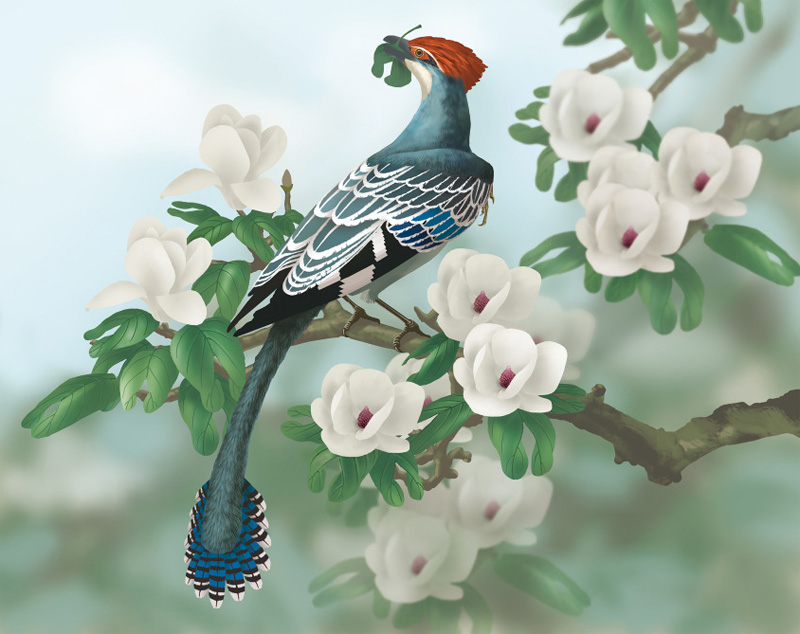
Artist's reconstruction of Jeholornis prima with its likely arboreal herbivorous feeding ecology.
Recently, Nature Communications published a study on the feeding habits of an ancient extinct bird called Jeholornis from the Early Cretaceous Jehol Biota of China led by researchers from the Institute of Vertebrate Paleontology and Paleoanthropology of the Chinese Academy of Sciences.1 Jeholornis and its closely related species are regarded as part of the second most primitive lineage in the family tree of birds, retaining a long bony dinosaurian tail, small teeth, and large claws on the wings. Adopting an interdisciplinary approach, the scientific team discovered hundreds of phytoliths originated from the leaves of the basal angiosperm group called magnoliids (which includes living magnolias, cinnamon, and avocadoes), while investigating the stomach residues contents of a well-preserved 120-million-year-old juvenile Jeholornis fossil. These fossil phytoliths are the first confirmation that help point to the origin and evolution of leaf eating in ancient birds and further sketch an interesting scientific story about the early interactions between birds and flowering plants.

