Decoding the proteostasis network in resistance to KRAS inhibitors

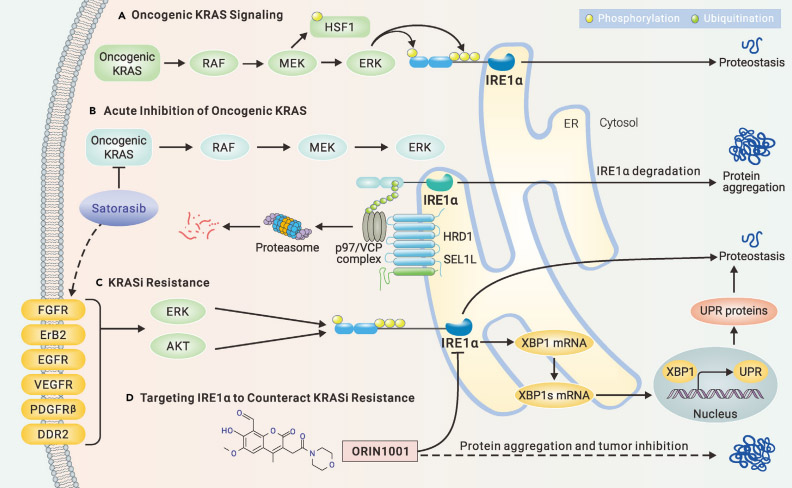
Rewiring proteostasis upon KRAS inhibition
The Kirsten rat sarcoma (KRAS) gene, which is one of the most frequently mutated genes in human cancers, has long captured the attention of oncologists. The recent approval of KRAS G12C inhibitors (KRASi), such as sotorasib and adagrasib, has signaled a promising turn in cancer therapy. However, emerging resistance to these drugs presents a formidable challenge.1 Lv et al.’s2 publication in Science suggests that the proteostasis network plays a role in mediating diverse KRASi resistance mechanisms. Their work shows that KRAS inhibition suppresses protein quality control in the majority of cancer cells. In the remaining cells, a subset can reactivate one of the endoplasmic reticulum (ER) stress sensors, specifically the inositol-requiring enzyme 1 alpha (IRE1α) branch of the unfolded protein response (UPR). This adaptation enables the cells to overcome their reliance on oncogenic KRAS, enhancing their resistance to KRASi (Figure 1). This insight underscores the complex interplay between oncogenic signaling and protein quality control in scenarios of drug resistance. Here, we review and discuss the major findings of this study in the following sections.

