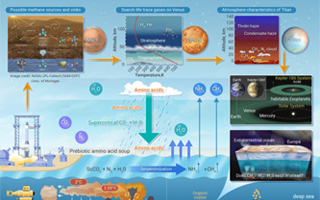
Gas detection-assisted deep-space and deep-sea exploration

The deep space and deep sea are imperative frontiers to explore the origin of life, comprehend the Earth, and protect the natural environment. Gases released by the metabolic processes of life leave their marks in the ocean dissolved gases and the atmospheric chemical balance. The study of the life evolution on Earth indicates that extraterrestrial oceans and habitable atmospheric environments on exoplanets are the most important elements for traces of extraterrestrial life. In most cutting-edge explorations, the gas molecule is probably one of the most important objects to expand the boundaries of our cognition.
Apart from Earth, planetary atmosphere exploration of Venus, Mars, Jupiter, Saturn, etc., is a key approach to understanding the planetary system evolution and the of life habitability.1 Analyzing atmospheric components (CO2, CH4, H2O, etc.) and dynamic processes (wind speed and temperature gradient) reveals the climate mechanism. The presence of H2O, O2, O3, CH4, PH3, etc., in habitable planets may suggest biological activities. The extreme greenhouse effect of Venus provides a warning model for Earth's climate change.
The deep sea, "Earth's final frontier," is the most mysterious part of the ocean. The hellish living conditions of darkness, cold, and high pressure make the survival of life almost impossible. This idea has been astoundingly defied by two ecosystems—cold seeps and hydrothermal vents.2 The dissolved gas reveal the cyclic process of a chemotrophic synthetic ecosystem without solar energy. Dissolved metal sulfides and reducing substances explain the chemical exchange through the Earth’s crust. Besides, the precise measurement of dissolved gas contributes to the study of the global carbon cycle and the geological activity history of Earth.
Deep sea and deep space also have integrations in science. For instance, evolutionary mechanisms and adaptation strategies of deep-sea ecosystems provide insights for the research on the origin and evolution of life in deep-space exploration. Meanwhile, research in fields such as astrophysics and planetary science involved in deep-space exploration is also closely related to disciplines like geochemistry and geophysics in deep-sea research.