
-

-
REFERENCES
[1] Jaeckel A. (2026). Seabed mining needs integrity, not haste. Science 392:445. DOI:10.1126/science.aei3119 [2] Rühlemann C. (2026). Seabed mining requires timely governance. Science 393:247. DOI:10.1126/science.aei7769 [3] Hyman J., Sonter L.J., McDonald-Madden E., et al. (2026). Growing nickel supply from the tropics threatens priority conservation areas. Nat. Ecol. Evol. 10:1305−1315. DOI:10.1038/s41559-026-03068-4 [4] Jones D.O.B., Arias M.B., Van Audenhaege L., et al. (2025). Long-term impact and biological recovery in a deep-sea mining track. Nature 642:112−118. DOI:10.1038/s41586-025-08921-3 [5] Muñoz-Royo C., Peacock T., Alford M.H., et al. (2021). Extent of impact of deep-sea nodule mining midwater plumes is influenced by sediment loading, turbulence and thresholds. Commun. Earth Environ. 2:148. DOI:10.1038/s43247-021-00213-8 -
ABOUT THIS ARTICLE
Cite this article:
Guo X., Luo Y., Qi X., et al. (2026). Deep-seabed mining needs evidence-based decisions. The Innovation Insights 1:100010. https://doi.org/10.59717/j.tiis.2026.100010
Welcome!
To request copyright permission to republish or share portions of our works, please visit Copyright Clearance Center's (CCC) Marketplace website at marketplace.copyright.com.
Export File
Citation
Guo X., Luo Y., Qi X., et al. (2026). Deep-seabed mining needs evidence-based decisions. The Innovation Insights 1:100010. https://doi.org/10.59717/j.tiis.2026.100010

Format
Content
 DownLoad:
-
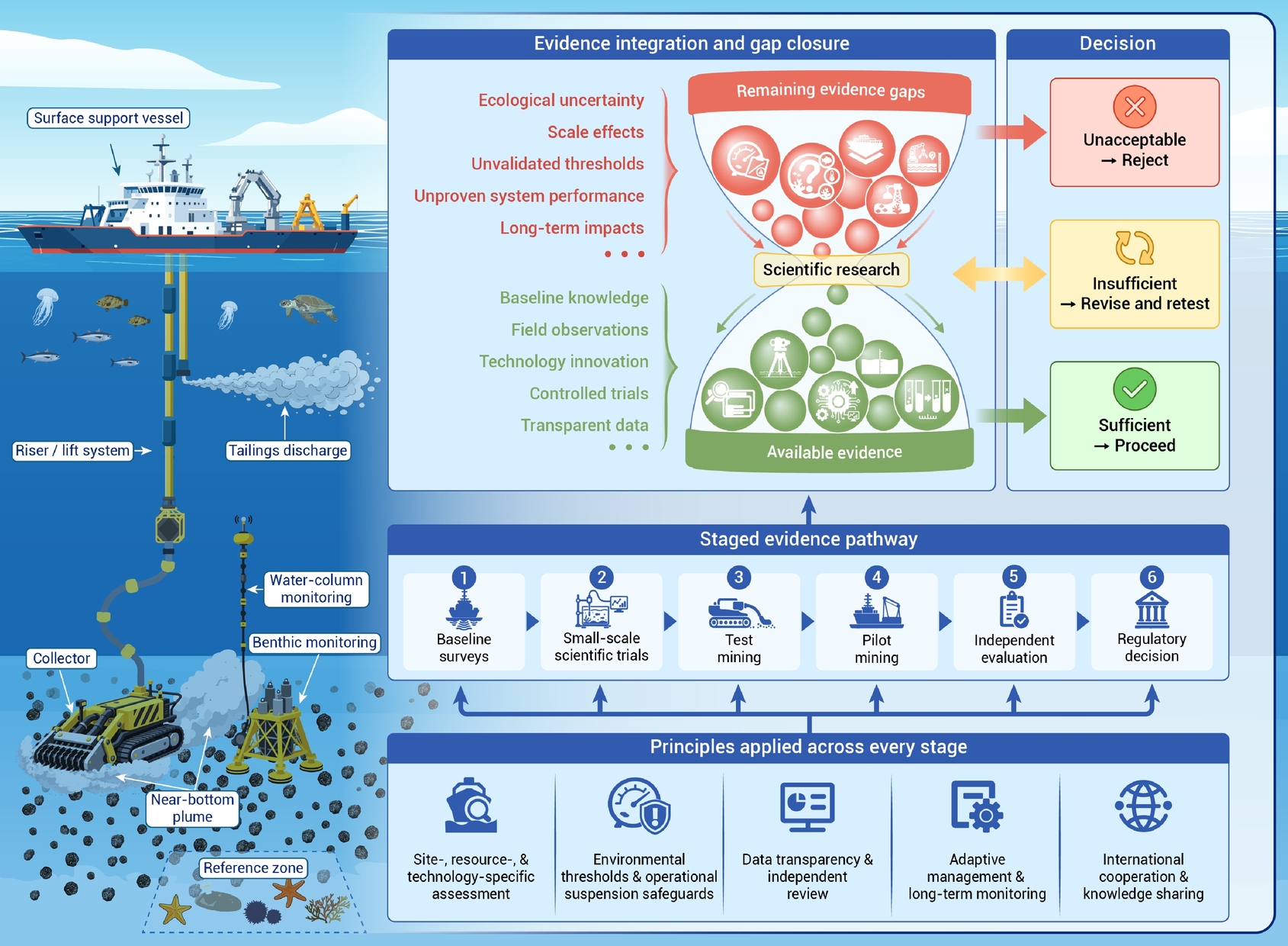
Figure 1.
An evidence-based pathway from scientific research and staged field testing to independent evaluation and future regulatory decisions on deep-seabed mining.
