
-
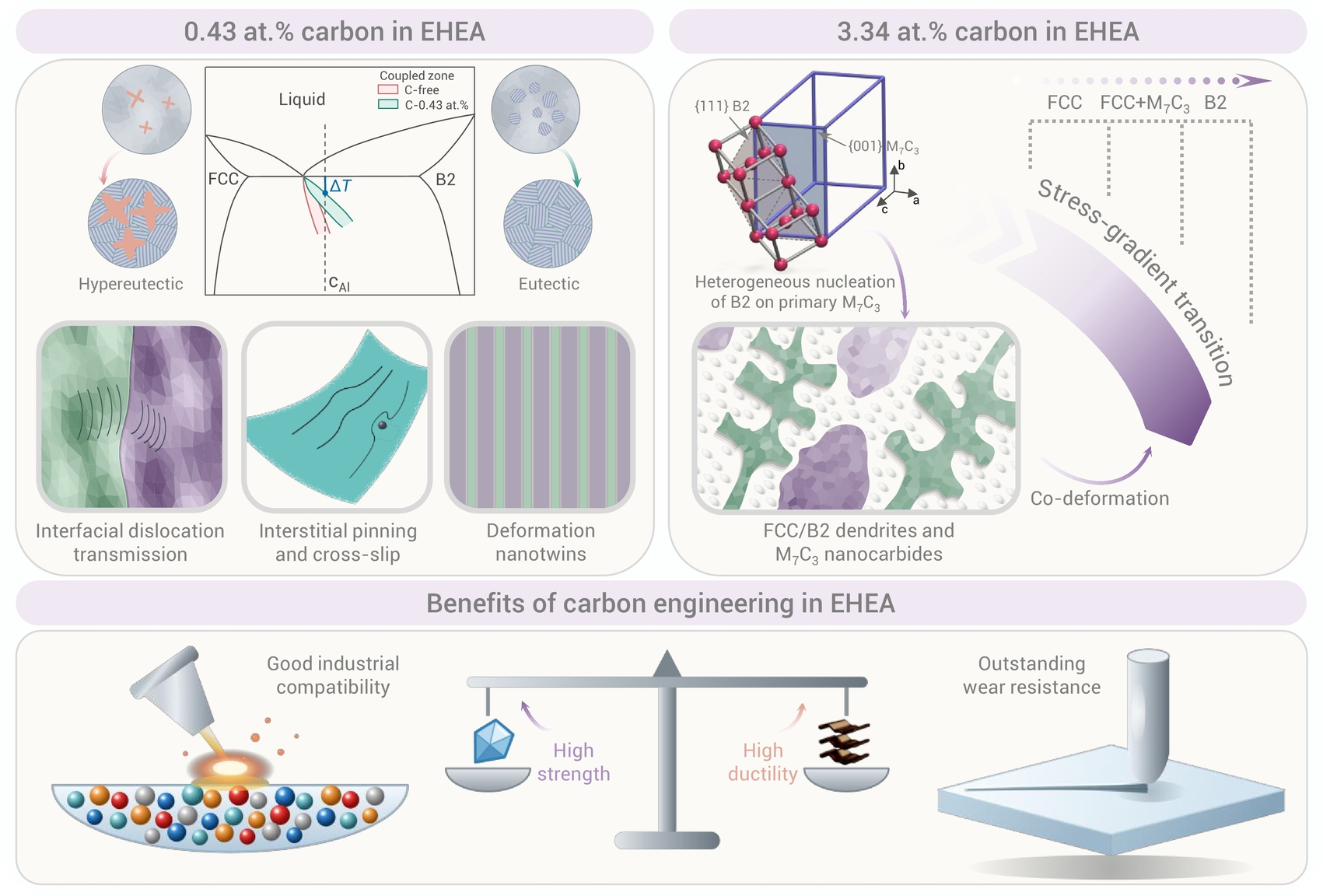
GRAPHICAL ABSTRACT
 DownLoad:
Full size image
DownLoad:
Full size image
-
PUBLIC SUMMARY
-
Carbon is a key element for tailoring the nucleation kinetics of eutectic high-entropy alloys (EHEAs).
Carbon-induced eutectic structures endow the EHEA with an exceptional combination of strength and ductility.
The proposed "carbon engineering" strategy can stimulate intensive research across the EHEA field.
-
-
ABSTRACT
Over the past decade, eutectic high-entropy alloys (EHEAs) with FCC and B2 phases have shown outstanding performance as advanced structural materials. Extensive efforts within the metallurgy community have established the thermodynamics-guided paradigm for eutectic synthesis. Here, we open a new frontier in physical metallurgy by exploiting carbon as a kinetic activator of eutectic solidification in EHEAs. Even trace carbon additions profoundly modified the eutectic transition, transforming hypereutectic structures into fully coupled FCC/B2 eutectics. With increased concentrations, carbon further induced decoupled FCC/B2 growth followed by a secondary FCC/carbide eutectic transformation, resulting in separated FCC and B2 dendrites together with high-density nanoscale M7C3 carbides. Multi-scale analyses reveal that carbon interstitials and carbides play an intriguing role in accelerating the nucleation kinetics. Across a broad range of additions, the tailored microstructures imparted an exceptional strength-ductility synergy in EHEAs. We found that interstitial carbon significantly enhanced dislocation storage and promoted the coordination of multiple slip modes, while the FCC/M7C3 nano-eutectics formed under high carbon content constructed a unique mechanical transition layer for global co-deformation. These discoveries establish “carbon engineering” as a powerful, kinetics-based strategy for EHEA design, pioneering new directions in advanced eutectic materials research. -

-
REFERENCES
[1] Chang I. and Cai Q. (2022). From simple binary to complex multicomponent eutectic alloys. Prog. Mater. Sci. 123:100779. DOI:10.1016/j.pmatsci.2021.100779 [2] Tiwary C. S., Pandey P., Sarkar S., et al. (2022). Five decades of research on the development of eutectic as engineering materials. Prog. Mater. Sci. 123:100793. DOI:10.1016/j.pmatsci.2021.100793 [3] Wen K., Cai X., Xin S., et al. (2024). Discovery of a novel low-cost medium-entropy stainless steel with exceptional mechanical behavior over a wide temperature range. Matter 7:3625−3644. DOI:10.1016/j.matt.2024.06.041 [4] Shi P., Li R., Li Y., et al. (2021). Hierarchical crack buffering triples ductility in eutectic herringbone high-entropy alloys. Science 373:912−918. DOI:10.1126/science.abf6986 [5] Ren J., Zhang Y., Zhao D., et al. (2022). Strong yet ductile nanolamellar high-entropy alloys by additive manufacturing. Nature 608:62−68. DOI:10.1038/s41586-022-04914-8 [6] Wu Q., He F., Li J., et al. (2022). Phase-selective recrystallization makes eutectic high-entropy alloys ultra-ductile. Nat. Commun. 13:4697. DOI:10.1038/s41467-022-32444-4 [7] Lu Y., Dong Y., Guo S., et al. (2014). A promising new class of high-temperature alloys: Eutectic high-entropy alloys. Sci. Rep. 4:6200. DOI:10.1038/srep06200 [8] Choudhuri D., Gwalani B., Gorsse S., et al. (2017). Change in the primary solidification phase from fcc to bcc-based B2 in high entropy or complex concentrated alloys. Scr. Mater. 127:186−190. DOI:10.1016/j.scriptamat.2016.09.023 [9] Bai K., Ng C. K., Lin M., et al. (2023). Short-range ordering heredity in eutectic high entropy alloys: A new model based on pseudo-ternary eutectics. Acta Mater. 243:118512. DOI:10.1016/j.actamat.2022.118512 [10] Huang L., Han Y., Sun Y., et al. (2025). Vermicular eutectic multi-principal element alloy with exceptional strength and ductility. Adv. Sci. 12:2501150. DOI:10.1002/advs.202501150 [11] Wu Q., Wang Z., Hu X., et al. (2020). Uncovering the eutectics design by machine learning in the Al–Co–Cr–Fe–Ni high entropy system. Acta Mater. 182:278−286. DOI:10.1016/j.actamat.2019.10.043 [12] Perepezko J. H. and Uttormark M. J. (1996). Nucleation-controlled solidification kinetics. Metall. Mater. Trans. A 27:533−547. DOI:10.1007/BF02648944 [13] Guo C., Wang J., Li J., et al. (2018). Coupling eutectic nucleation mechanism investigated by phase field crystal model. Acta Mater. 145:175−185. DOI:10.1016/j.actamat.2017.12.012 [14] Li M. X., Wang H. P., Lin M. J., et al. (2022). Rapid eutectic growth kinetics of undercooled Nb-Si alloys at electrostatic levitation state. Acta Mater. 237:118157. DOI:10.1016/j.actamat.2022.118157 [15] Barclay R. S., Kerr H. W. and Niessen P. (1971). Off-eutectic composite solidification and properties in Al-Ni and Al-Co alloys. J. Mater. Sci. 6:1168−1173. DOI:10.1007/BF00550086 [16] Han L., Sun Z., Xia W., et al. (2024). Thermodynamics-guided high-throughput discovery of eutectic high-entropy alloys for rapid solidification. Adv. Sci. 11:2401559. DOI:10.1002/advs.202401559 [17] Xie W. J., Cao C. D., Lü Y. J., et al. (2002). Eutectic growth under acoustic levitation conditions. Phys. Rev. E 66:061601. DOI:10.1103/PhysRevE.66.061601 [18] Liu S., Kaban V., Witusiewicz V. T., et al. (2026). In situ synchrotron X-ray diffraction revealing competition between A1 and B2 phases in AlCoCrFeNix high-entropy alloys. Acta Mater. 309:122097. DOI:10.1016/j.actamat.2026.122097 [19] Mohanty P. S. and Gruzleski J. E. (1996). Grain refinement mechanisms of hypoeutectic Al-Si alloys. Acta Mater. 44:3749−3760. DOI:10.1016/1359-6454(96)00021-3 [20] Eiken J., Apel M., Liang S.-M., et al. (2015). Impact of P and Sr on solidification sequence and morphology of hypoeutectic Al–Si alloys: Combined thermodynamic computation and phase-field simulation. Acta Mater. 98:152−163. DOI:10.1016/j.actamat.2015.06.056 [21] Li J., Hage F. S., Liu X., et al. (2016). Revealing heterogeneous nucleation of primary Si and eutectic Si by AlP in hypereutectic Al-Si alloys. Sci Rep 6:25244. DOI:10.1038/srep25244 [22] Spierings A. B., Schneider M. and Eggenberger R. (2011). Comparison of density measurement techniques for additive manufactured metallic parts. Rapid Prototyping J. 17:380−386. DOI:10.1108/13552541111156504 [23] Liu P., Xing W., Cheng X., et al. (2014). Effects of dilute substitutional solutes on interstitial carbon in α-Fe: Interactions and associated carbon diffusion from first-principles calculations. Phys. Rev. B 90:024103. DOI:10.1103/PhysRevB.90.024103 [24] Soysal T. (2021). Effect of solidification models on predicting susceptibility of carbon steels to solidification cracking. Weld. World 65:1943−1954. DOI:10.1007/s40194-021-01132-0 [25] Toby B. H. and Von Dreele R. B. (2013). GSAS-II: the genesis of a modern open-source all purpose crystallography software package. J. Appl. Crystallogr. 46:544−549. DOI:10.1107/S0021889813003531 [26] Oliver W. C. and Pharr G. M. (2004). Measurement of hardness and elastic modulus by instrumented indentation: Advances in understanding and refinements to methodology. J. Mater. Res. 19:3−20. DOI:10.1557/jmr.2004.19.1.3 [27] Johnson K. L. (1987). Contact mechanics (Cambridge Univ. Press [28] Chipman J. (1972). Thermodynamics and phase diagram of the Fe-C system. Metall. Trans. 3:55−64. DOI:10.1007/BF02680585 [29] He F., Wang Z., Cheng P., et al. (2016). Designing eutectic high entropy alloys of CoCrFeNiNbx. J. Alloy. Compd. 656:284−289. DOI:10.1016/j.jallcom.2015.09.153 [30] Wang X., Zhai W., Li H., et al. (2023). Ultrasounds induced eutectic structure transition and associated mechanical property enhancement of FeCoCrNi2.1Al high entropy alloy. Acta Mater. 252:118900. DOI:10.1016/j.actamat.2023.118900 [31] Guo C., Wang J., Li J., et al. (2017). Uncoupling growth mechanisms of binary eutectics during rapid solidification. J. Phys. Chem. C 121:8204−8210. DOI:10.1021/acs.jpcc.7b01311 [32] Kurz W. and and Fisher D. J. (1979). Dendrite growth in eutectic alloys: The coupled zone. Int. Met. Rev. 24:177−204. DOI:10.1179/imtr.1979.24.1.177 [33] Turnbull D. and Vonnegut B. (2002). Nucleation catalysis. Ind. Eng. Chem. 44:1292−1298. DOI:10.1021/ie50510a031 [34] Zargaran A., Trang T. T. T., Park G., et al. (2021). κ-Carbide assisted nucleation of B2: A novel pathway to develop high specific strength steels. Acta Mater. 220:117349. DOI:10.1016/j.actamat.2021.117349 [35] Bramfitt B. L. (1970). The effect of carbide and nitride additions on the heterogeneous nucleation behavior of liquid iron. Metall. Trans. 1:1987−1995. DOI:10.1007/BF02642799 [36] Zhu Y., Ameyama K., Anderson P. M., et al. (2021). Heterostructured materials: Superior properties from hetero-zone interaction. Mater. Res. Lett. 9:1−31. DOI:10.1080/21663831.2020.1796836 [37] Kondo S., Shibata N. and Ikuhara Y. (2025). Direct observations of jog formation and drag caused by screw-screw dislocation interaction. Scr. Mater. 258:116513. DOI:10.1016/j.scriptamat.2024.116513 [38] Jiang L., Lu Y. P., Song M., et al. (2019). A promising CoFeNi2V0.5Mo0.2 high entropy alloy with exceptional ductility. Scr. Mater. 165:128-133. DOI:10.1016/j.scriptamat.2019.02.038 [39] Sato Y., Shinzato S., Ohmura T., et al. (2020). Unique universal scaling in nanoindentation pop-ins. Nat. Commun. 11:4177. DOI:10.1038/s41467-020-17918-7 [40] Qiao X., Han L., Zhang W., et al. (2015). Nano-indentation investigation on the mechanical stability of individual austenite in high-carbon steel. Mater. Charact. 110:86−93. DOI:10.1016/j.matchar.2015.10.024 [41] Zeng Q., Gan K., Chen F., et al. (2022). Interstitial concentration effects on incipient plasticity and dislocation behaviors of face-centered cubic FeNiCr multicomponent alloys based on nanoindentation. J. Mater. Sci. Technol. 112:212−221. DOI:10.1016/j.jmst.2021.09.056 [42] Qiu S., Zhang X.-C., Zhou J., et al. (2020). Influence of lattice distortion on stacking fault energies of CoCrFeNi and Al-CoCrFeNi high entropy alloys. J. Alloy. Compd. 846:156321. DOI:10.1016/j.jallcom.2020.156321 [43] Li Z. (2019). Interstitial equiatomic CoCrFeMnNi high-entropy alloys: Carbon content, microstructure, and compositional homogeneity effects on deformation behavior. Acta Mater. 164:400−412. DOI:10.1016/j.actamat.2018.10.050 [44] Zhang L. J., Yu P. F., Fan J. T., et al. (2020). Investigating the micro and nanomechanical properties of CoCrFeNi-Cx high-entropy alloys containing eutectic carbides. Mater. Sci. Eng. A. 796:140065. DOI:10.1016/j.msea.2020.140065 [45] Xu Y., Liu S., Chang J., et al. (2024). Formation of lamellar eutectic structure and improved mechanical properties of directional solidified Al0.9CoCrNi2.1 high-entropy alloy. Intermetallics 173:108430. DOI:10.1016/j.intermet.2024.108430 [46] Guo Y., Su H., Yang P., et al. (2022). New insight into tailorable eutectic high entropy alloys with remarkable strength–ductility synergy and ample shaping freedom fabricated using laser powder bed fusion. Addit. Manuf. 60:103257. DOI:10.1016/j.addma.2022.103257 [47] Nassar A., Mullis A., Cochrane R., et al. (2022). Rapid solidification of AlCoCrFeNi2.1 High-entropy Alloy. J. Alloy. Compd. 900:163350. DOI:10.1016/j.jallcom.2021.163350 [48] Zheng H., Chen R., Qin G., et al. (2019). Phase separation of AlCoCrFeNi2.1 eutectic high-entropy alloy during directional solidification and their effect on tensile properties. Intermetallics 113:106569. DOI:10.1016/j.intermet.2019.106569 [49] Shi P., Zhong Y., Li Y., et al. (2020). Multistage work hardening assisted by multi-type twinning in ultrafine-grained heterostructural eutectic high-entropy alloys. Mater. Today 41:62−71. DOI:10.1016/j.mattod.2020.09.029 [50] Schramm R. E. and Reed R. P. (1975). Stacking fault energies of seven commercial austenitic stainless steels. Metall. Trans. A 6:1345−1351. DOI:10.1007/BF02641927 [51] Fan G., Jiang Y., Tan Z., et al. (2018). Enhanced interfacial bonding and mechanical properties in CNT/Al composites fabricated by flake powder metallurgy. Carbon 130:333−339. DOI:10.1016/j.carbon.2018.01.037 [52] Xia Z., Riester L., Curtin W. A., et al. (2004). Direct observation of toughening mechanisms in carbon nanotube ceramic matrix composites. Acta Mater. 52:931−944. DOI:10.1016/j.actamat.2003.10.050 [53] Zhang L., Ji Y., Wang Y., et al. (2024). Enhanced hot corrosion resistance of AlCoCrFeNi2.1 high entropy alloy coatings by extreme high-speed laser cladding. Corrosion Sci. 240:112486. DOI:10.1016/j.corsci.2024.112486 -
ABOUT THIS ARTICLE
Cite this article:
Bai X., Cui D., Wang C., et al. (2026). Carbon engineering in eutectic high-entropy alloys. The Innovation Insights 1:100014. https://doi.org/10.59717/j.tiis.2026.100014
Welcome!
To request copyright permission to republish or share portions of our works, please visit Copyright Clearance Center's (CCC) Marketplace website at marketplace.copyright.com.
Export File
Citation
Bai X., Cui D., Wang C., et al. (2026). Carbon engineering in eutectic high-entropy alloys. The Innovation Insights 1:100014. https://doi.org/10.59717/j.tiis.2026.100014

Format
Content
-
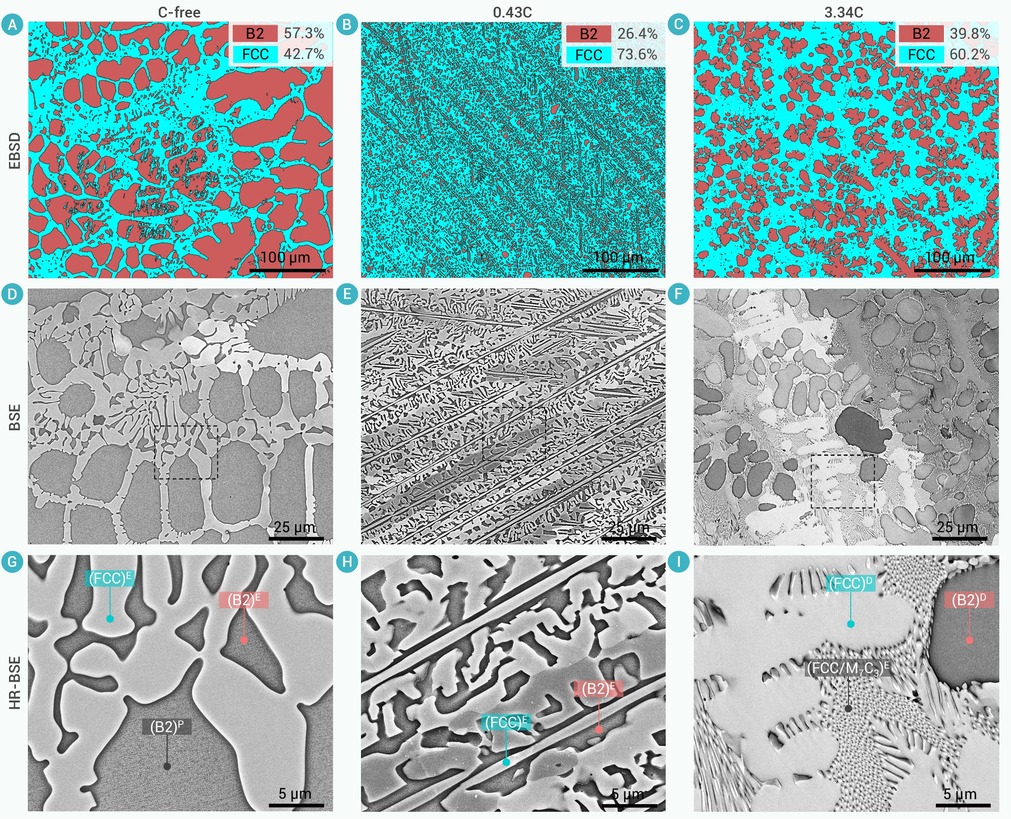
Figure 1.
Microstructures of the as-cast (Al17Cr12Fe35Ni36)100-xCx alloys with different carbon contents
-
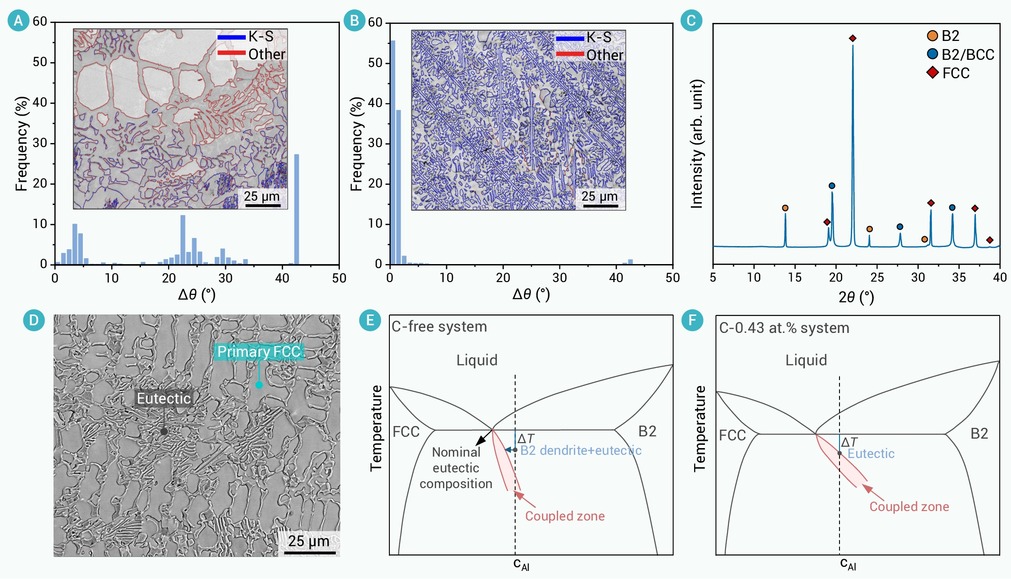
Figure 2.
Mechanism of eutectic transition with minor carbon addition
-
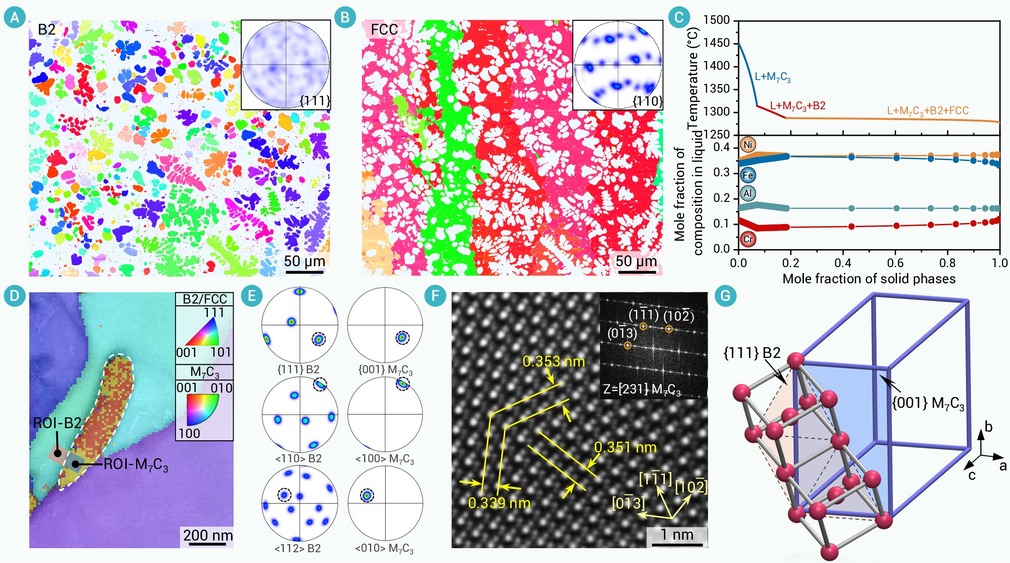
Figure 3.
Mechanism of the decoupled eutectic growth for the 3.34C alloy
-
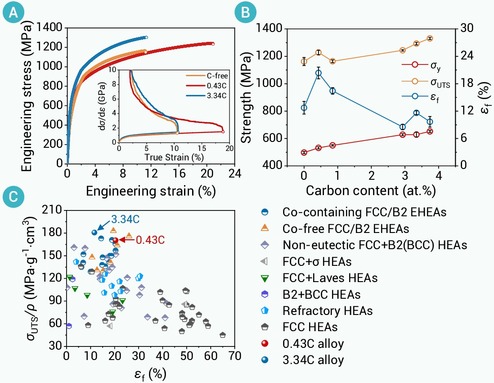
Figure 4.
Mechanical properties of as-cast (Al17Cr12Fe35Ni36)100-xCx EHEAs
-
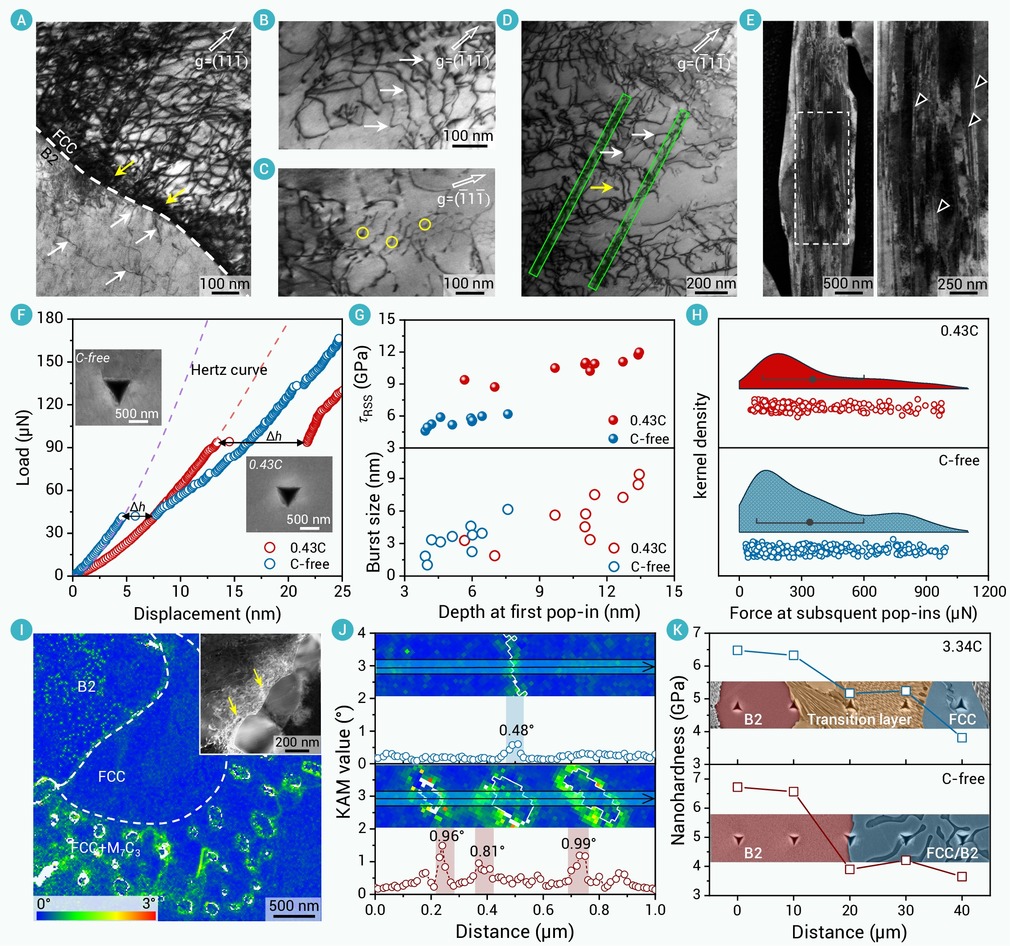
Figure 5.
Carbon-mediated deformation mechanisms across multiple scales
