
Microbial taxonomy with DNA sequence data as nomenclatural type: How far should we go?
-

-
REFERENCES
[1] Jiao, J.Y., Liu, L., Hua, Z.S., et al. (2021). Microbial dark matter coming to light: Challenges and opportunities. Natl. Sci. Rev. 8: nwaa280. DOI: 10.1093/nsr/nwaa280. [2] Hedlund, B.P., Chuvochina, M., Hugenholtz, P., et al. (2022). SeqCode: A nomenclatural code for prokaryotes described from sequence data. Nat. Microbiol. 7: 1702−1708. DOI: 10.1038/s41564-022-01214-9. [3] Lewis, W.H., Tahon, G., Geesink, P., et al. (2021) Innovations to culturing the uncultured microbial majority. Nat. Rev. Microbiol. 19: 225–240. [4] Lücking, R., Aime, M.C., Robbertse, B., et al. (2021). Fungal taxonomy and sequence-based nomenclature. Nat. Microbiol. 6: 540−548. DOI: 10.1038/s41564-021-00888-x. [5] Khan, F.K., Kluting, K., Tångrot, J., et al. (2020). Naming the untouchable – environmental sequences and niche partitioning as taxonomical evidence in fungi. IMA Fungus 11: 23. DOI: 10.1186/s43008-020-00045-9. -
ABOUT THIS ARTICLE
Cite this article:
Zhou L.W. (2023). Microbial taxonomy with DNA sequence data as nomenclatural type: How far should we go? The Innovation Life 1(2), 100017. https://doi.org/10.59717/j.xinn-life.2023.100017
Welcome!
To request copyright permission to republish or share portions of our works, please visit Copyright Clearance Center's (CCC) Marketplace website at marketplace.copyright.com.
Export File
Citation
Zhou L.W. (2023). Microbial taxonomy with DNA sequence data as nomenclatural type: How far should we go? The Innovation Life 1(2), 100017. https://doi.org/10.59717/j.xinn-life.2023.100017

Format
Content
 DownLoad:
-
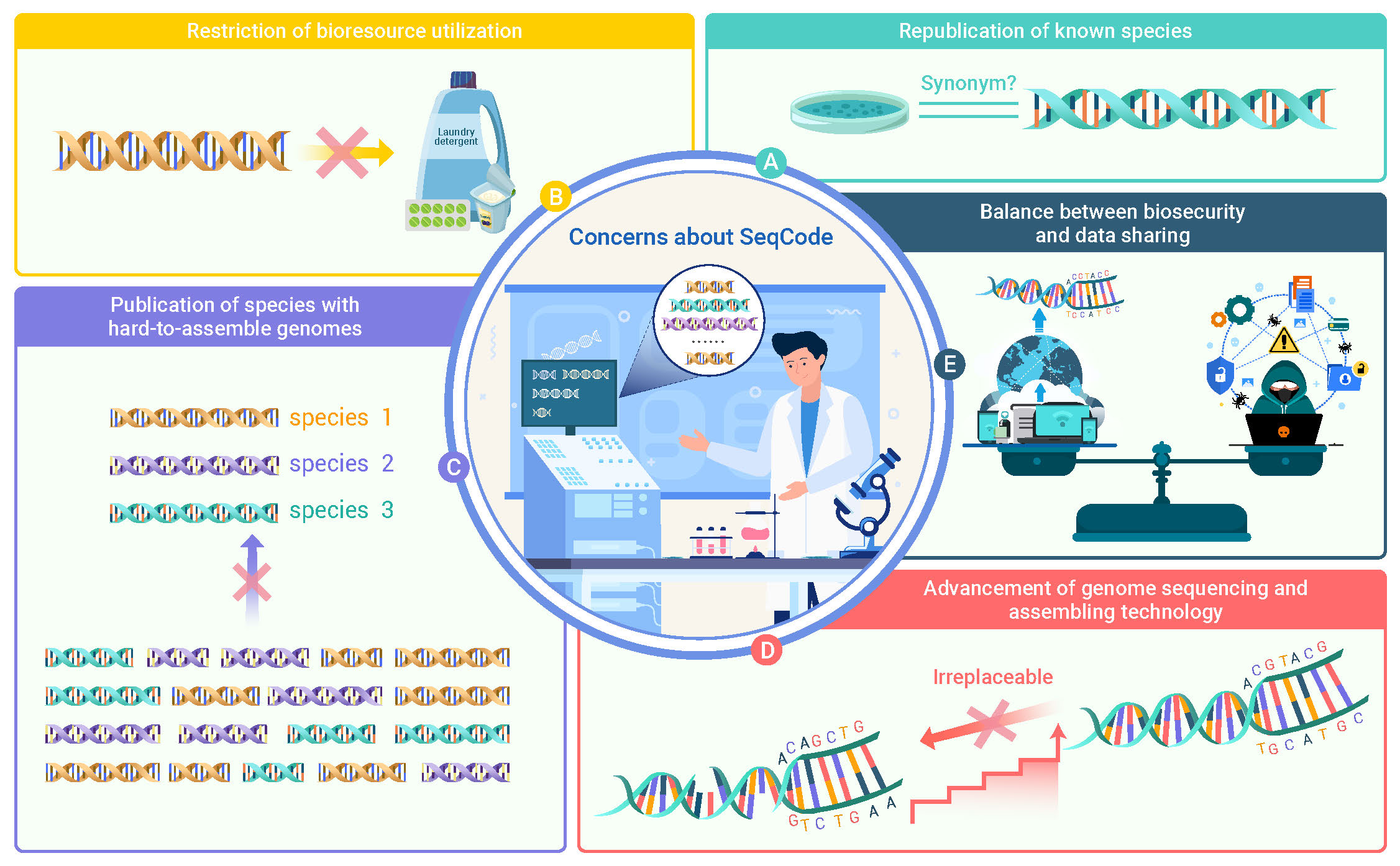
Figure 1.
The concerns about SeqCode using whole-genome sequence data as the nomenclatural type for prokaryotes.
