
Fungi employ the GCN2 pathway to maintain the circadian clock under amino acid starvation
-

-
REFERENCES
[1] Diernfellner, A.C.R., Brunner, M. (2020). Phosphorylation timers in the Neurospora crassa circadian clock. J. Mol. Biol. 432 : 3449-3465. DOI: 10.1016/j.jmb.2020.04.004. [2] Panda, S. (2016). Circadian physiology of metabolism. Science 354 : 1008-1015. DOI: 10.1126/science.aah4967. [3] Sattlegger, E., Hinnebusch, A.G., Barthelmess, I.B. (1998). cpc-3, the Neurospora crassa homologue of yeast GCN2, encodes a polypeptide with juxtaposed eIF2α kinase and histidyl-tRNA synthetase-related domains required for general amino acid control. J. Biol. Chem. 273 : 20404-20416. DOI: 10.1074/jbc.273.32.20404. [4] Liu, X.L., Yang, Y., Hu, Y., et al. (2023). The nutrient-sensing GCN2 signaling pathway is essential for circadian clock function by regulating histone acetylation under amino acid starvation. eLife 12 : e85241. DOI: 10.7554/eLife.85241. [5] Kelliher, C.M., Stevenson, E.L., Loros, J.J., et al. (2023). Nutritional compensation of the circadian clock is a conserved process influenced by gene expression regulation and mRNA stability. PLoS Biol. 21 : e3001961. DOI: 10.1371/journal.pbio.3001961. -
ABOUT THIS ARTICLE
Cite this article:
Li Y., Zhang J., Shen Q., et al., (2023). Fungi employ the GCN2 pathway to maintain the circadian clock under amino acid starvation. The Innovation Life 1(2), 100026. https://doi.org/10.59717/j.xinn-life.2023.100026
Welcome!
To request copyright permission to republish or share portions of our works, please visit Copyright Clearance Center's (CCC) Marketplace website at marketplace.copyright.com.
Export File
Citation
Li Y., Zhang J., Shen Q., et al., (2023). Fungi employ the GCN2 pathway to maintain the circadian clock under amino acid starvation. The Innovation Life 1(2), 100026. https://doi.org/10.59717/j.xinn-life.2023.100026

Format
Content
 DownLoad:
-
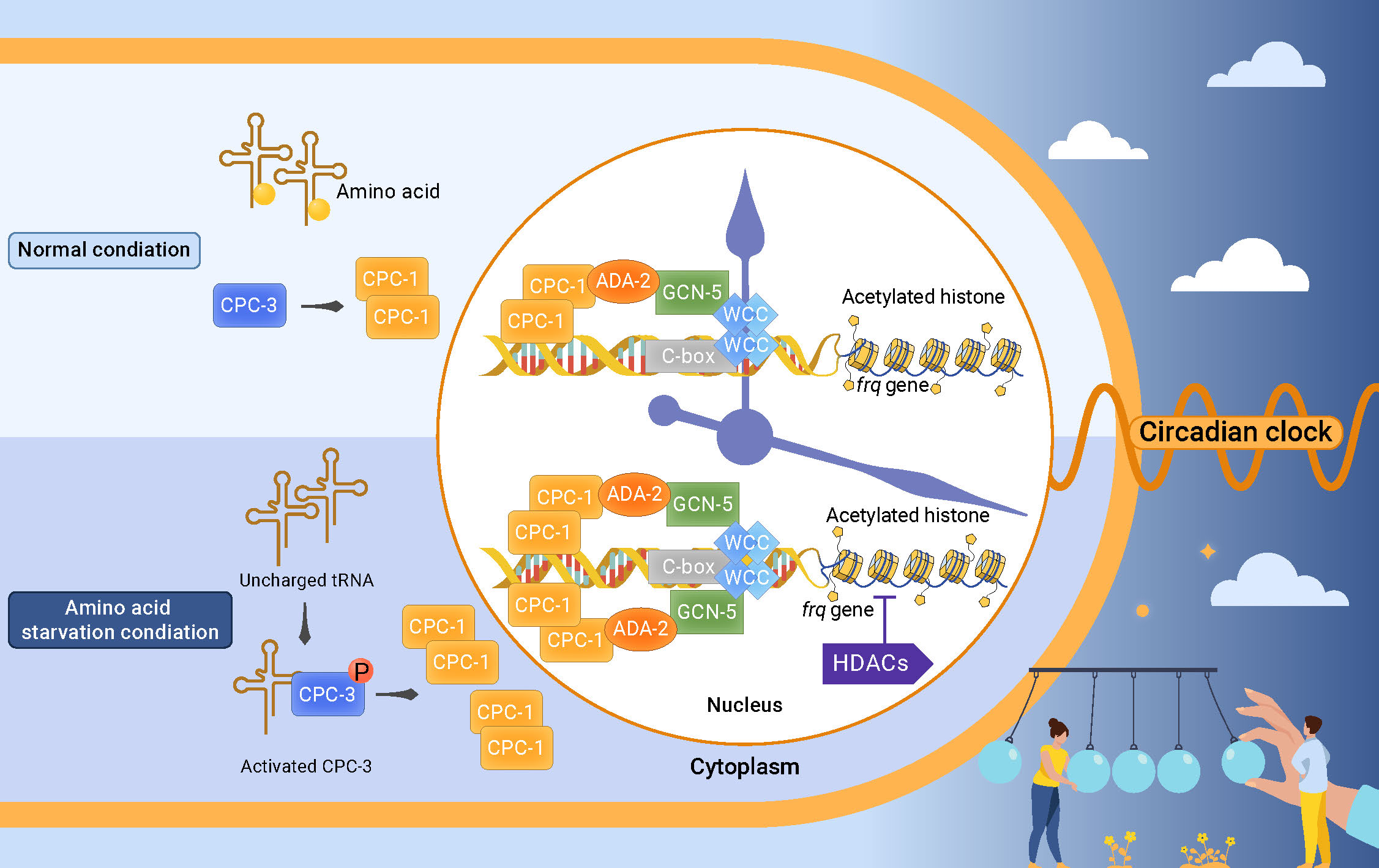
Figure 1.
Schematic model for the orchestration of CPC-1, SAGA complex and WCC at the frq promoter under amino acid starvation stress.
