
The enigmatic spherical-horned Tsaidamotherium reveals an unsuccessful grazing adaptation of early giraffoids
-
GRAPHICAL ABSTRACT
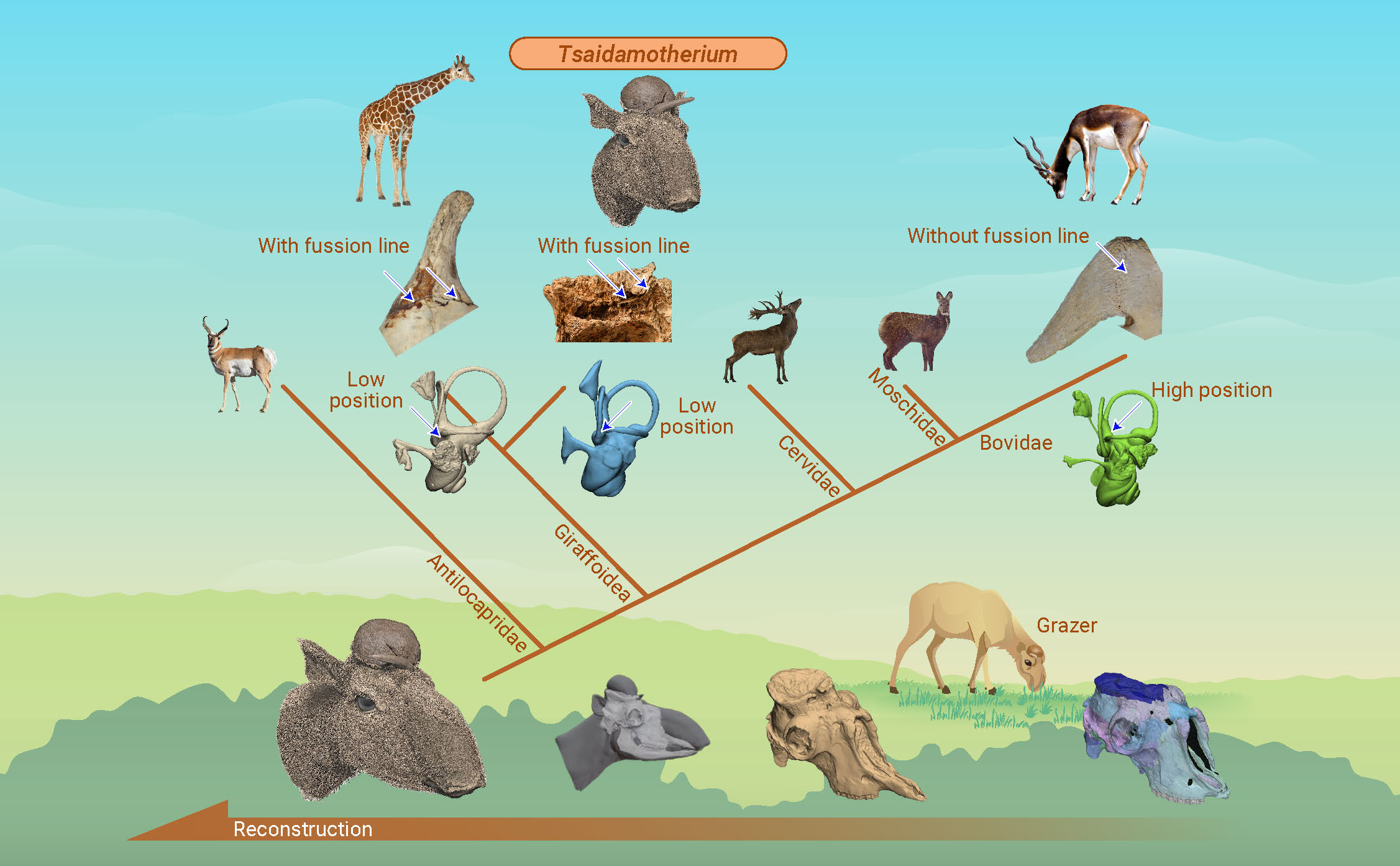
 DownLoad:
Full size image
DownLoad:
Full size image
-
PUBLIC SUMMARY
-
Crucial evidence reveals a giraffid-like ossicone fusion mode in Tsaidamotherium.
Tsaidamotherium is a small grazing giraffoid characterized by a spherical horn.
Tsaidamotherium represents the open-ecosystem grazing adaptation in early giraffoids.
-
-
ABSTRACT
Tsaidamotherium was previously believed to be an “Ovibos-like” bovid because of its specialized basicranial morphology, which closely parallels that of living Ovibos. However, the plate-like headgear of Tsaidamotherium is so strange that confidently categorizing it as bovid horncores is challenging. In this paper, we conducted a comparative development study on the morphology of Tsaidamotherium. The headgear of a juvenile Tsaidamotherium exhibits a stepwise fusion state, with a distinct seam between the headgear and the calvaria. This morphology contradicts the typical development of bovid horncore anlagen, where fusion occurs in the early stages and is limited to a small area, making the fusion seam unobservable. Developmental conservatism dictates that primary bovid horncores form in pairs and strictly develop on the frontals. However, Tsaidamotherium possesses only one headgear primarily supported by the parietal. Therefore, the Tsaidamotherium headgear cannot be classified as bovid horncores but aligns better with giraffoid ossicones in terms of both development and morphology. Tsaidamotherium, as a miniaturized grazing giraffoid, likely represents a giraffoid lineage that adapted to open-land grazing, competing with various bovids but ultimately facing defeat. This may serve as another example to understand the early evolution and radiation of giraffoids: basal giraffoids exhibited diversity and expanded into open ecosystems. While most failed as small grazers, some survived as high-level browsers, eventually giving rise to Giraffa, which succeeded with an extremely long neck among giraffoids.-
Keywords:
- ruminant headgear /
- headgear development /
- horncore /
- ossicone /
- grazer /
- bony labyrinth
-

-
REFERENCES
[1] Bohlin, B. (1935). Tsaidamotherium hedini, n. g., n. sp. Geograf. Ann. 17: 66−74. DOI: 10.2307/519848. [2] Bohlin, B. (1935). Cavicornier der Hipparion-Fauna Nord-Chinas. Palaeontol. Sin. Ser. C 9: 1−166. [3] Pilgrim, G.E. (1911). The fossil Giraffidae of India. Mem. Geol. Surv. Ind. Palaeontol. 4: 1−29. [4] Shi, Q.-Q. (2014). New species of Tsaidamotherium (Bovidae, Artiodactyla) from China sheds new light on the skull morphology and systematics of the genus. Sci. China-Earth Sci. 57: 258−266. DOI: 10.1007/s11430-013-4722-2. [5] Bibi, F. Bukhsianidze, M., Gentry A.W., et al. (2009). The fossil record and evolution of Bovidae: state of the field. Palaeontol. Electron. 12: 1−10. DOI: 10.5167/UZH-23587. [6] Wang, S.-Q., Ye, J., Meng J., et al. (2022). Sexual selection promotes giraffoid head-neck evolution and ecological adaptation. Science 376: eabl8316. DOI: 10.1126/science.abl8316. [7] Hou, S.-K., Shi, Q.-Q., Benton, M.J., et al. (2023). Comment on “Sexual selection promotes giraffoid head-neck evolution and ecological adaptation”. Science 379: eadd9559. DOI: 10.1126/science.add9559. [8] Wang, X.-M., Xie, G.-P., Li, Q., et al. (2011). Early explorations of Qaidam Basin (Tibetan Plateau) by Birger Bohlin—reconciling classic vertebrate fossil localities with modern biostratigraphy. Vert. PalAsiat. 49: 285−310. DOI: 10.0000/2096-9899-49/3/285. [9] Dove, W.F. (1935). The physiology of horn growth: A study of the morphogenesis, interaction of tissues, and the evolutionary processes of a Mendelian recessive character by means of transplantation of tissues. J. Experim. Zool. 69: 347−405. DOI: 10.1002/jez.1400690302. [10] Dürst, J.U. (1902). Hörner der Cavicornia (Huber & Co. Buchdruckerei). [11] Deng, T., Hou, S.-K., Xie, G.-P., et al. (2013). Chronostratigraphic subdivision and correlation of the Upper Miocene of the Linxia Basin in Gansu, China. J. Stratigr. 37: 417−427. [12] Solounias, N. and Semprebon, G. (2002). Advances in the reconstruction of ungulate ecomorphology with application to early fossil equids. Am. Mus. Novit. 3366: 1−49. DOI: 2.0.CO;2">10.1206/0003-0082(2002)366<0001:AITROU>2.0.CO;2. [13] Solounias, N. and Moelleken, S.M.C. (1992). Tooth microwear analysis of Eotragus sansaniensis (Mammalia: Ruminantia), one of the oldest known bovids. J. Vertebr. Paleontol. 12: 113−121. DOI: 10.1080/02724634.1992.10011437. [14] Hassanin, A., Delsuc, F., Ropiquet, A., et al. (2012). Pattern and timing of diversification of Cetartiodactyla (Mammalia, Laurasiatheria), as revealed by a comprehensive analysis of mitochondrial genomes. C. R. Biol. 335: 32−50. DOI: 10.1016/j.crvi.2011.11.002. [15] Ronquist, F., Teslenko, M., Mark, P.v.d., et al. (2012). MrBayes 3.2: Efficient Bayesian phylogenetic inference and model choice across a large model space. Syst. Biol. 61 : 539–542. DOI: 10.1093/sysbio/sys029. [16] Goloboff, P.A., Farris, J.S., and Nixon, K.C. (2008). TNT, a free program for phylogenetic analysis. Cladistics 24: 774−786. DOI: 10.1111/j.1096-0031.2008.00217.x. [17] Davis, E.B., Brakora, K.A., and Lee, A.H. (2011). Evolution of ruminant headgear: A review. Proc. Royal Soc. B 278: 2857−2865. DOI: 10.1098/rspb.2011.0938. [18] Bubenik, A.B. (1990). Epigenetical, morphological, physiological, and behavioral aspects of evolution of horns, pronghorns, and antlers. Bubenik, G.A. and Bubenik, A.B. (eds). Horns, pronghorns, and antlers: Evolution, morphology, physiology, and social significance, (Springer-Verlag, New York), pp: 1–113. [19] Janis, C.M. and Scott, K.M. (1987). The interrelationships of higher ruminant families with special emphasis on the members of the Cervoidea. Am. Mus. Novit. 2893: 1−85. [20] Dürst, J.U. (1926). Das Horn der Cavicornia. Seine Entstchungsursache, seine Entwicklung, Gestaltung auf den Schadel der horntragenden Wiederkauer. Denkschr. Schweizer. Naturforsch. Ges. Zurich 68: 1−180. [21] Ganey, T., Ogden, J., and Olsen, J. (1990). Development of the giraffe horn and its blood supply. Anatom. Rec. 227: 497−507. DOI: 10.1002/ar.1092270413. [22] Lankester, E.R. (1907). On the origin of the horns of the giraffe in feotal life on the area of the parietal bones. Proceed. Zoolog. Soc. Lond. 4: 100−115. DOI: 10.1111/j.1096-3642.1907.tb01802.x. [23] Spinage, C.A. (1993). The median ossicone of Giraffa camelopardalis. J. Zoo. Lond. 230: 1−5. DOI: 10.1111/j.1469-7998.1993.tb02667.x. [24] Churcher, C.S. (1990). Cranial appendages of Giraffoidea.Bubenik, G.A. and Bubenik, A.B. (eds). Horns, pronghorns, and antlers: Evolution, morphology, physiology, and social significance, (Springer-Verlag, New York), pp: 180–194. [25] Barbour, E.H. (1931). The Musk-Oxen of Nebraska. Bull. Univ. Neb. State Mus. 1: 211−233. [26] Geraads, D., Güleç, E.S. (1999). A Bramatherium skull (Giraffidae, Mammalia) from the late Mocene of Kavakdere (central Turkey). Biogeographic and phylogenetic implications. Mineral Res. Expl. Bul. 121: 5−156. [27] Solounias, N. (2007). Family Bovidae. Prothero, D.R. and Foss, S.E., (eds). The Evolution of Artiodactyls. (The Johns Hopkins University Press, Baltimore), pp: 278–291. [28] Ríos, M., Sánchez, I.M., and Morales, J. (2017). A new giraffid (Mammalia, Ruminantia, Pecora) from the Late Miocene of Spain, and the evolution of the sivathere-samothere lineage. PLoS One 12: e0185378. DOI: 10.1371/journal.pone.0185378. [29] Mennecart, B. Dziomber, L., Aiglstorfer, M., et al. (2022). Ruminant inner ear shape records 35 million years of neutral evolution. Nat. Comm. 13: 7222. DOI: 10.5281/zenodo.7060117. [30] Wang, S.-Q., Meng J., Mennecart, B., et al. (2023). Response to comment on “Sexual selection promotes giraffoid head-neck evolution and ecological adaptation”. Science 379: eade3392. DOI: 10.1126/science.ade3392. [31] Hamilton, W.R. (1978). Fossil giraffes from the Miocene of Africa and a revision of the phylogeny of the Giraffoidea. Philosoph. Trans. Royal Soc. Lond. Biolog. Sci. 283: 165−229. DOI: 10.1098/rstb.1978.0019. [32] Hamilton, W.R. (1973). The lower miocene ruminants of Gebel Zelten, Libya. Bull. Br. Mus. Nat. Hist. Geol. 21: 73−150. [33] Turner, A., Antón, M. (1997). The big cats and their fossil relatives: An illustrated guide to their evolution and natural history (Columbia University Press, New York). [34] Janis, C.M., Lister, A. (1985). The morphological of the lower fourth premolar as a taxonomic character in the ruminantia (Mammalia; Artiodactyla), and the systematic position of Triceromeryx. J. Paleontol. 59: 405−410. [35] Sánchez, I.M., Cantalapiedra, J.L., Ríos, M., et al. (2015). Systematics and evolution of the Miocene three-horned palaeomerycid ruminants (Mammalia, Cetartiodactyla). PLoS One 10: e0143034. DOI: 10.1371/journal.pone.0143034. [36] Bohlin, B. (1935). Einige Bemerkungen Uber die Horner der Oviboninae. Forsyth Major. Bull. Geolog. Inst. Univ. Upps. 25: 1−12. [37] Bohlin, B. (1953). Triceromeryx: An American immigrant to Europe. Bull. Geolog. Inst. Univ. Upps. 35: 1−6. [38] Zhang, C., Wang, Y., Li, Q., et al. (2012). Diets and environments of late Cenozoic mammals in the Qaidam Basin, Tibetan Plateau: Evidence from stable isotopes. Earth Planet. Sci. Lett. 330–334 : 70–82. DOI: 10.1016/j.jpgl.2012.04.013. -
ABOUT THIS ARTICLE
Cite this article:
Wang S. and Ye J. (2023). The enigmatic spherical-horned Tsaidamotherium reveals an unsuccessful grazing adaptation of early giraffoids. The Innovation Life 1(3), 100035. https://doi.org/10.59717/j.xinn-life.2023.100035
Welcome!
To request copyright permission to republish or share portions of our works, please visit Copyright Clearance Center's (CCC) Marketplace website at marketplace.copyright.com.
Supplementary Information
-
download_supplementary
Contains two files
Article Metrics
Relative Articles
Cited by
Export File
Citation
Wang S. and Ye J. (2023). The enigmatic spherical-horned Tsaidamotherium reveals an unsuccessful grazing adaptation of early giraffoids. The Innovation Life 1(3), 100035. https://doi.org/10.59717/j.xinn-life.2023.100035

Format
Content



-
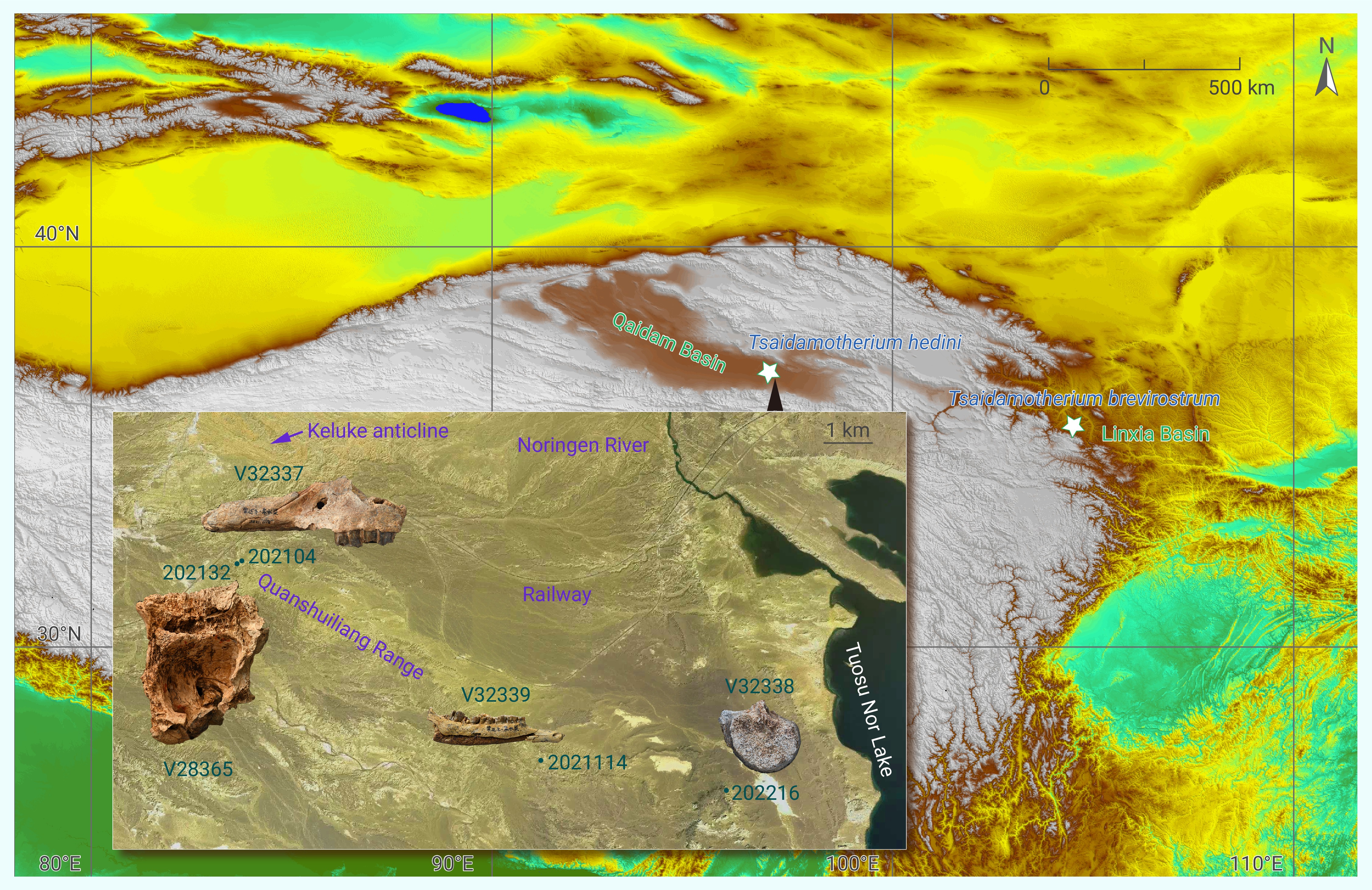
Figure 1.
The locations of fossil Tsaidamotherium, including T. hedini from the Qaidam Basin and T. brevirostrum from the Linxia Basin
-
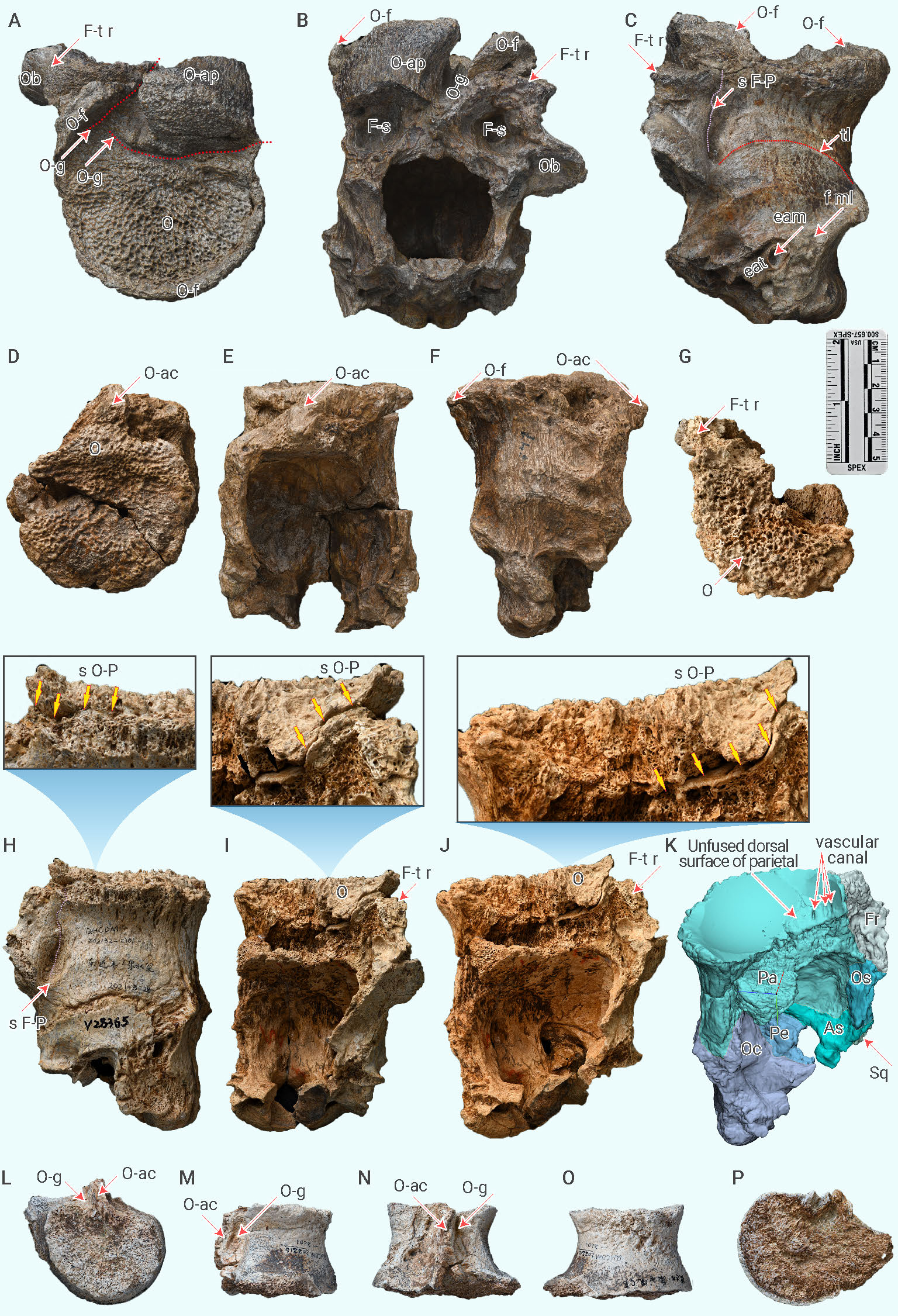
Figure 2.
Ossicone and braincase of Tsaidamotherium hedini, from Quanshuiliang loc., Qaidam Basin
-
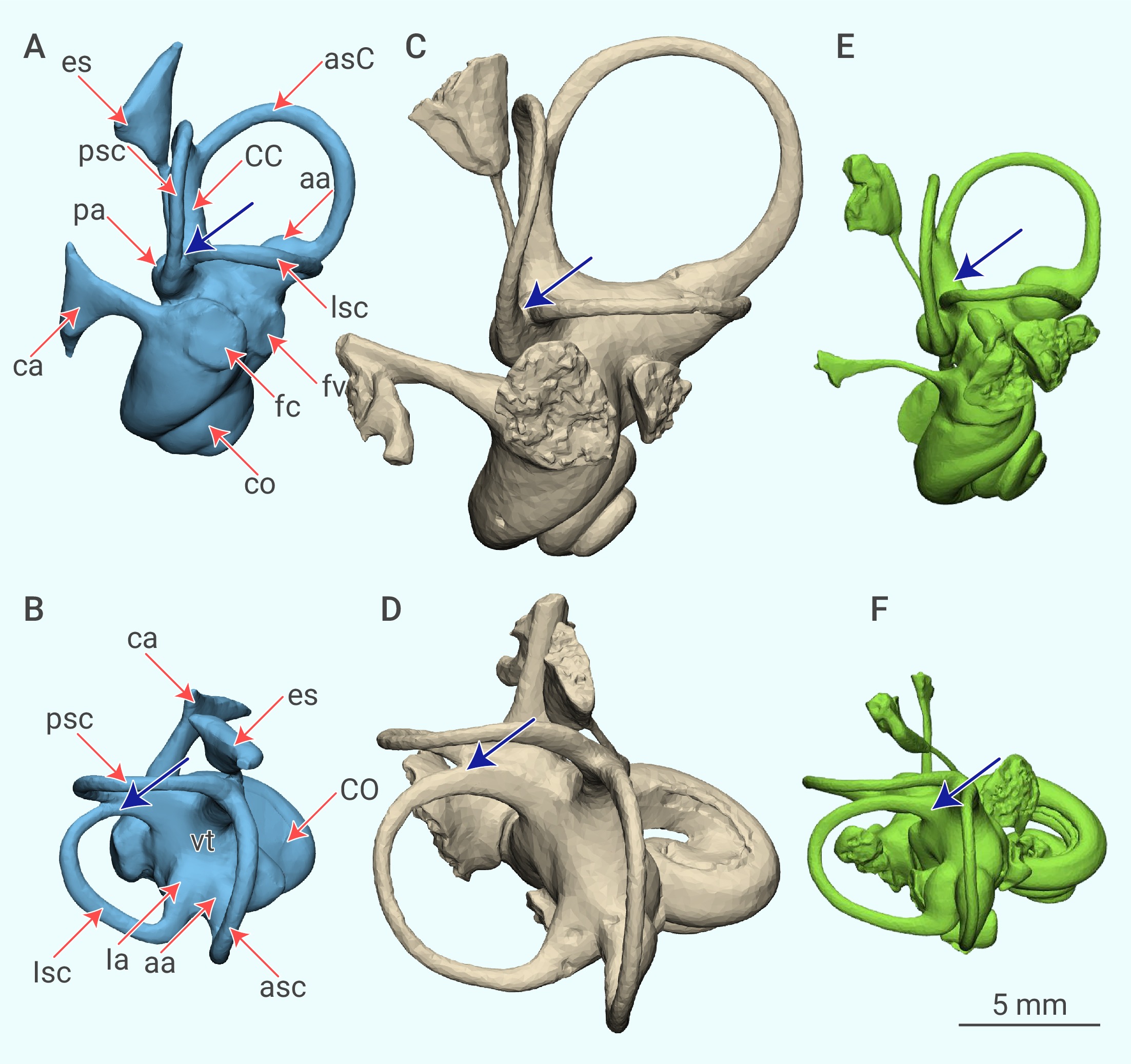
Figure 3.
Right bony labyrinth of Tsaidamotherium hedini (IVPP RV35052, type specimen) (A and B), compared with that of a giraffid, Giraffa camelopardalis (IVPP OV
1273 ) (C and D) and a bovid, Gazella subgutturosa (IVPP OV 574) (E and F), in lateral (A, C and E) and dorsal (B, D and F) views -
Figure 4.
Upper and lower jaws of Tsaidamotherium hedini, from Quanshuiliang loc., Qaidam Basin
-
Figure 5.
The phylogenetic reconstruction of pecoran ruminants based on morphological and molecular data using the Bayesian total-evidence dating method with the molecular backbone constraint
-
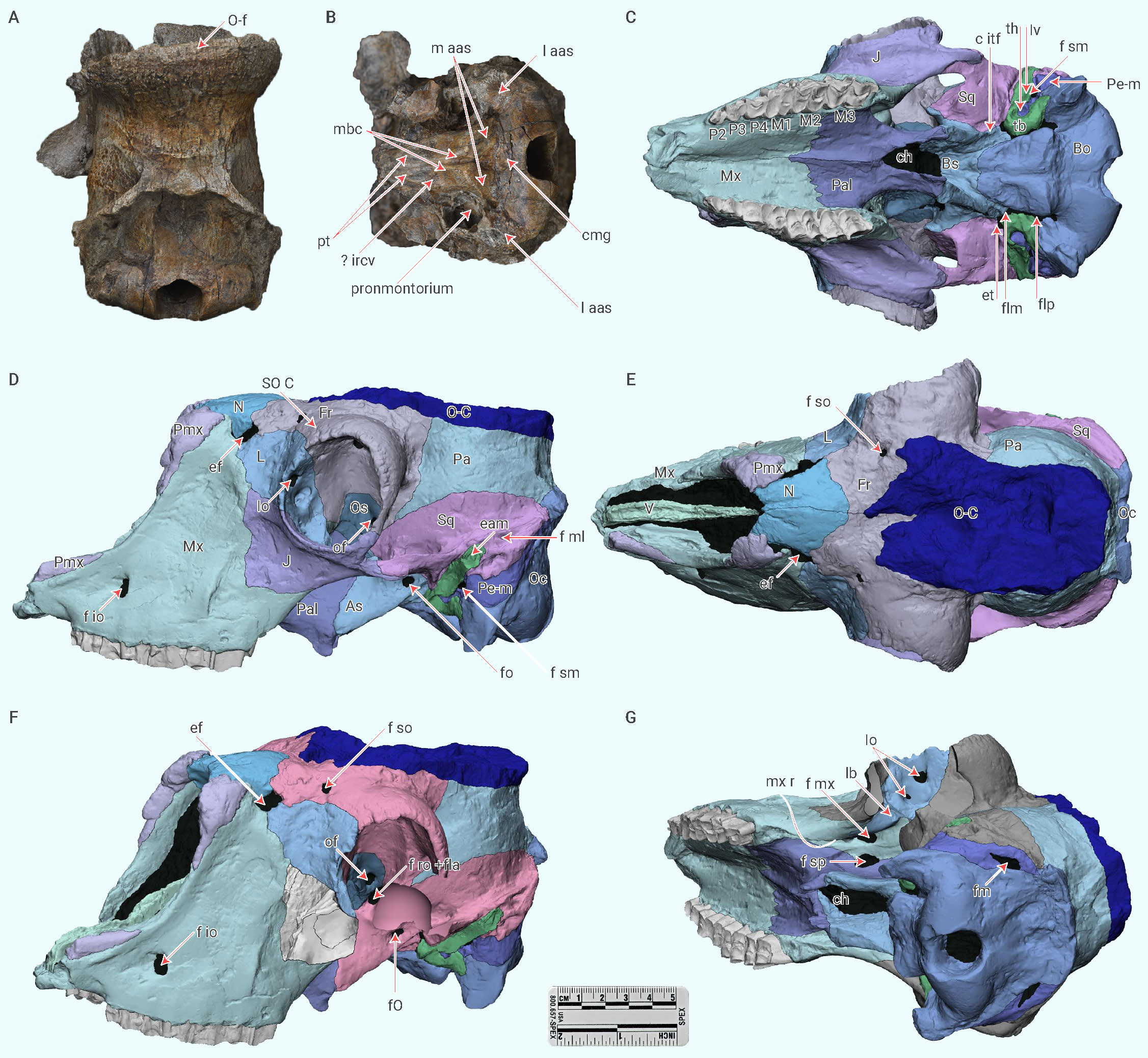
Figure 6.
Cranium of Tsaidamotherium
-
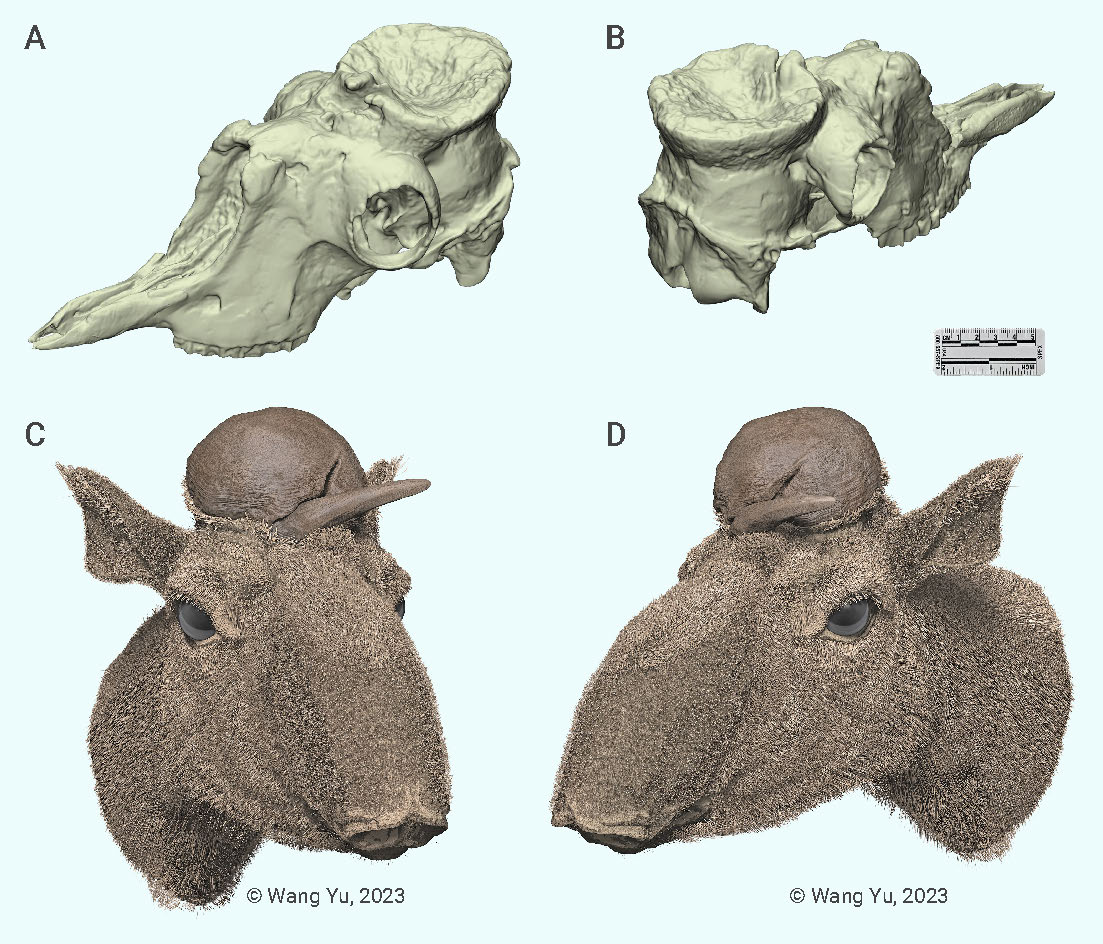
Figure 7.
3D reconstruction of Tsaidamotherium brevirostrum
-
Figure 8.
Microwear analysis of the Quanshuiliang mammalian community
