
Fighting caterpillar pests and managing agricultural insecticide resistance with Lepidoptera-associated Enterococcus casseliflavus
-
ABSTRACT
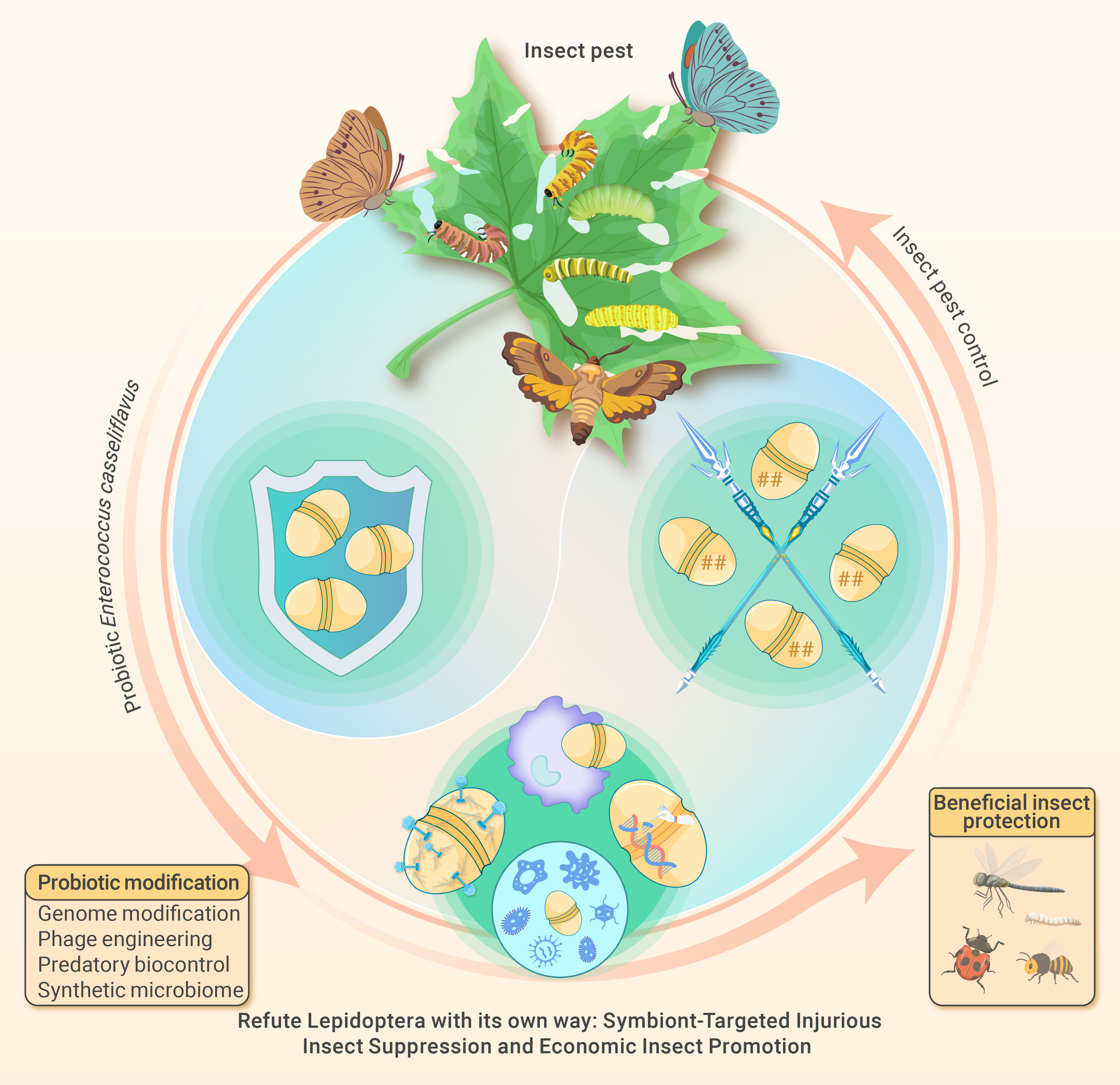
Probiotics are live microorganisms that are intended to benefit the health of metazoan hosts. Mutualism in insects (both pests and beneficial insects) provides a vital contribution to host fitness. With the development and demand for healthy modern agriculture, bacterial symbionts are considered to be an important toolbox for pest control and beneficial insect protection. Enterococcus casseliflavus is a widespread symbiont in most Lepidoptera insect pests. Recent studies indicated that E. casseliflavus provides beneficial phenotypes to the host, including supplying a diet lacking amino acids and enhancing insecticide resistance. We propose that E. casseliflavus should have enormous biotechnological potential awaiting further exploitation for Lepidoptera insect pest control or beneficial insect protection through symbiont-targeted insecticide resistance management, because this symbiont is widespread in natural caterpillar hosts, easily isolatable and cultured, and rapidly spreadable within the caterpillar population. We outline the rationales for why E. casseliflavus is suitable for application in pest management and envision possible plans of symbiont-targeted therapeutics via four potential approaches: genome modification, phage engineering, predatory biocontrol, and synthetic microbiome. This perspective opens up a grand blueprint for the future of symbiont-targeted insect pest suppression or economic insect promotion. -

-
REFERENCES
[1] Rivera-Vega, L. J., Acevedo, F. E., and Felton, G. W. (2017). Genomics of Lepidoptera saliva reveals function in herbivory. Curr. Opin. Insect Sci. 19 : 61−69. DOI: 10.1016/j.cois.2017.01.002. [2] Chen, B., Mason, C. J., Peiffer, M., et al. (2022). Enterococcal symbionts of caterpillars facilitate the utilization of a suboptimal diet. J. Insect Physiol. 138 : 104369. DOI: 10.1016/j.jinsphys.2022.104369. [3] Guo, Z., Jin, R., Guo, Z., et al. (2022). Insecticide susceptibility and mechanism of Spodoptera frugiperda on different host plants. J. Agric. Food Chem. 70 : 11367−11376. DOI: 10.1021/acs.jafc.2c04189. [4] Liang, X., He, J., Zhang, N., et al., (2022). Probiotic potentials of the silkworm gut symbiont Enterococcus casseliflavus ECB140, a promising L-tryptophan producer living inside the host. J. Appl. Microbiol. 133 : 1620-1635. DOI: 10.1111/jam.15675. [5] Zhang, Y., and Ju, F., (2023). Uninheritable but widespread bacterial symbiont mediates insecticide detoxification of an agricultural invasive pest Spodoptera frugiperda. bioRxiv.559648. DOI: 10.1101/2023.09.26.559648. [6] Xu, P., Yang, L., Yang, X., et al. (2020). Novel partiti-like viruses are conditional mutualistic symbionts in their normal lepidopteran host, African armyworm, but parasitic in a novel host, Fall armyworm. PLoS Pathog. 16 : e1008467. DOI: 10.1371/journal.ppat.1008467. [7] Gomes, A. F. F., de Almeida, L. G., and Cônsoli, F. L. (2023). Comparative genomics of pesticide-degrading Enterococcus symbionts of Spodoptera frugiperda (Lepidoptera: Noctuidae) leads to the identification of two new species and the reappraisal of insect-associated Enterococcus species. Microb. Ecol. 86 : 2583−2605. DOI: 10.1007/s00248-023-02264-0. [8] Chang, Y., Bai, J., Lee. J. H., et al. (2019). Mutation of a Staphylococcus aureus temperate bacteriophage to a virulent one and evaluation of its application. Food Microbiol. 82 : 523−532. DOI: 10.1016/j.fm.2019.03.025. [9] Gong, J. T., Li, Y., Li, TP., et al. (2020). Stable Introduction of plant-virus-inhibiting Wolbachia into planthoppers for rice protection. Curr. Biol. 30 : 4837−4845.e5. DOI: 10.1016/j.cub.2020.09.033. [10] Zhang, L., Guo, L., Cui, Z., et al. (2023). Exploiting predatory bacteria as biocontrol agents across ecosystems. Trends Microbiol. S0966-842 : 00293-7. DOI: 10.1111/jam.15675. -
ABOUT THIS ARTICLE
Cite this article:
Zhang Y. and Ju F. (2023). Fighting caterpillar pests and managing agricultural insecticide resistance with Lepidoptera-associated Enterococcus casseliflavus. The Innovation Life 1(3), 100042. https://doi.org/10.59717/j.xinn-life.2023.100042
Welcome!
To request copyright permission to republish or share portions of our works, please visit Copyright Clearance Center's (CCC) Marketplace website at marketplace.copyright.com.
Export File
Citation
Zhang Y. and Ju F. (2023). Fighting caterpillar pests and managing agricultural insecticide resistance with Lepidoptera-associated Enterococcus casseliflavus. The Innovation Life 1(3), 100042. https://doi.org/10.59717/j.xinn-life.2023.100042

Format
Content
 DownLoad:
-
Figure 1.
A schematic diagram of Enterococcus casseliflavus applied in caterpillar insecticide resistance management (e.g., via biodegradation) and Symbiont-Targeted Insect Control (STIC) including Injurious Insect Suppression and Economic Insect Promotion based on traditional Chinese culture “Tai Chi” and the old Chinese saying that “refute somebody with his own way”
