
Asymmetric inheritance of parental histones leads to differentiation defects in mouse embryonic stem cells
-

-
REFERENCES
[1] Wen, Q., Zhou, J., Tian, C., et al. (2023). Symmetric inheritance of parental histones contributes to safeguarding the fate of mouse embryonic stem cells during differentiation. Nat. Genet. 55 : 1555−1566. DOI: 10.1038/s41588-023-01477-w. [2] Yu, C., Gan, H., Serra-Cardona, A., et al. (2018). A mechanism for preventing asymmetric histone segregation onto replicating DNA strands. Science 361: 1386−1389. DOI: 10.1126/science.aat8849. [3] Wenger, A., Biran, A., Alcaraz, N., et al. (2023). Symmetric inheritance of parental histones governs epigenome maintenance and embryonic stem cell identity. Nat. Genet. 55: 1567−1578. DOI: 10.1038/s41588-023-01476-x. [4] Buitrago, D., Labrador, M., Arcon, J.P., et al. (2021). Impact of DNA methylation on 3D genome structure. Nat. Commun. 12: 3243. DOI: 10.1038/s41467-021-23142-8. [5] Xie, J., Wooten, M., Tran, V., et al. (2015). Histone H3 threonine phosphorylation regulates asymmetric histone inheritance in the drosophila male germline. Cell 163: 920−933. DOI: 10.1016/j.cell.2015.10.002. -
ABOUT THIS ARTICLE
Cite this article:
Yang X., Karri S., and Yu C. (2024). Asymmetric inheritance of parental histones leads to differentiation defects in mouse embryonic stem cells. The Innovation Life 2(1): 100047. https://doi.org/10.59717/j.xinn-life.2024.100047
Welcome!
To request copyright permission to republish or share portions of our works, please visit Copyright Clearance Center's (CCC) Marketplace website at marketplace.copyright.com.
Export File
Citation
Yang X., Karri S., and Yu C. (2024). Asymmetric inheritance of parental histones leads to differentiation defects in mouse embryonic stem cells. The Innovation Life 2(1): 100047. https://doi.org/10.59717/j.xinn-life.2024.100047

Format
Content
 DownLoad:
-
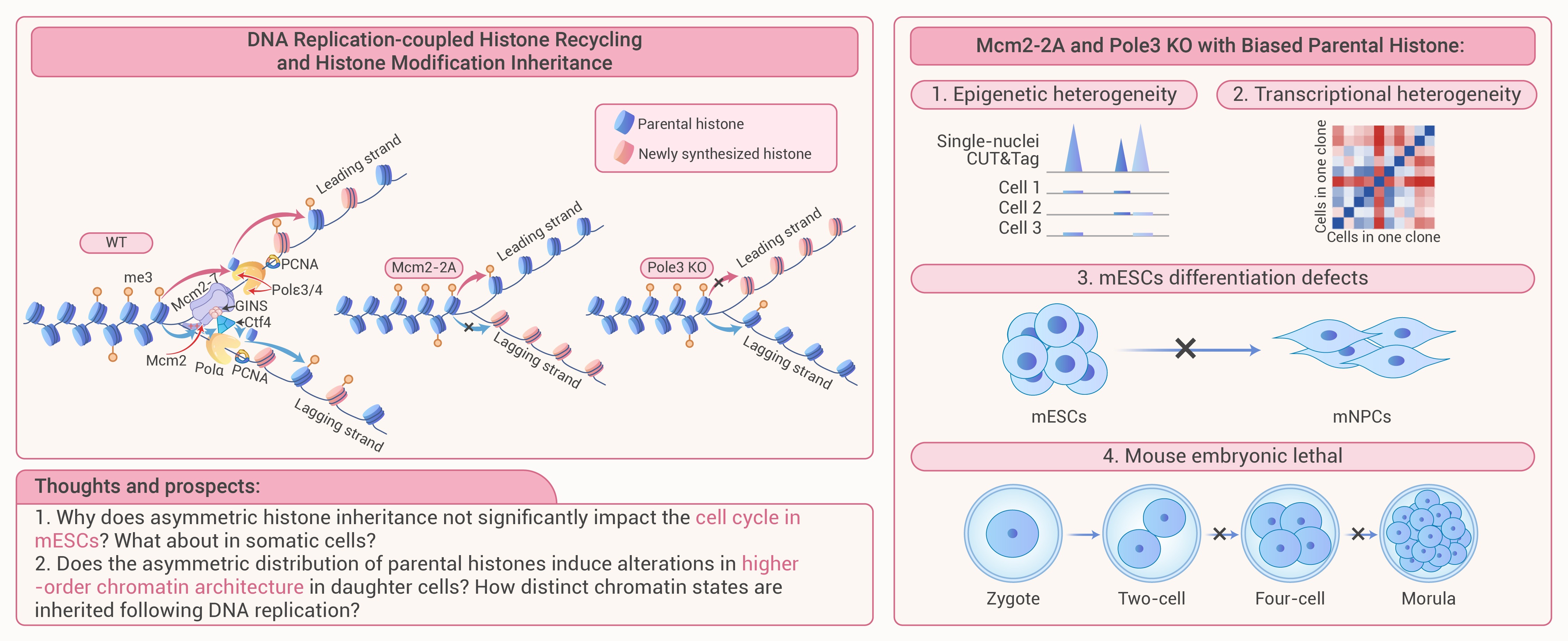
Figure 1.
Schematic representing asymmetric inheritance of parental histones in DNA replication as a result of the mutation of Mcm2-2A or the deletion of Pole3, and the resulting functional and differentiation defects in mouse embryonic stem cells (mESCs).
