
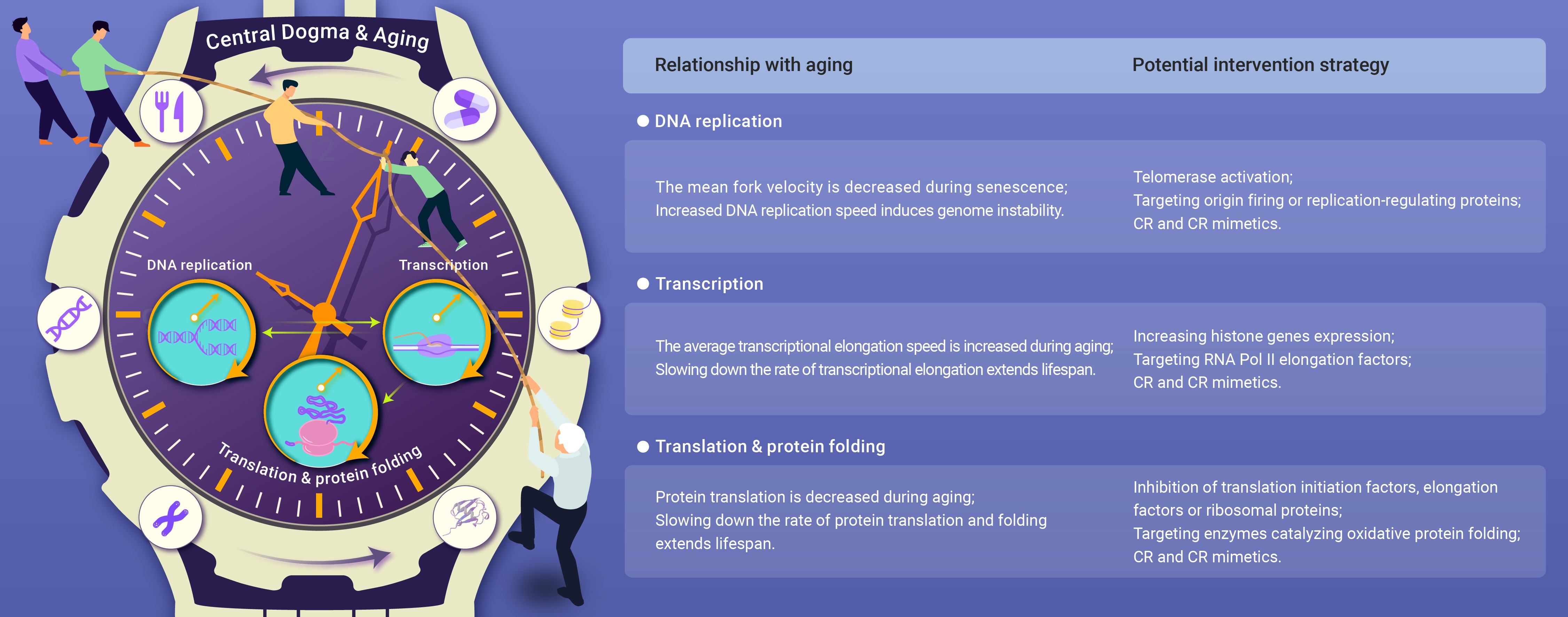
Slowing down the central dogma rate for alleviating aging
-

-
REFERENCES
[1] Yang, J.H., Hayano, M., Griffin, P.T., et al. (2023). Loss of epigenetic information as a cause of mammalian aging. Cell 186 :305-326.e327. DOI: 10.1016/j.cell.2022.12.027. [2] Maya-Mendoza, A., Moudry, P., Merchut-Maya, J.M., et al. (2018). High speed of fork progression induces DNA replication stress and genomic instability. Nature 559: 279−284. DOI: 10.1038/s41586-018-0261-5. [3] Debes, C., Papadakis, A., Gronke, S., et al. (2023). Ageing-associated changes in transcriptional elongation influence longevity. Nature 616: 814−821. DOI: 10.1038/s41586-023-05922-y. [4] Xie, J., de Souza Alves, V., von der Haar, T., et al. (2019). Regulation of the elongation phase of protein synthesis enhances translation accuracy and modulates lifespan. Curr. Biol. 29 :737-749 e735. DOI: 10.1016/j.cub.2019.01.029. [5] Cheng, F., Ji, Q., Wang, L., et al. (2023). Reducing oxidative protein folding alleviates senescence by minimizing ER-to-nucleus H2O2 release. EMBO Rep. 24: e56439. DOI: 10.15252/embr.202256439. -
ABOUT THIS ARTICLE
Cite this article:
Cheng F. and Wang L. (2024). Slowing down the central dogma rate for alleviating aging. The Innovation Life 2(1): 100049. https://doi.org/10.59717/j.xinn-life.2024.100049
Welcome!
To request copyright permission to republish or share portions of our works, please visit Copyright Clearance Center's (CCC) Marketplace website at marketplace.copyright.com.
Export File
Citation
Cheng F. and Wang L. (2024). Slowing down the central dogma rate for alleviating aging. The Innovation Life 2(1): 100049. https://doi.org/10.59717/j.xinn-life.2024.100049

Format
Content
 DownLoad:
-
Figure 1.
Slowing down the ticking of the ‘central dogma’ clock can alleviate aging
