
-
ABSTRACT
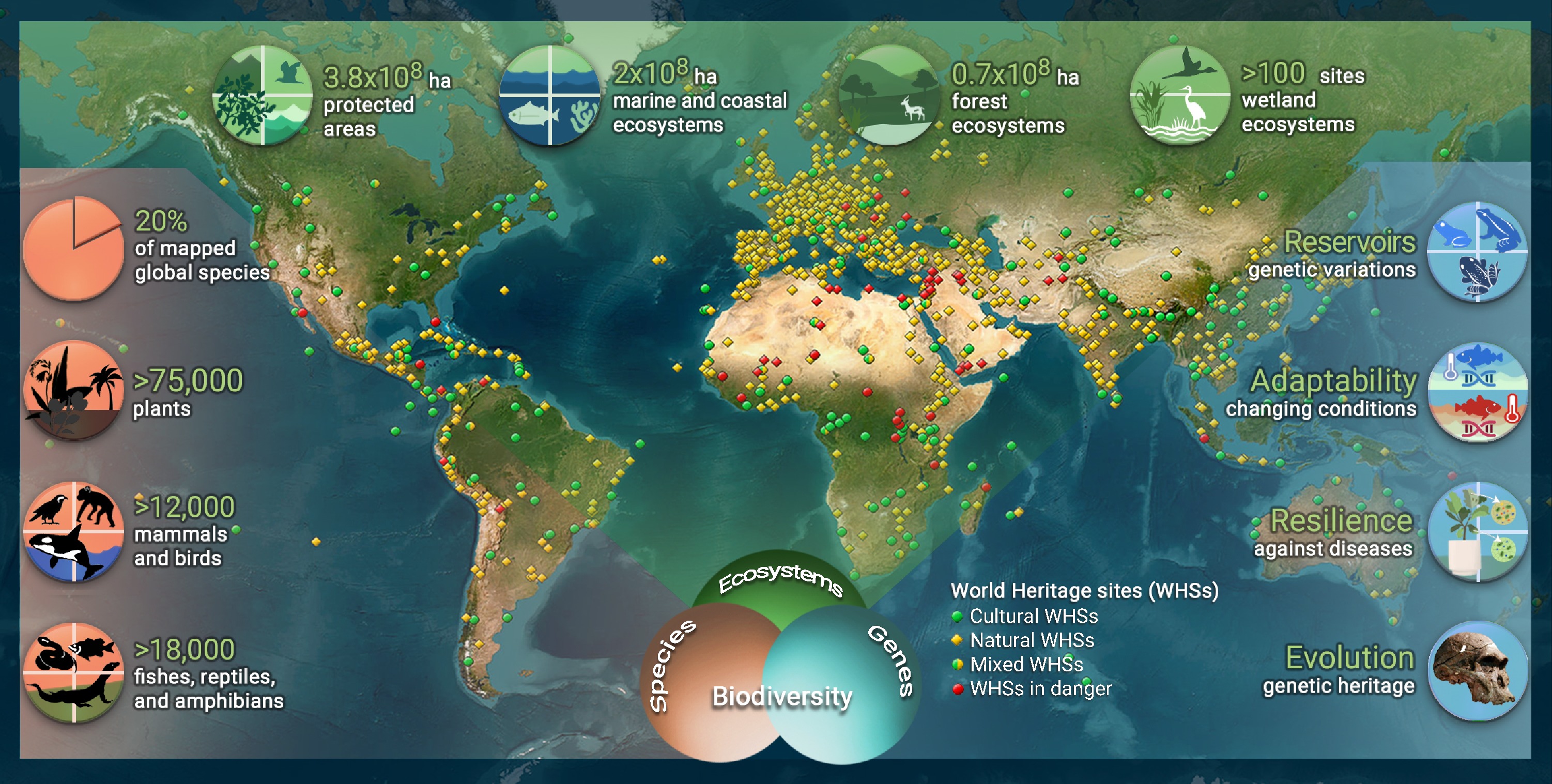
Preserving World Heritage sites (WHSs) safeguards unique habitats, maintaining varied ecosystems that are essential for the survival of numerous species. It fosters genetic diversity by conserving distinct gene pools within species. Protecting these sites upholds the equilibrium of the ecosystem, aiding in maintaining species richness and resilience. These protective efforts serve as living laboratories, offering insights into evolutionary processes and adaptation, enriching global biodiversity, and reinforcing the harmony between humans and nature. In this Perspective, we explore the threefold biodiversity co-benefits of World Heritage (WH) protection through the lenses of ecosystems, species, and genes. Finally, we outline future challenges in WH protection and their impacts on biodiversity conservation and sustainable development. -

-
REFERENCES
[1] International Union for Conservation of Nature (IUCN) (2023). IUCN World Heritage Strategy: New ambition for World Heritage (IUCN). [2] Luo, L., Wang, X., and Guo, H. (2022). Contribution of UNESCO designated sites to the achievement of Sustainable Development Goals. The Innovation 3: 100227. DOI: 10.1016/j.xinn.2022.100227. [3] UNESCO and IUCN (2023). World Heritage: A unique contribution to biodiversity conservation. (UNESCO, IUCN). [4] UNESCO, WRI and IUCN (2021). World Heritage forests: Carbon sinks under pressure. (UNESCO, WRI, IUCN). [5] Ortolano, L., Sánchez-Triana, E., and Ferdausi, S.A. (2017). Strategy for adapting to climate change and conserving biodiversity in the Bangladesh Sundarbans. Clim. Dev. 9: 325−336. DOI: 10.1080/17565529.2016.1167660. [6] Brodie, J.F., Mohd-Azlan, J., Chen, C., et al. (2023). Landscape-scale benefits of protected areas for tropical biodiversity. Nature 620: 807−812. DOI: 10.1038/s41586-023-06410-z. [7] Osipova, E., Wilson, L., Blaney, R., et al. (2014). The benefits of natural World Heritage: Identifying and assessing ecosystem services and benefits provided by the world’s most iconic natural places. Gland, Switzerland: IUCN. [8] Kloosterman, B., Abelenda, J.A., Gomez, M.D.C., et al. (2013). Naturally occurring allele diversity allows potato cultivation in northern latitudes. Nature 495: 246−250. DOI: 10.1038/nature11912. [9] Lombard, M., Malmström, H., Schlebusch, C., et al. (2019). Genetic data and radiocarbon dating question Plovers Lake as a Middle Stone Age hominin-bearing site. J. Hum. Evol. 131: 203−209. DOI: 10.1016/j.jhevol.2019.03.014. [10] Wang, H., Xu, C., Liu, Y., et al. (2021). From unusual suspect to serial killer: Cyanotoxins boosted by climate change may jeopardize megafauna. The Innovation 2: 100092. DOI: 10.1016/j.xinn.2021.100092. -
ABOUT THIS ARTICLE
Cite this article:
Luo L., Wang H., Chen Z., et al., (2024). Biodiversity co-benefits of World Heritage protection. The Innovation Life 2(1): 100051. https://doi.org/10.59717/j.xinn-life.2024.100051
Welcome!
To request copyright permission to republish or share portions of our works, please visit Copyright Clearance Center's (CCC) Marketplace website at marketplace.copyright.com.
Export File
Citation
Luo L., Wang H., Chen Z., et al., (2024). Biodiversity co-benefits of World Heritage protection. The Innovation Life 2(1): 100051. https://doi.org/10.59717/j.xinn-life.2024.100051

Format
Content
 DownLoad:
-
Figure 1.
An illustration of the three lenses of biodiversity co-benefits of World Heritage protection
