
Fluorescent probe: A novel visualization tool for rapidly assessing the health risk of organisms exposed to microcystins
-

-
REFERENCES
[1] Merder, J., Harris, T., Zhao, G., et al. (2023). Geographic redistribution of microcystin hotspots in response to climate warming. Nat. Water 1: 844−854. DOI: 10.1038/s44221-023-00138-w. [2] Paerl, H.W., Otten, T.G. (2013). Blooms bite the hand that feeds them. Science 342: 433−434. DOI: 10.1126/science.1245276. [3] Pouria, S., de Andrade, A., Barbosa, J., et al. (1998). Fatal microcystin intoxication in haemodialysis unit in Caruaru, Brazil. The Lancet 352: 21−26. DOI: 10.1016/s0140-6736(97)12285-1. [4] Jia, R., Tian, W., Bai, H., et al. (2019). Amine-responsive cellulose-based ratiometric fluorescent materials for real-time and visual detection of shrimp and crab freshness. Nat. Commun. 10: 795. DOI: 10.1038/s41467-019-08675-3. [5] He, L., He, L.-H., Xu, S., et al. (2022). Engineering of reversible NIR-II redox-responsive fluorescent probes for imaging of inflammation in vivo. Angew. Chem. Int. Ed. 61: e202211409. DOI: 10.1002/anie.202211409. -
ABOUT THIS ARTICLE
Cite this article:
Li B., Zhang Y., Xie P., et al., (2024). Fluorescent probe: A novel visualization tool for rapidly assessing the health risk of organisms exposed to microcystins. The Innovation Life 2(2): 100062. https://doi.org/10.59717/j.xinn-life.2024.100062
Welcome!
To request copyright permission to republish or share portions of our works, please visit Copyright Clearance Center's (CCC) Marketplace website at marketplace.copyright.com.
Export File
Citation
Li B., Zhang Y., Xie P., et al., (2024). Fluorescent probe: A novel visualization tool for rapidly assessing the health risk of organisms exposed to microcystins. The Innovation Life 2(2): 100062. https://doi.org/10.59717/j.xinn-life.2024.100062

Format
Content
 DownLoad:
-
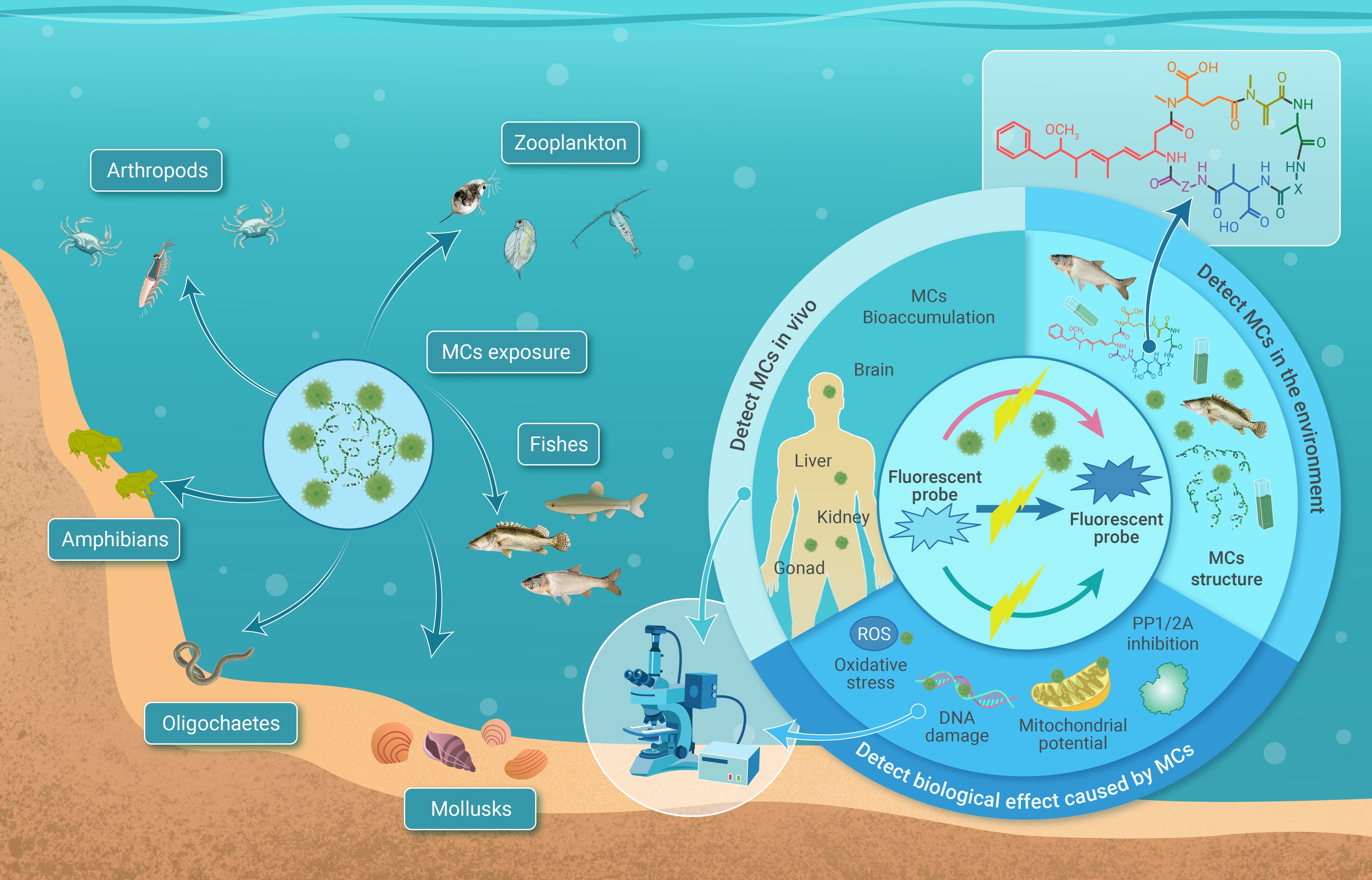
Figure 1.
Perspective of using fluorescent probe to assess the health risk of organisms exposed to MCs
