
Mouthbrooding behavior and sexual immune dimorphism in Indian perch Jaydia lineata
-
GRAPHICAL ABSTRACT

 DownLoad:
Full size image
DownLoad:
Full size image
-
PUBLIC SUMMARY
-
Mouthbrooding teleosts, like Jaydia lineata, show unique parental care behaviors, revealing convergent evolution.
Genomic analysis identifies genes associated with embryonic development, emphasizing parental care’s importance.
Adaptive convergence in oxytocin signaling pathway-related genes indicates the crucial role of hormonal regulation.
The study reveals a trade-off between parental care and immune activation, with sexual immune dimorphism.
-
-
ABSTRACT
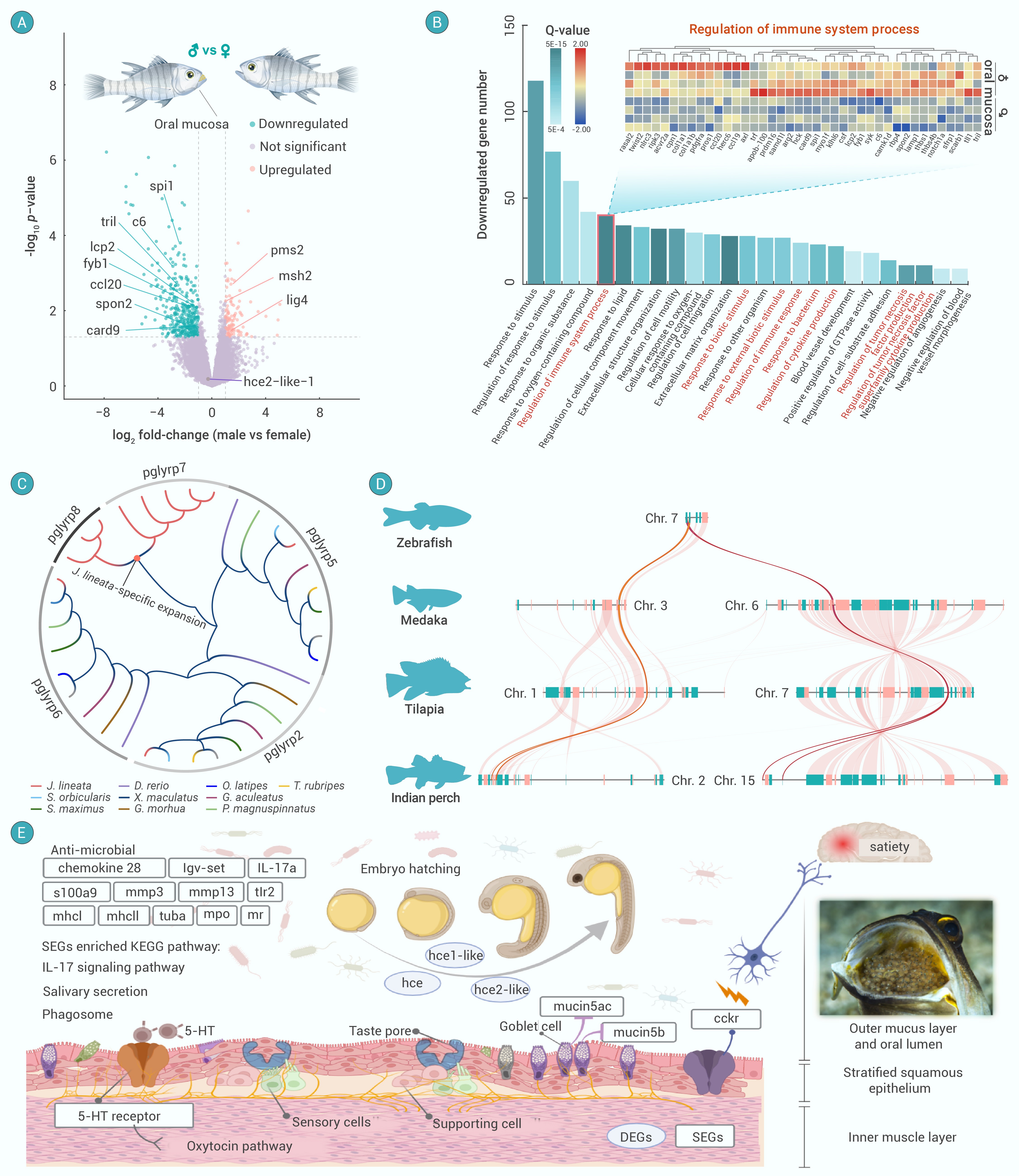
Parental care enhances offspring survival in teleost vertebrates; however, its genetic basis and evolutionary traits remain unexplored. Therefore, we assembled the chromosome-level genome of the paternal mouthbrooder, Jaydia lineata, and observed convergent evolution in parental care fish. Genomic signatures revealed the association of certain genes with embryonic development, implying that parental behavior is conducive for offspring. Adaptive convergence occurred as an in evolutionary response oxytocin signaling pathway-related genes; thus, hormonal regulation is vital in this process. Specific neuropeptides and steroid hormones co-opted and primary immunodeficiency-related transcripts were enriched in Indian perch. Comparative transcriptome analysis revealed a trade-off between parental care and immunological activation in mouthbrooders. Sexual immune dimorphism, evident in the buccal mucosa, is characterized by the functional differentiation of immune-related genes in male mouthbrooders. Thus, we elucidated the genetic basis and unique physiological traits of mouthbrooding, offering insights into the independent evolution of complex parental care adaptations in teleosts. -

-
REFERENCES
[1] Trivers, R. (1972). Parental investment and sexual selection. In Sexual selection and the descent of man 1871-1971, Campbell B. (Aldine Publishing Company, 1972), pp : 136-179. DOI: 10.4324/9781315129266. [2] Blumer, L.S. (1982). A bibliography and categorization of bony fishes exhibiting parental care. Zool. J. Linn. Soc. 75: 1−22. DOI: 10.1111/j.1096-3642.1982.tb01939.x. [3] Smith, C. and Wootton, R.J. (1994). The cost of parental care in Haplochromis argens (Cichlidae). Environ. Biol. Fish 40: 99−104. DOI: 10.1007/Bf00002184. [4] Keenleyside, M.H.A. (1981). Parental care patterns of fishes. Am. Nat. 117: 1019−1022. DOI: 10.1086/283789. [5] Grone, B.P., Carpenter, R.E., Lee, M., et al. (2012). Food deprivation explains effects of mouthbrooding on ovaries and steroid hormones, but not brain neuropeptide and receptor mRNAs, in an African cichlid fish. Horm. Behav. 62: 18−26. DOI: 10.1016/j.yhbeh.2012.04.012. [6] Reardon, E.E. and Chapman, L.J. (2010). Hypoxia and energetics of mouth brooding: Is parental care a costly affair. Comp. Biochem. Physiol. A Mol. Integr. Physiol. 400−406. DOI: 10.1016/j.cbpa.2010.03.007. [7] Morley, J.I. and Balshine, S. (2003). Reproductive biology of Eretmodus cyanostictus, a cichlid fish from Lake Tanganyika. Environ. Biol. Fish 66: 169−179. DOI: 10.1023/A:1023610905675. [8] Schurch, R., and Taborsky, B. (2005). The functional significance of buccal feeding in the mouthbrooding cichlid Tropheus moorii. Behaviour 142: 265−281. DOI: 10.1163/1568539053778274. [9] Keller, I.S., Salzburger, W., and Roth, O. (2017). Parental investment matters for maternal and offspring immune defense in the mouthbrooding cichlid Astatotilapia burtoni. BMC Evol. Biol. 17: 264. DOI: 10.1186/s12862-017-1109-6. [10] Sawecki, J., Miros, E., Border, S.E., et al. (2019). Reproduction and maternal care increase oxidative stress in a mouthbrooding cichlid fish. Behav. Ecol. 30: 1662−1671. DOI: 10.1093/beheco/arz133. [11] Alonso‐Alvarez, C. and Velando, A. (2012). Benefits and costs of parental care. In The evolution of parental care (Oxford University Press), pp : 40-61. DOI: 10.1093/acprof:oso/9780199692576.003.0003. [12] Zhang, Y.H., Ravi, V., Qin, G., et al. (2020). Comparative genomics reveal shared genomic changes in syngnathid fishes and signatures of genetic convergence with placental mammals. Natl. Sci. Rev. 7: 964−977. DOI: 10.1093/nsr/nwaa002. [13] Wang, X., Qu, M., Liu, Y., et al. (2022). Genomic basis of evolutionary adaptation in a warm-blooded fish. The Innovation 3: 100185. DOI: 10.1016/j.xinn.2021.100185. [14] Li, R.Q., Fan, W., Tian, G., et al. (2010). The sequence and de novo assembly of the giant panda genome. Nature 463: 311−317. DOI: 10.1038/Nature08696. [15] Koren, S., Walenz, B.P., Berlin, K., et al. (2017). Canu: Scalable and accurate long-read assembly via adaptive k-mer weighting and repeat separation. Genome Res. 27: 722−736. DOI: 10.1101/gr.215087.116. [16] Ruan, J. and Li, H. (2020). Fast and accurate long-read assembly with wtdbg2. Nat. Methods 17: 155−158. DOI: 10.1038/s41592-019-0669-3. [17] Li, H. and Durbin, R. (2009). Fast and accurate short read alignment with Burrows-Wheeler transform. Bioinformatics 25: 1754−1760. DOI: 10.1093/bioinformatics/btp324. [18] Durand, N.C., Shamim, M.S., Machol, I., et al. (2016). Juicer provides a one-click system for analyzing loop-resolution Hi-C experiments. Cell Syst. 3: 95−98. DOI: 10.1016/j.cels.2016.07.002. [19] Durand, N.C., Robinson, J.T., Shamim, M.S., et al. (2016). Juicebox provides a visualization system for Hi-C contact maps with unlimited zoom. Cell Syst. 3: 99−101. DOI: 10.1016/j.cels.2015.07.012. [20] Simao, F.A., Waterhouse, R.M., Ioannidis, P., et al. (2015). BUSCO: Assessing genome assembly and annotation completeness with single-copy orthologs. Bioinformatics 31: 3210−3212. DOI: 10.1093/bioinformatics/btv351. [21] Benson, G. (1999). Tandem repeats finder: A program to analyze DNA sequences. Nucleic Acids Res. 27: 573−580. DOI: 10.1093/nar/27.2.573. [22] Jurka, J., Kapitonov, V.V., Pavlicek, A., et al. (2005). Repbase Update, a database of eukaryotic repetitive elements. Cytogenet. Genome Res. 110: 462−467. DOI: 10.1159/000084979. [23] Xu, Z., and Wang, H. (2007). LTR_FINDER: An efficient tool for the prediction of full-length LTR retrotransposons. Nucleic Acids Res 35: W265−W268. DOI: 10.1093/nar/gkm286. [24] Stanke, M., Keller, O., Gunduz, I., et al. (2006). AUGUSTUS: Ab initio prediction of alternative transcripts. Nucleic Acids Res 34: W435−W439. DOI: 10.1093/nar/gkl200. [25] Keilwagen, J., Hartung, F., and Grau, J. (2019). GeMoMa: Homology-based gene prediction utilizing intron position conservation and RNA-seq data. Methods Mol Biol 1962: 161−177. DOI: 10.1007/978-1-4939-9173-0_9. [26] Pertea, M., Kim, D., Pertea, G.M., et al. (2016). Transcript-level expression analysis of RNA-seq experiments with HISAT, StringTie and Ballgown. Nat. Protoc. 11: 1650−1667. DOI: 10.1038/nprot.2016.095. [27] Kanehisa, M., and Goto, S. (2000). KEGG: Kyoto encyclopedia of genes and genomes. Nucleic Acids Res. 28: 27−30. DOI: 10.1093/nar/28.1.27. [28] Ashburner, M., Ball, C.A., Blake, J.A., et al. (2000). Gene ontology: Tool for the unification of biology. Nat. Genet. 25: 25−29. DOI: 10.1038/75556. [29] Bairoch, A., and Apweiler, R. (2000). The SWISS-PROT protein sequence database and its supplement TrEMBL in 2000. Nucleic Acids Res. 28: 45. DOI: 10.1093/nar/28.1.45. [30] Yang, Z.H. (2007). PAML 4: Phylogenetic analysis by maximum likelihood. Mol. Biol. Evol. 24: 1586−1591. DOI: 10.1093/molbev/msm088. [31] Hu, Y., Wu, Q., Ma, S., et al. (2017). Comparative genomics reveals convergent evolution between the bamboo-eating giant and red pandas. Comparative Study 114 : 1081-1086. DOI: 10.1073/pnas.1613870114. [32] Zou, Z.T. and Zhang, J.Z. (2015). No genome-wide protein sequence convergence for echolocation. Mol. Biol. Evol. 32: 1237−1241. DOI: 10.1093/molbev/msv014. [33] Thomas, G.W.C. and Hahn, M.W. (2015). Determining the null model for detecting adaptive convergence from genomic data: A case study using echolocating mammals. Mol. Biol. Evol. 32: 1232−1236. DOI: 10.1093/molbev/msv013. [34] Chen, L., Qiu, Q., Jiang, Y., et al. (2019). Large-scale ruminant genome sequencing provides insights into their evolution and distinct traits. Science 364: eaav6202. DOI: 10.1126/science.aav6202. [35] Mank, J.E., Promislow, D.E.L., and Avise, J.C. (2005). Phylogenetic perspectives in the evolution of parental care in ray-finned fishes. Evolution 59 : 1570-1578. DOI: 10.1111/j.0014-3820.2005.tb01806.x. [36] Wootton, R.J., and Smith, C. (2014). Parental care. In Reproductive biology of teleost fishes (Wiley Blackwell), pp: 251-279. DOI: 10.1002/9781118891360. [37] Maisey, J.G. (1996). Discovering fossil fishes (Henry Holt and Company). [38] Ghezelayagh, A., Harrington, R.C., Burress, E.D., et al. (2022). Prolonged morphological expansion of spiny-rayed fishes following the end-Cretaceous. Nat. Ecol. Evol. 6: 1211−1220. DOI: 10.1038/s41559-022-01801-3. [39] Yu, Y.Y., Kong, W.G., Xu, H.Y., et al. (2019). Convergent evolution of mucosal immune responses at the buccal cavity of teleost fish. iScience 19: 821−835. DOI: 10.1016/j.isci.2019.08.034. [40] Gross, M.R. (2005). The evolution of parental care. Q. Rev. Biol. 80: 37−45. DOI: 10.1086/431023. [41] Closs, G.P., Hicks, A.S., and Jellyman, P.G. (2013). Life histories of closely related amphidromous and non-migratory fish species: A trade-off between egg size and fecundity. Freshwater Biol. 58: 1162−1177. DOI: 10.1111/fwb.12116. [42] Morrongiello, J.R., Bond, N.R., Crook, D.A., et al. (2012). Spatial variation in egg size and egg number reflects trade-offs and bet-hedging in a freshwater fish. J. Anim. Ecol. 81: 806−817. DOI: 10.1111/j.1365-2656.2012.01961.x. [43] Nassari, S., Del Olmo, T., and Jean, S. (2020). Rabs in signaling and embryonic development. Int. J. Mol. Sci. 21: 1064. DOI: 10.3390/ijms21031064. [44] Xu, S.Y., Liu, Y., Meng, Q., et al. (2018). Rab34 small GTPase is required for Hedgehog signaling and an early step of ciliary vesicle formation in mouse. J. Cell Sci. 131: jcs213710. DOI: jcs21371010.1242/jcs.213710. [45] Williamson, R.A., Henry, M.D., Daniels, K.J., et al. (1997). Dystroglycan is essential for early embryonic development: Disruption of Reichert's membrane in Dag1-null mice. Hum. Mol. Genet. 6: 831−841. DOI: 10.1093/hmg/6.6.831. [46] Regard, J.B., Scheek, S., Borbiev, T., et al. (2004). Verge: A novel vascular early response gene. J. Neurosci. 24: 4092−4103. DOI: 10.1523/Jneurosci.4252-03.2004. [47] Li, J., Kurasawa, Y., Wang, Y., et al. (2014). Requirement for Ssbp2 in hematopoietic stem cell maintenance and stress response. J. Immunol. 193: 4654−4662. DOI: 10.4049/jimmunol.1300337. [48] Zhang, L.I., and Poo, M.M. (2001). Electrical activity and development of neural circuits. Nat. Neurosci. 4: 1207−1214. DOI. DOI: 10.1038/nn753. [49] Feller, M.B. (1999). Spontaneous correlated activity in developing neural circuits. Neuron 22: 653−656. DOI: 10.1016/S0896-6273(00)80724-2. [50] Koga, K., Iwahori, Y., Ozaki, S., et al. (2010). Regulation of spontaneous Ca2+ spikes by metabotropic glutamate receptors in primary cultures of rat cortical neurons. J. Neurosci. Res. 88: 2252−2262. DOI: 10.1002/jnr.22382. [51] Liu, C.H., Wang, I.J., Wei, F.D., et al. (2013). Neuronal intermediate filament α-internexin is expressed by neuronal lineages in the developing chicken retina. Exp. Eye Res. 18−25. DOI: 10.1016/j.exer.2013.02.013. [52] Liang, J., Fu, Y., Cruciat, C.-M., et al. (2011). Transmembrane protein 198 promotes LRP6 phosphorylation and wnt signaling activation. Mol. Cell Biol. 31: 2577−2590. DOI: 10.1128/MCB.05103-11. [53] Mtango, N.R. and Latham, K.E. (2007). Ubiquitin proteasome pathway gene expression varies in rhesus monkey oocytes and embryos of different developmental potential. Physiol. Genomics 31: 1−14. DOI: 10.1152/physiolgenomics.00040.2007. [54] Kumari, R., Fazekas, E.A., Morvai, B., et al. (2022). Transcriptomics of parental care in the hypothalamic-septal region of female zebra finch brain. Int. J. Mol. Sci. 23: 2518. DOI: 10.3390/ijms23052518. [55] Cunningham, C.B., Badgett, M.J., Meagher, R.B., et al. (2017). Ethological principles predict the neuropeptides co-opted to influence parenting. Nat. Commun. 8: 14225. DOI: 10.1038/ncomms14225. [56] Olazábal, D.E. (2018). Role of oxytocin in parental behaviour. J. Neuroendocrinol. 30: e12594. DOI: 10.1111/jne.12594. [57] Jin, D., Liu, H.-X., Hirai, H., et al. (2007). CD38 is critical for social behaviour by regulating oxytocin secretion. Nature 446: 41−45. DOI: 10.1038/nature05526. [58] Michel, L.Y.M., Verkaart, S., Koopman, W.J.H., et al. (2014). Function and regulation of the Na+-Ca2+ exchanger NCX3 splice variants in brain and skeletal muscle. J. Biol. Chem. 289: 11293−11303. DOI: 10.1074/jbc.M113.529388. [59] Zhang, X., Huang, R., Zhou, Y., et al. (2020). IP3R channels in male reproduction. Int. J. Mol. Sci. 21: 9179. DOI: 10.3390/ijms21239179. [60] Bukhari, S.A., Saul, M.C., James, N., et al. (2019). Neurogenomic insights into paternal care and its relation to territorial aggression. Nat. Commun. 10: 4437. DOI: 10.1038/s41467-019-12212-7. [61] Kuroda, K.O., Tachikawa, K., Yoshida, S., et al. (2011). Neuromolecular basis of parental behavior in laboratory mice and rats: With special emphasis on technical issues of using mouse genetics. Prog. Neuro-Psychoph. Biol. Psych. 35 : 1205-1231. DOI: 10.1016/j.pnpbp.2011.02.008. [62] Gibson, K.M., Jakobs, C., Pearl, P.L., et al. (2005). Murine succinate semialdehyde dehydrogenase (SSADH) deficiency, a heritable disorder of GABA metabolism with epileptic phenotype. IUBMB Life 57: 639−644. DOI: 10.1080/15216540500264588. [63] Shukla, K.K., Kwon, W.S., Rahman, M.S., et al. (2013). Nutlin-3a decreases male fertility via UQCRC2. Plos One 8(10): e76959. DOI: 10.1371/journal.pone.0076959. [64] Rolff, J. (2002). Bateman's principle and immunity. Proc. Biol. Sci. 269: 867−872. DOI: 10.1098/rspb.2002.1959. [65] Bourgeon, S., Maho, Y.L., and Raclot, T. (2009). Proximate and ultimate mechanisms underlying immunosuppression during the incubation fast in female eiders: Roles of triiodothyronine and corticosterone. Gen. Comp. Endocr. 163: 77−82. DOI: 10.1016/j.ygcen.2008.11.015. [66] French, S.S., Johnston, G.I.H., and Moore, M.C. (2007). Immune activity suppresses reproduction in food-limited female tree lizards Urosaurus ornatus. Funct. Ecol. 21 : 1115-1122. DOI: 10.1111/j.1365-2435.2007.01311.x. [67] Tian, S., Zeng, J., Jiao, H., et al. (2023). Comparative analyses of bat genomes identify distinct evolution of immunity in Old World fruit bats. Sci. Adv. 9: eadd0141. DOI: 10.1126/sciadv.add0141. [68] Brandtzaeg, P. (2009). Mucosal immunity: Induction, dissemination, and effector functions. Scand. J. Immunol. 70 : 505-515. DOI: 10.1111/j.1365-3083.2009.02319.x. [69] Liu, Y., Qu, M., Jiang, H., et al. (2022). Immunogenetic losses co-occurred with seahorse male pregnancy and mutation in tlx1 accompanied functional asplenia. Nat. Commun. 13: 7610. DOI: 10.1038/s41467-022-35338-7. [70] Brandtzaeg, P. (2013). Secretory immunity with special reference to the oral cavity. J. Oral. Microbiol. 5 . DOI: 10.3402/jom.v5i0.20401. [71] Yashpal, M., Kumari, U., Mittal, S., et al. (2007). Histochemical characterization of glycoproteins in the buccal epithelium of the catfish, Rita rita. Acta. Histochem. 109: 285−303. DOI: 10.1016/j.acthis.2007.03.002. [72] Keller, I.S., Bayer, T., Salzburger, W., et al. (2018). Effects of parental care on resource allocation into immune defense and buccal microbiota in mouthbrooding cichlid fishes. Evolution 72: 1109−1123. DOI: 10.1111/evo.13452. [73] Rauta, P.R., Nayak, B., and Das, S. (2012). Immune system and immune responses in fish and their role in comparative immunity study: A model for higher organisms. Immunol. Lett. 148: 23−33. DOI: 10.1016/j.imlet.2012.08.003. [74] Gaffen, S.L. and Moutsopoulos, N.M. (2020). Regulation of host-microbe interactions at oral mucosal barriers by type 17 immunity. Sci. Immunol. 5: eaau4594. DOI: 10.1126/sciimmunol.aau4594. [75] Vogl, T., Stratis, A., Wixler, V., et al. (2018). Autoinhibitory regulation of S100A8/S100A9 alarmin activity locally restricts sterile inflammation. J. Clin. Invest. 128: 1852−1866. DOI: 10.1172/jci89867. [76] Ramadori, G., Ljubicic, S., Ricci, S., et al. (2019). S100A9 extends lifespan in insulin deficiency. Nat. Commun. 10: 3545. DOI: 10.1038/s41467-019-11498-x. [77] Kawaguchi, M., Okazawa, Y., Imafuku, A., et al. (2021). Pactacin is a novel digestive enzyme in teleosts. Sci. Rep. 11: 7230. DOI: 10.1038/s41598-021-86565-9. [78] Kume, G., Yamaguchi, A., and Taniuchi, T. (2000). Filial cannibalism in the paternal mouthbrooding cardinalfish Apogon lineatus: Egg production by the female as the nutrition source for the mouthbrooding male. Environ. Biol. Fish 58: 233−236. DOI: 10.1023/A:1007670410804. [79] Liu, Q., Yang, D., Zhuang, Y., et al. (2021). Ligand recognition and G-protein coupling selectivity of cholecystokinin A receptor. Nat. Chem. Biol. 17: 1238−1244. DOI: 10.1038/s41589-021-00841-3. [80] Whittington, C.M., and Wilson, A.B. (2013). The role of prolactin in fish reproduction. Gen. Comp. Endocr. 191: 123−136. DOI: 10.1016/j.ygcen.2013.05.027. [81] Liu, Y., Shan, L., Liu, T., et al. (2023). Molecular and cellular mechanisms of the first social relationship: A conserved role of 5-HT from mice to monkeys, upstream of oxytocin. Neuron 111: 1468−1485.e1467. DOI: 10.1016/j.neuron.2023.02.010. -
ABOUT THIS ARTICLE
Cite this article:
Zhang Y., Wang X., Yu H., et al., (2024). Mouthbrooding behavior and sexual immune dimorphism in Indian perch Jaydia lineata. The Innovation Life 2(2): 100066. https://doi.org/10.59717/j.xinn-life.2024.100066
Welcome!
To request copyright permission to republish or share portions of our works, please visit Copyright Clearance Center's (CCC) Marketplace website at marketplace.copyright.com.

Supplementary Information
-
download_supplementary
Table S16-S19, S25-S31
Article Metrics
Relative Articles
Cited by
Export File
Citation
Zhang Y., Wang X., Yu H., et al., (2024). Mouthbrooding behavior and sexual immune dimorphism in Indian perch Jaydia lineata. The Innovation Life 2(2): 100066. https://doi.org/10.59717/j.xinn-life.2024.100066

Format
Content


-
Figure 1.
Phylogenetic position and reproductive strategies in fishes with parental behaviors
-
Figure 2.
Genomic convergence analysis in fishes with parental behaviors
-
Figure 3.
Evolutionary basis of mouthbrooding
-
Figure 4.
Unique biological function of buccal mucosa and specific immune responses in Indian perch
