
Evolutionary paradox: Conserved zinc finger proteins target rapidly evolving pericentric sequences
-

-
REFERENCES
[1] Allshire, R.C. and Madhani, H.D. (2018). Ten principles of heterochromatin formation and function. Nat. Rev. Mol. Cell Bio. 19: 229−244. DOI: 10.1038/nrm.2017.119. [2] Ma, R., Zhang, Y., Zhang, J., et al. (2024). Targeting pericentric non-consecutive motifs for heterochromatin initiation. Nature 631: 678−685. DOI: 10.1038/s41586-024-07640-5. [3] Grewal, S.I.S. (2023). The molecular basis of heterochromatin assembly and epigenetic inheritance. Mol. Cell 83: 1767−1785. DOI: 10.1016/j.molcel.2023.04.020. [4] Wutz, A. and Jaenisch, R. (2000). A shift from reversible to irreversible X inactivation is triggered during ES cell differentiation. Mol. Cell 5: 695−705. DOI: 10.1016/s1097-2765(00)80248-8. [5] Müller, M.M., Fierz, B., Bittova, L., et al. (2016). A two-state activation mechanism controls the histone methyltransferase Suv39h1. Nat. Chem. Biol. 12: 188−193. DOI: 10.1038/nchembio.2008. -
ABOUT THIS ARTICLE
Cite this article:
Ma R., Wang H. T., and Zhu B. (2024). Evolutionary paradox: Conserved zinc finger proteins target rapidly evolving pericentric sequences. The Innovation Life 2(4): 100100. https://doi.org/10.59717/j.xinn-life.2024.100100
Welcome!
To request copyright permission to republish or share portions of our works, please visit Copyright Clearance Center's (CCC) Marketplace website at marketplace.copyright.com.
Export File
Citation
Ma R., Wang H. T., and Zhu B. (2024). Evolutionary paradox: Conserved zinc finger proteins target rapidly evolving pericentric sequences. The Innovation Life 2(4): 100100. https://doi.org/10.59717/j.xinn-life.2024.100100

Format
Content
 DownLoad:
-
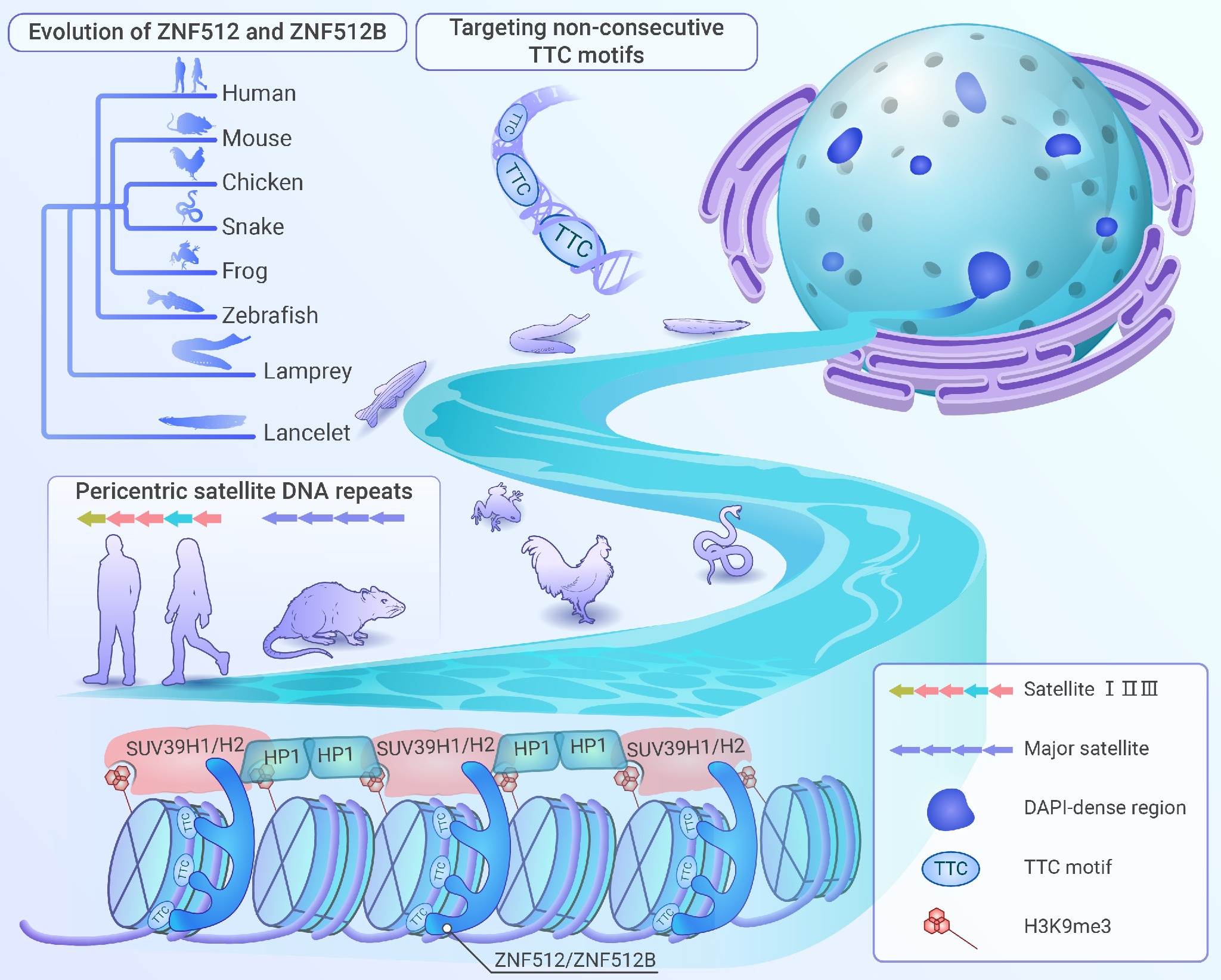
Figure 1.
ZNF512 and ZNF512B, conserved among vertebrates, recognize non-consecutive TTC sequences in pericentric heterochromatin and recruit histone H3K9 methyltransferase SUV39H1/SUV39H2, leading to the establishment of constitutive heterochromatin. Despite the divergence of pericentric satellite DNA repeats, the non-consecutive TTC motifs remain conserved.
