
Crop-livestock integration: Implications for food security, resource efficiency and greenhouse gas mitigation
-

-
REFERENCES
[1] Van Dijk, M., Morley, T., Rau, M.L., et al. (2021). A meta-analysis of projected global food demand and population at risk of hunger for the period 2010–2050. Nat. Food 2: 494−501. DOI: 10.1038/s43016-021-00322-9. [2] Paul, B. K., Epper, C. A., Tschopp, et al. (2022). Crop-livestock integration provides opportunities to mitigate environmental trade-offs in transitioning smallholder agricultural systems of the Greater Mekong Subregion. Agric. Syst. 195: 103285. DOI: 10.1016/j.agsy.2021.103285. [3] Bonetti, J.D.A., Paulino, H.B., Souza, E.D.D., et al. (2018). Soil physical and biological properties in an integrated crop-livestock system in the Brazilian Cerrado. Pesq. Agropec. Bras. 53: 1239−1247. DOI: 10.1590/s0100-204x2018001100006. [4] Xu, X., Xu, Y., Li, J., et al. (2023). Coupling of crop and livestock production can reduce the agricultural GHG emission from smallholder farms. iScience 26: 106798. DOI: 10.1016/j.isci.2023.106798. [5] Wei, Z., Ying, H., Guo, X., et al. (2020). Substitution of mineral fertilizer with organic fertilizer in maize systems: A meta-analysis of reduced nitrogen and carbon emissions. Agronomy 10: 1149. DOI: 10.3390/agronomy10081149. -
ABOUT THIS ARTICLE
Cite this article:
Wang M., Wan D., Xie X., et al., (2024). Crop-livestock integration: Implications for food security, resource efficiency and greenhouse gas mitigation. The Innovation Life 2(4): 100103. https://doi.org/10.59717/j.xinn-life.2024.100103
Welcome!
To request copyright permission to republish or share portions of our works, please visit Copyright Clearance Center's (CCC) Marketplace website at marketplace.copyright.com.
Export File
Citation
Wang M., Wan D., Xie X., et al., (2024). Crop-livestock integration: Implications for food security, resource efficiency and greenhouse gas mitigation. The Innovation Life 2(4): 100103. https://doi.org/10.59717/j.xinn-life.2024.100103

Format
Content
 DownLoad:
-
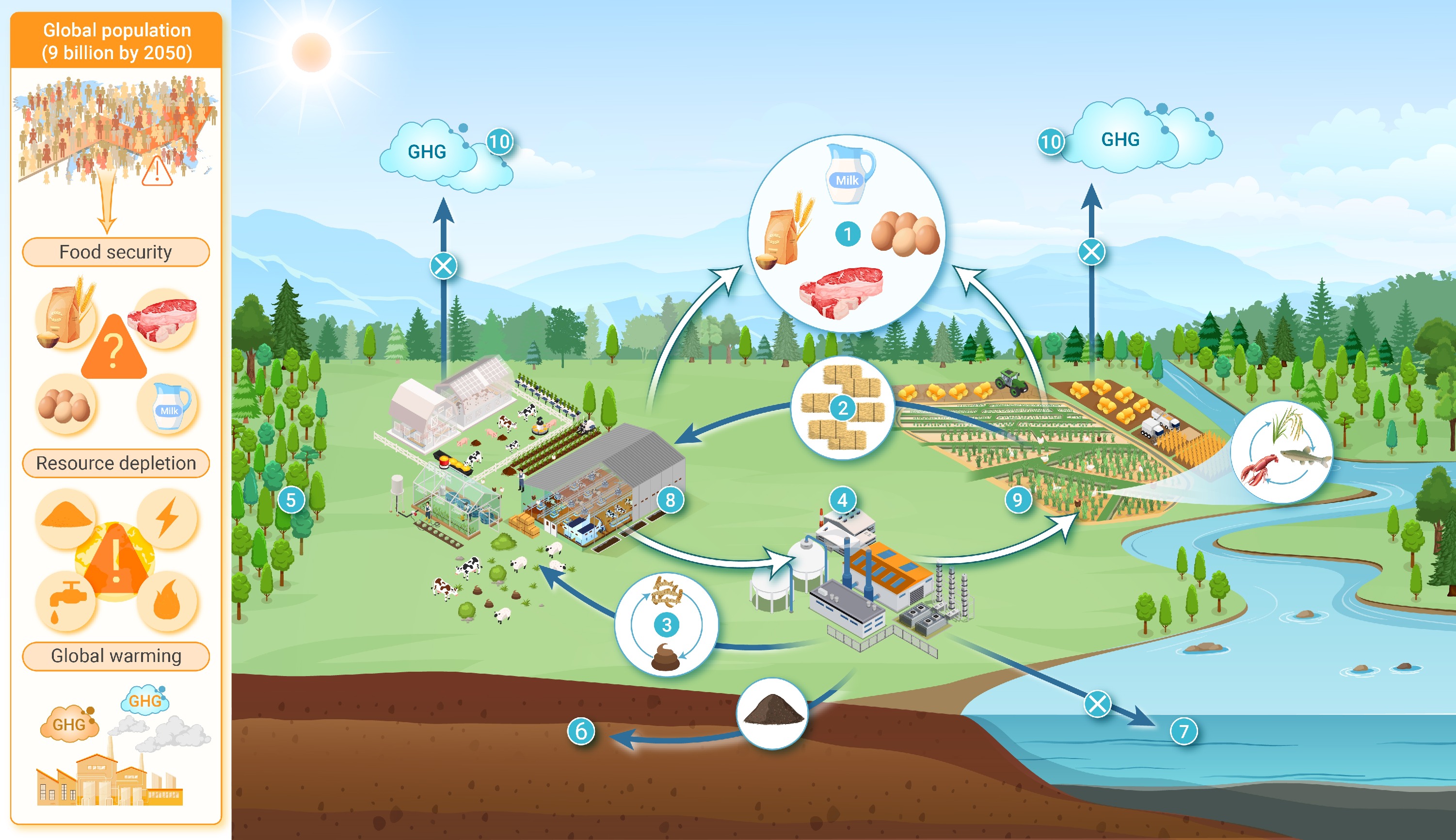
Figure 1.
Overview of crop-livestock integration for food security, resource efficiency and greenhouse gas mitigation
