
-

-
REFERENCES
[1] Liu S.R., Yang Y.J. and Wang H. (2018). Development strategy and management countermeasures of planted forests in China: Transforming from timber-centered single objective management towards multi-purpose management for enhancing quality and benefits of ecosystem services. Acta Ecol. Sin. 38 :1-10. DOI:10.5846/stxb201712072201 [2] Liu X.M., Wang C., Gao J.X., et al. (2023). Approaches to carbon sequestration enhancement in China’s plantation ecosystem for carbon peaking and carbon neutrality goals. Acta Ecol. Sin. 43 :5662-5673. DOI:10.5846/stxb202206221770 [3] Ren H., Gao L., Hui D.F., et al. (2024). Converting farmlands to forests or forests to farmlands? Biol.Diversity 1 :54-57. DOI:10.1002/bod2.12015 [4] Corlett R. (2016). Restoration, reintroduction, and rewilding in a changing world. Trends Ecol. Evol. 31 :453-462. DOI: 10.1016/j.tree.2016.02.017 [5] Yang R. and Cao Y. (2019). Rewilding: New ideas for ecological protection and restoration projects of mountains-rivers-forests-farmlands-lakes-grasslands. Acta Ecol. Sin. 39 :8763-8770. DOI:10.5846/stxb201907301612 -
ABOUT THIS ARTICLE
Cite this article:
Ren H., Corlett R., Hui D. et al. (2025). Rewilding artificial forests in China and the world. The Innovation Life 3:100113. https://doi.org/10.59717/j.xinn-life.2024.100113
Welcome!
To request copyright permission to republish or share portions of our works, please visit Copyright Clearance Center's (CCC) Marketplace website at marketplace.copyright.com.
Export File
Citation
Ren H., Corlett R., Hui D. et al. (2025). Rewilding artificial forests in China and the world. The Innovation Life 3:100113. https://doi.org/10.59717/j.xinn-life.2024.100113

Format
Content
 DownLoad:
-
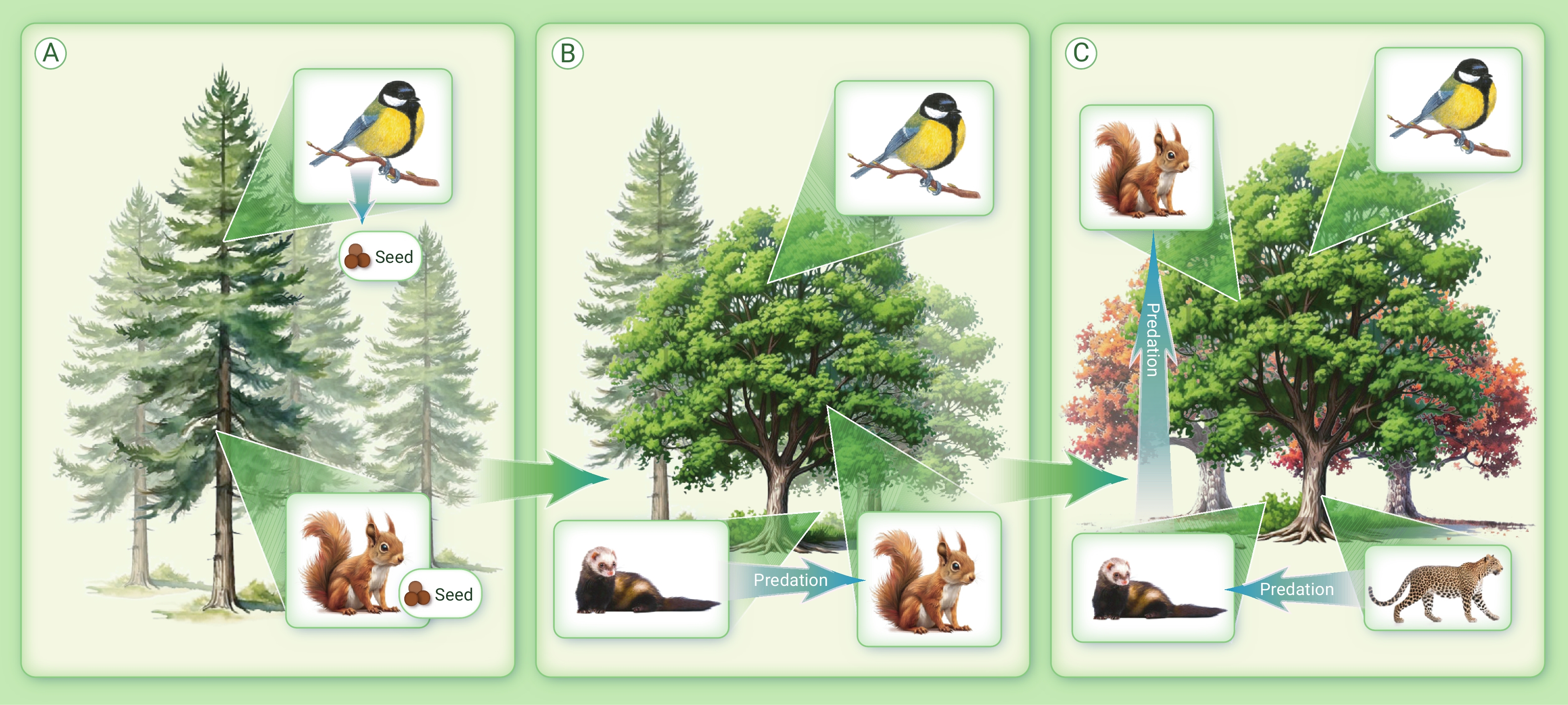
Figure 1.
The number of plant and animal species gradually increases during rewilding artificial forests.
