
Many birds with one stone: When bioremediation meets synthetic biology
-

-
REFERENCES
[1] Huynh, B.Q., Kwong, L.H., Kiang, M.V., et al. (2021). Public health impacts of an imminent red sea oil spill. Nat. Sustain. 4:1084−1091. DOI:10.1038/s41893-021-00774-8 [2] Dvořák, P. Nikel, P.I., Damborský, J., et al. (2017). Bioremediation 3.0: Engineering pollutant-removing bacteria in the times of systemic biology. Biotechnol. Adv. 35:845-866. DOI:10.1016/j.biotechadv.2017.08.001. [3] Cong, S. Cui, H., Wang, W. et al. (2025). Bioremediation of complex organic pollutants by engineered Vibrio natriegens. Nature DOI:10.1038/s41586-025-08947-7. [4] Liu, H. Zhang, L., Wang, W., et al. (2023). An intelligent synthetic bacterium for chronological toxicant detection, biodegradation, and its subsequent suicide. Adv. Sci. 10:2304318. DOI:10.1002/advs.202304318 [5] Lu, Q., Liang, Q. and Wang, S. (2024). Burning question: Rethinking organohalide degradation strategy for bioremediation applications. Microb. Biotechnol. 17:e14539 . DOI:10.1111/1751-7915.14539 -
ABOUT THIS ARTICLE
Cite this article:
Cui H., Su C., Wang W., et al. (2025). Many birds with one stone: When bioremediation meets synthetic biology. The Innovation Life 3:100136. https://doi.org/10.59717/j.xinn-life.2025.100136
Welcome!
To request copyright permission to republish or share portions of our works, please visit Copyright Clearance Center's (CCC) Marketplace website at marketplace.copyright.com.
Export File
Citation
Cui H., Su C., Wang W., et al. (2025). Many birds with one stone: When bioremediation meets synthetic biology. The Innovation Life 3:100136. https://doi.org/10.59717/j.xinn-life.2025.100136

Format
Content
 DownLoad:
-
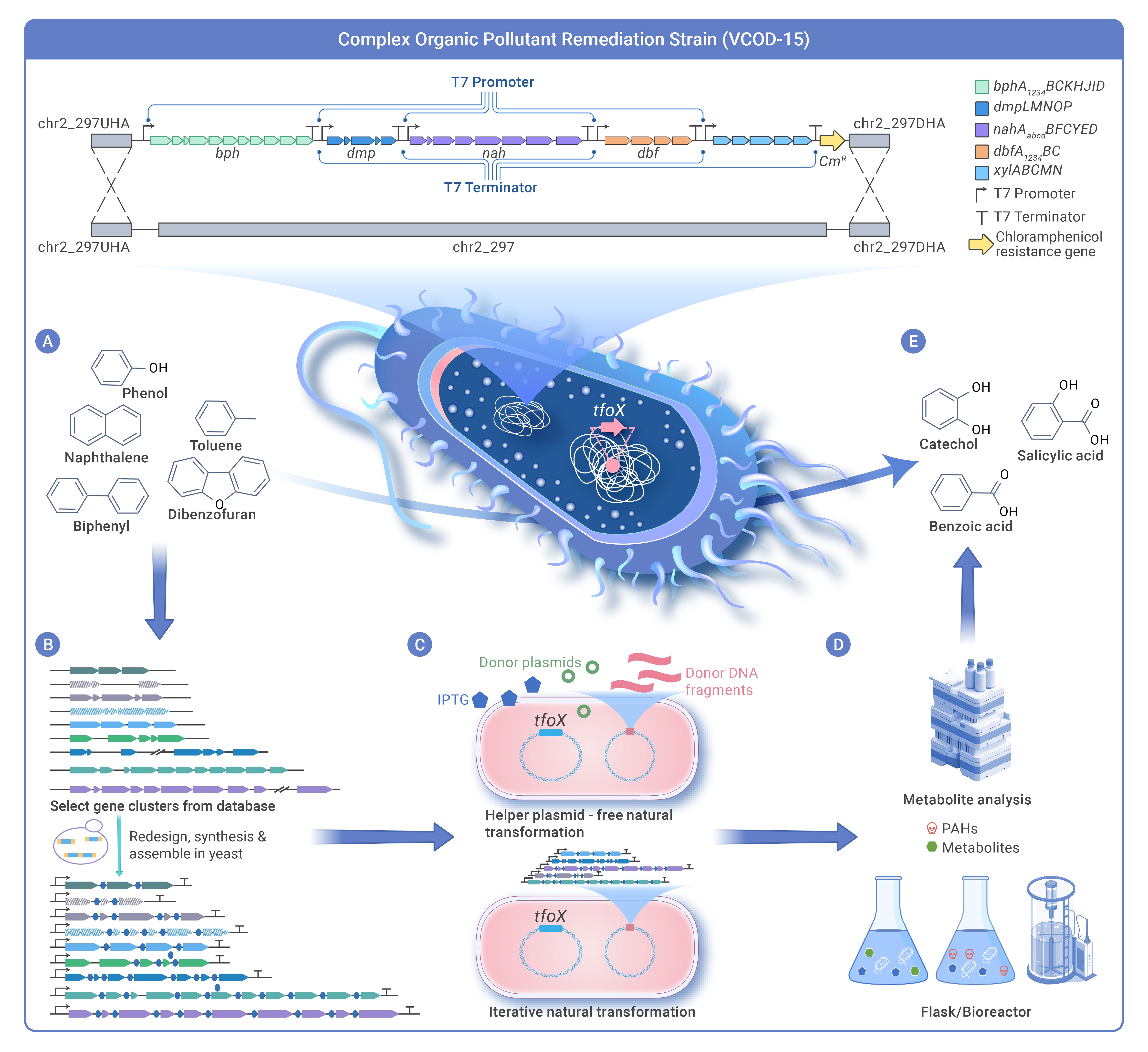
Figure 1.
Schematic for development of complex organic pollutant remediation strain (VCOD-15) construction
