
Ovarian extracellular matrix hydrogel microspheres increase the efficacy of stem cell treatment in premature ovarian insufficiency
-
GRAPHICAL ABSTRACT

 DownLoad:
Full size image
DownLoad:
Full size image
-
PUBLIC SUMMARY
-
Ovarian-ECM hydrogel microspheres serve as an effective carrier for BMSCs delivery.
OG-HMPs enhance BMSCs proliferation and paracrine effects in vitro.
OG-HMPs prolong BMSCs retention time in ovaries.
OG-HMPs@BMSCs restore estrous cycles and reproductive outcomes in POI mice.
-
-
ABSTRACT
Premature ovarian insufficiency (POI) affects approximately 1-2% of reproductive-aged women, significantly impacting their reproductive potential and systemic health. Stem cell-based therapy has demonstrated promising therapeutic efficacy in restoring ovarian function through promoting neovascularization, attenuating fibrosis, and suppressing ovarian cell apoptosis. However, conventional cell transplantation approaches are limited by poor cell viability and retention. Here, we developed a novel therapeutic strategy utilizing hydrogel microspheres (OG-HMPs) fabricated from decellularized ovarian extracellular matrix (OECM) and gelatin as delivery vehicles for bone marrow mesenchymal stem cells (BMSCs) to treat POI. OG-HMPs effectively supported BMSCs attachment and proliferation, facilitating the formation of high-density cellular spheroids. The retained ovary-specific bioactive components in OECM recapitulate the native ovarian microenvironment, enhancing cell survival and significantly elevating the expression of angiogenic factors including VEGF and HGF. Moreover, OG-HMPs@BMSCs demonstrate immunomodulatory effects on activated macrophages and cytoprotective properties against chemically-induced granulosa cell apoptosis. In vivo studies using POI mouse models confirmed that OG-HMPs@BMSCs transplantation significantly enhanced BMSCs retention within ovarian tissue and improved both endocrine function, estrous cycle pattern, and reproductive outcomes compared to conventional cell delivery. Collectively, OG-HMPs, exhibiting excellent biocompatibility and biological activity, represent a promising therapeutic platform for POI treatment through enhanced stem cell-mediated tissue regeneration. -

-
REFERENCES
[1] De Vos M., Devroey P. and Fauser B.C. (2010). Primary ovarian insufficiency. Lancet 376:911−921. DOI:10.1016/S0140-6736(10)60355-8 [2] Falsetti L., Scalchi S., Villani M.T., et al. (1999). Premature ovarian failure. Gynecol. Endocrinol. 13:189−195. DOI:10.3109/09513599909167554 [3] Cao C., Pei W., Zhou P., et al., (2024). GNAS deficiency is associated with premature ovarian insufficiency phenotype via regulating ovarian steroidogenesis. The Innovation Life 2: 100080. DOI:10.59717/j.xinn-life.2024.100080 [4] Chernyshov V.P., Radysh T.V., Gura I.V., et al. (2001). Immune Disorders in Women with Premature Ovarian Failure in Initial Period. Am. J. Reprod. Immunol. 46:220−5. DOI:10.1034/j.1600-0897.2001.d01-5.x [5] Deng T., He J., Yao Q., et al. (2021). Human Umbilical Cord Mesenchymal Stem Cells Improve Ovarian Function in Chemotherapy-Induced Premature Ovarian Failure Mice Through Inhibiting Apoptosis and Inflammation via a Paracrine Mechanism. Reprod. Sci. 28:1718−32. DOI:10.1007/s43032-021-00499-1 [6] Kapoor E. (2023). Premature Ovarian Insufficiency. Curr. Opin. Endocr. Metab. Res. 28:100435. DOI:10.1016/j.coemr.2023.100435 [7] Zhang S., Zhu D., Li Z., et al. (2021). A stem cell-derived ovarian regenerative patch restores ovarian function and rescues fertility in rats with primary ovarian insufficiency. Theranostics 11:8894−908. DOI:10.7150/thno.61690 [8] Takahashi A., Yousif A., Hong L., et al. (2021). Premature ovarian insufficiency: pathogenesis and therapeutic potential of mesenchymal stem cell. J. Mol. Med. 99:637−50. DOI:10.1007/s00109-021-02055-5 [9] Na J. and Kim G.J. (2020). Recent trends in stem cell therapy for premature ovarian insufficiency and its therapeutic potential: a review. J. Ovarian Res. 13:74. DOI:10.1186/s13048-020-00671-2 [10] Wang J., Liu W., Yu D., et al. (2021). Research Progress on the Treatment of Premature Ovarian Failure Using Mesenchymal Stem Cells: A Literature Review. Front. Cell Dev. Biol. 9:749822. DOI:10.3389/fcell.2021.749822 [11] Sun B., Ma Y., Wang F., et al. (2019). miR-644-5p carried by bone mesenchymal stem cell-derived exosomes targets regulation of p53 to inhibit ovarian granulosa cell apoptosis. Stem Cell Res. Ther. 10:360. DOI:10.1186/s13287-019-1442-3 [12] Ran X., Wang Q., Sun Y., et al. (2024). Dual microparticles programmed delivery system regulating stem cell-based cartilage regeneration by cartilage-specific matrix hydrogels. Compos. Part B: Eng. 272:111221. DOI:10.1016/j.compositesb.2024.111221 [13] Fu X., He Y., Xie C., et al. (2008). Bone marrow mesenchymal stem cell transplantation improves ovarian function and structure in rats with chemotherapy-induced ovarian damage. Cytotherapy 10:353−363. DOI:10.1080/14653240802035926 [14] N K., Hr S., M M., et al. (2018). Effect of transplantation of bone marrow stromal cell-conditioned medium on ovarian function, morphology and cell death in cyclophosphamide-treated rats. Cell J. 20:10−18. DOI:10.22074/cellj.2018.4919 [15] Fischer U.M., Harting M.T., Jimenez F., et al. (2009). Pulmonary passage is a major obstacle for intravenous stem cell delivery: the pulmonary first-pass effect. Stem Cells Dev. 18:683−691. DOI:10.1089/scd.2008.0253 [16] Wang L., Mei Q., Xie Q., et al. (2022). A comparative study of mesenchymal stem cells transplantation approach to antagonize age-associated ovarian hypofunction with consideration of safety and efficiency. J. Adv. Res. 38:245−259. DOI:10.1016/j.jare.2021.09.001 [17] Laronda M.M., Rutz A.L., Xiao S., et al. (2017). A bioprosthetic ovary created using 3D printed microporous scaffolds restores ovarian function in sterilized mice. Nat. Commun. 8:1−10. DOI:10.1038/ncomms15261 [18] Taraballi F., Sushnitha M., Tsao C., et al. (2018). Biomimetic tissue engineering: tuning the immune and inflammatory response to implantable biomaterials. Adv. Healthc. Mater. 7:1800490. DOI:10.1002/adhm.201800490 [19] Que R., Mohraz A., Da Silva N.A., et al. (2014). Expanding functionality of recombinant human collagen through engineered non-native cysteines. Biomacromolecules 15:3540−3549. DOI:10.1021/bm500735d [20] Chen Y., Chen L.-F., Wang Y., et al. (2025). Engineered dECM-based microsystem promotes cartilage regeneration in osteoarthritis by synergistically enhancing chondrogenesis of BMSCs and anti-inflammatory effect. Compos. Part B: Eng. 290:111974. DOI:10.1016/j.compositesb.2024.111974 [21] Yuan X., Wei Y., Villasante A., et al. (2017). Stem cell delivery in tissue-specific hydrogel enabled meniscal repair in an orthotopic rat model. Biomaterials 132:59−71. DOI:10.1016/j.biomaterials.2017.04.004 [22] Rao N., Agmon G., Tierney M.T., et al. (2017). Engineering an injectable muscle-specific microenvironment for improved cell delivery using a nanofibrous extracellular matrix hydrogel. ACS Nano 11:3851−3859. DOI:10.1021/acsnano.7b00093 [23] Wu T., Huang K.-C., Yan J.-F., et al. (2023). Extracellular matrix-derived scaffolds in constructing artificial ovaries for ovarian failure: a systematic methodological review. Hum. Reprod. Open 2023:hoad014. DOI:10.1093/hropen/hoad014 [24] Zhao Z., Wang Z., Li G., et al. (2021). Injectable microfluidic hydrogel microspheres for cell and drug delivery. Adv. Funct. Mater. 2103339:1−24. DOI:10.1002/adfm.202103339 [25] Wang S., Wang Z., Shen Z., et al. (2024). Magnetic soft microrobots for erectile dysfunction therapy. Proc. Natl. Acad. Sci. USA 121:e2407809121. DOI:10.1073/pnas.2407809121 [26] An G., Guo F., Liu X., et al. (2020). Functional reconstruction of injured corpus cavernosa using 3D-printed hydrogel scaffolds seeded with HIF-1α-expressing stem cells. Nat. Commun. 11:2687. DOI:10.1038/s41467-020-16192-x [27] Francés-Herrero E., Lopez R., Campo H., et al. (2023). Advances of xenogeneic ovarian extracellular matrix hydrogels for in vitro follicle development and oocyte maturation. Biomater. Adv. 151:213480. DOI:10.1016/j.bioadv.2023.213480 [28] Li Y., Zhang H., Cai C., et al. (2024). Microfluidic encapsulation of exosomes derived from lipopolysaccharide-treated mesenchymal stem cells in hyaluronic acid methacryloyl to restore ovarian function in mice. Adv. Healthc. Mater. 13:2303068. DOI:10.1002/adhm.202303068 [29] Liu X., Chen Y., Mao A.S., et al. (2020). Molecular recognition-directed site-specific release of stem cell differentiation inducers for enhanced joint repair. Biomaterials 232:119644. DOI:10.1016/j.biomaterials.2019.119644 [30] Wang Z., An G., Zhu Y., et al. (2019). 3D-printable self-healing and mechanically reinforced hydrogels with host-guest non-covalent interactions integrated into covalently linked networks. Mater. Horiz. 6:733−742. DOI:10.1039/c8mh01208c [31] Zhang W., Chen J., Tao J., et al. (2013). The use of type 1 collagen scaffold containing stromal cell-derived factor-1 to create a matrix environment conducive to partial-thickness cartilage defects repair. Biomaterials 34:713−723. DOI:10.1016/j.biomaterials.2012.10.027 [32] Kulus J., Kulus M., Kranc W., et al. (2021). Transcriptomic profile of new gene markers encoding proteins responsible for structure of porcine ovarian granulosa cells. Biology (Basel) 10:1214. DOI:10.3390/biology10111214 [33] Mantri M., Zhang H.H., Spanos E., et al. (2024). A spatiotemporal molecular atlas of the ovulating mouse ovary. Proc. Natl. Acad. Sci. USA 121:e2317418121. DOI:10.1073/pnas.2317418121 [34] Crapo P.M., Gilbert T.W., Badylak S.F. (2011). An overview of tissue and whole organ decellularization processes. Biomaterials 32:3233−3243. DOI:10.1016/j.biomaterials.2011.01.057 [35] Kennelly H., Mahon B.P., English K. (2016). Human mesenchymal stromal cells exert HGF dependent cytoprotective effects in a human relevant pre-clinical model of COPD. Sci. Rep. 6:38207. DOI:10.1038/srep38207 [36] Chang H.-K., Kim P.-H., Kim D.W., et al. (2018). Coronary stents with inducible VEGF/HGF-secreting UCB-MSCs reduced restenosis and increased re-endothelialization in a swine model. Exp. Mol. Med. 50:1−14. DOI:10.1038/s12276-018-0143-9 [37] Chi A., Yang B., Dai H., et al. (2024). Stem Leydig cells support macrophage immunological homeostasis through mitochondrial transfer in mice. Nat. Commun. 15:2120. DOI:10.1038/s41467-024-46190-2 [38] Saraiva M. and O’Garra A. (2010). The regulation of IL-10 production by immune cells. Nat. Rev. Immunol. 10:170−181. DOI:10.1038/nri2711 [39] Huang Y., Zhu M., Liu Z., et al. (2022). Bone marrow mesenchymal stem cells in premature ovarian failure: mechanisms and prospects. Front. Immunol. 13:997808. DOI:10.3389/fimmu.2022.997808 [40] Ding C., Zou Q., Wang F., et al. (2018). Human amniotic mesenchymal stem cells improve ovarian function in natural aging through secreting hepatocyte growth factor and epidermal growth factor. Stem Cell Res. Ther. 9:55. DOI:10.1186/s13287-018-0781-9 [41] Zhou Y., Zhou J., Xu X., et al. (2021). Matrigel/umbilical cord-derived mesenchymal stem cells promote granulosa cell proliferation and ovarian vascularization in a mouse model of premature ovarian failure. Stem Cells Dev. 30:782−796. DOI:10.1089/scd.2021.0005 [42] Ma M., Wang H., Zhang Y., et al. (2021). circRNA-mediated inhibin–activin balance regulation in ovarian granulosa cell apoptosis and follicular atresia. Int. J. Mol. Sci. 22:9113. DOI:10.3390/ijms22179113 [43] Chiti M.-C., Vanacker J., Ouni E., et al. (2022). Ovarian extracellular matrix-based hydrogel for human ovarian follicle survival in vivo: a pilot work. J. Biomed. Mater. Res. B 110:1012−1022. DOI:10.1002/jbm.b.34974 [44] Yi X., Liu F., Gao K., et al. (2022). Reconstructable uterus‐derived materials for uterus recovery toward efficient live births. Adv. Mater. 34:2106510. DOI:10.1002/adma.202106510 [45] Chiti M.-C., Vanacker J., Ouni E., et al. (2022). Ovarian extracellular matrix‐based hydrogel for human ovarian follicle survival in vivo: a pilot work. J. Biomed. Mater. Res. B 110:1012−1022. DOI:10.1002/jbm.b.34974 -
ABOUT THIS ARTICLE
Cite this article:
Liu X., Chen M., Liang X., et al. (2025). Ovarian extracellular matrix hydrogel microspheres increase the efficacy of stem cell treatment in premature ovarian insufficiency. The Innovation Life 3:100147. https://doi.org/10.59717/j.xinn-life.2025.100147
Welcome!
To request copyright permission to republish or share portions of our works, please visit Copyright Clearance Center's (CCC) Marketplace website at marketplace.copyright.com.

Article Metrics
Relative Articles
Cited by
Export File
Citation
Liu X., Chen M., Liang X., et al. (2025). Ovarian extracellular matrix hydrogel microspheres increase the efficacy of stem cell treatment in premature ovarian insufficiency. The Innovation Life 3:100147. https://doi.org/10.59717/j.xinn-life.2025.100147

Format
Content



-
Figure 1.
Characterization and biocompatibility evaluation of hydrogel microspheres (OG-HMPs)
-
Figure 2.
Growth factor expression and proliferation of BMSCs
-
Figure 3.
OG-HMPs@BMSCs-mediated immunomodulation and cytoprotection of OGCs
-
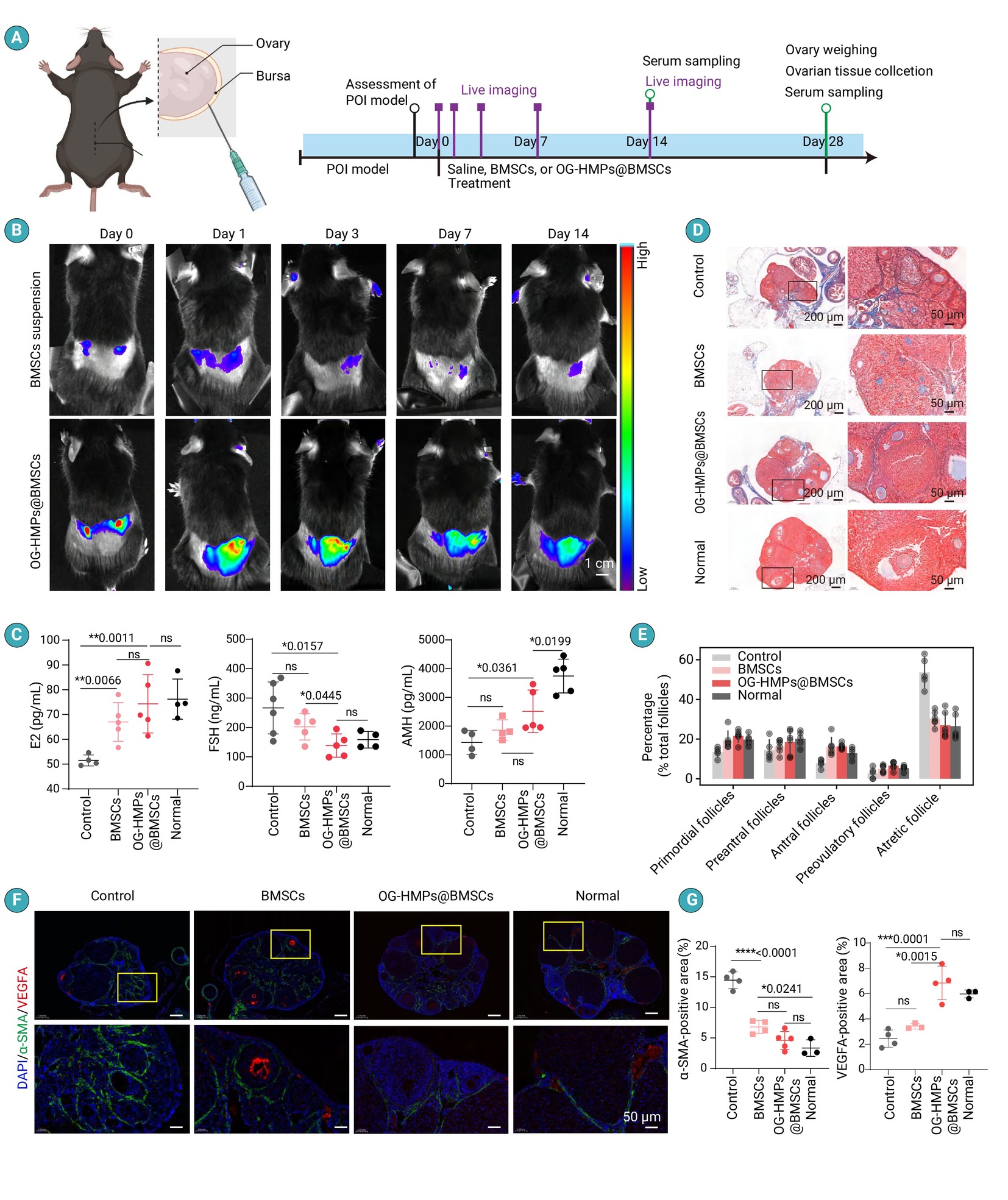
Figure 4.
OG-HMPs delivering BMSCs for POI treatment in mice
-
Figure 5.
Immunofluorescence and histological analysis of ovarian tissue
-
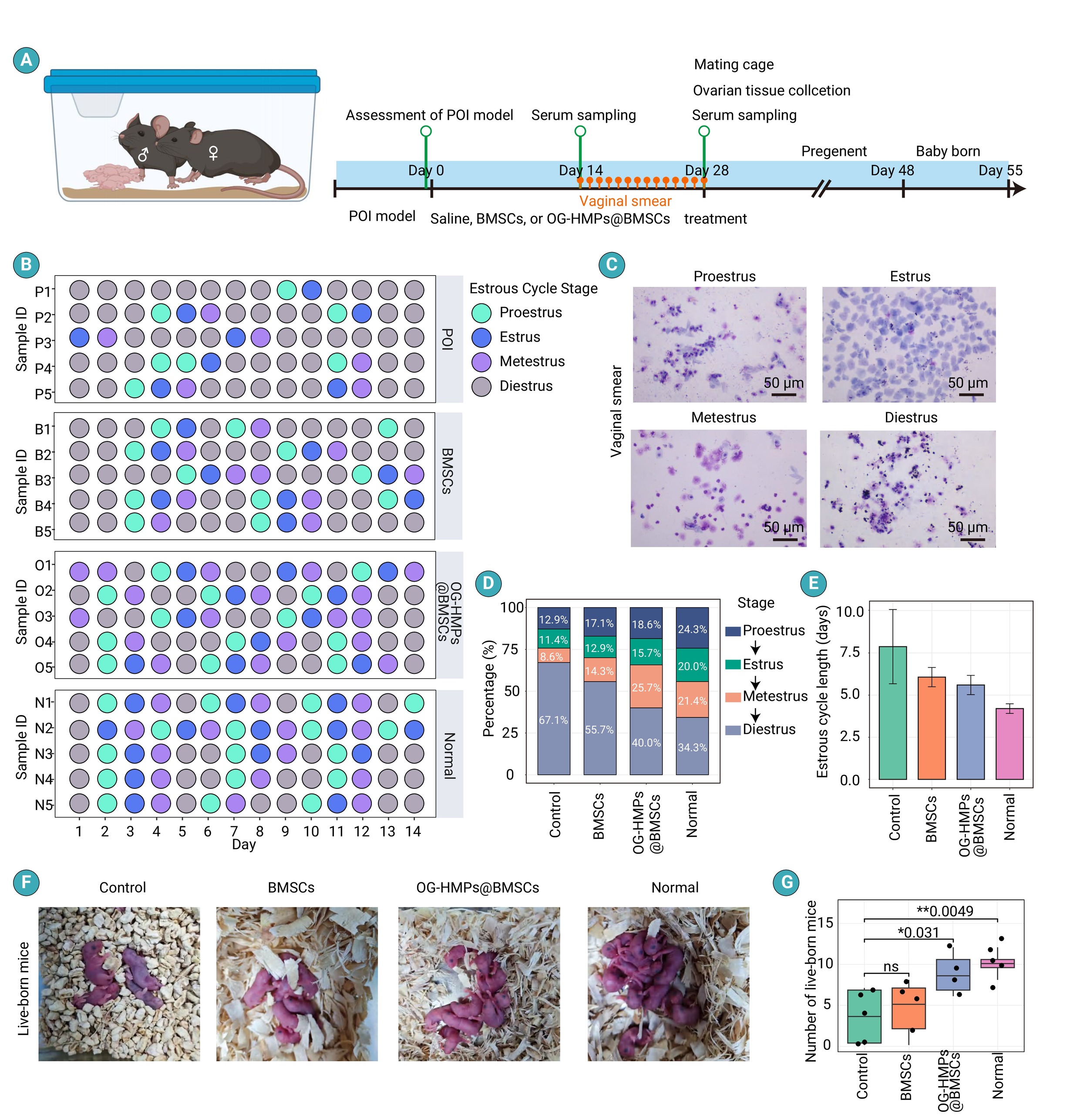
Figure 6.
Assessment of ovarian function and fertility
