
SeekSoul Online: A user-friendly bioinformatics platform focused on single-cell multi-omics analysis
-
GRAPHICAL ABSTRACT
 DownLoad:
Full size image
DownLoad:
Full size image
-
PUBLIC SUMMARY
-
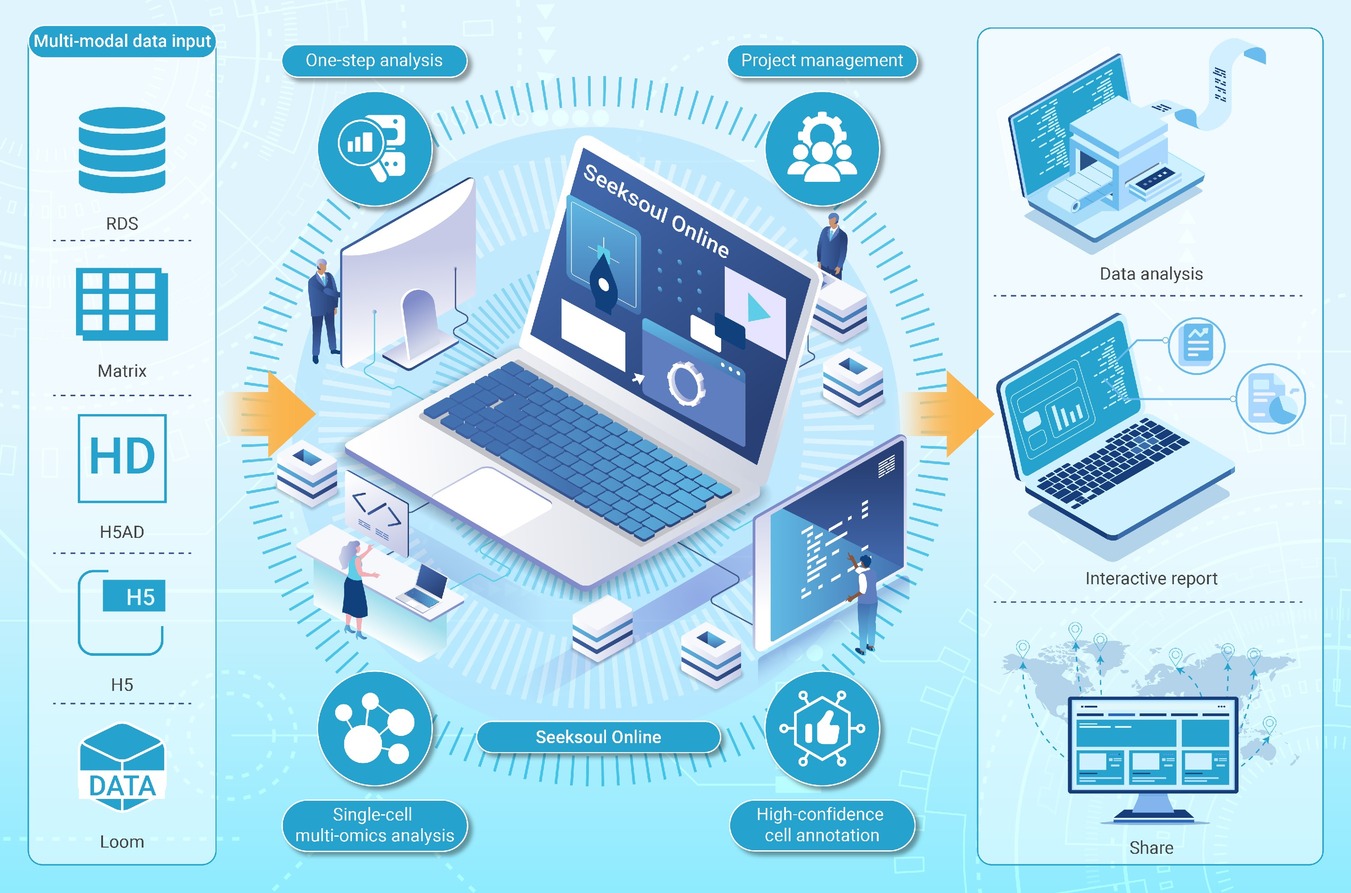
SeekSoul Online supports the complete analysis process for scRNA, scTCR/BCR, and SeekSpace data.
It provides a simple interface for manipulating, and visualising analysis to help users achieve efficient data analysis.
The platform significantly improves the accuracy of cell-type annotation by high-quality reference sets and AI.
It supports privilege management and multi-user collaborative analysis for cooperation and knowledge sharing.
-
-
ABSTRACT
The rapid advancement of single-cell technologies has brought revolutionary progress in biology, medicine, and drug development. However, the sheer volume of data and the complexity of analysis methods often pose a significant challenge for researchers lacking programming skills. To address this problem, we developed SeekSoul Online (https://seeksoul.online/index.html#/login), a comprehensive platform for single-cell multi-omics data analysis and interactive visualisation that requires no programming foundation. Designed with a user-friendly interface, the platform combines modular architecture and powerful computational capabilities to support the complete analysis process of single-cell transcriptome, single-cell immune repertoire data, and SeekSpace single-cell spatial transcriptome data. The platform achieves accurate cell type identification through self-constructed high-quality reference sets and artificial intelligence technology. In addition, SeekSoul Online offers interactive data analysis and report generation, allowing users to adjust analysis parameters in real time and generate analysis reports for communication. The platform also provides comprehensive project management and sharing functions to facilitate collaboration and knowledge sharing among research teams. With automated data processing workflows and an intuitive user interface, SeekSoul Online significantly enhances the convenience and efficiency of data analysis, allowing researchers to focus more on scientific discovery and accelerating research progress. -

-
REFERENCES
[1] Rebuffet L., Melsen J.E., Escaliere B., et al. (2024). High-dimensional single-cell analysis of human natural killer cell heterogeneity. Nat. Immunol. 25:1474−1488. DOI:10.1038/s41590-024-01883-0 [2] Chen X., Huang Y., Huang L., et al. (2024). A brain cell atlas integrating single-cell transcriptomes across human brain regions. Nat. Med. 30:2679−2691. DOI:10.1038/s41591-024-03150-z [3] Thomas T., Friedrich M., Rich-Griffin C., et al. (2024). A longitudinal single-cell atlas of anti-tumour necrosis factor treatment in inflammatory bowel disease. Nat. Immunol. 25:2152−2165. DOI:10.1038/s41590-024-01994-8 [4] Zhang H., Wang T., Gong H., et al. (2023). A novel molecular classification method for osteosarcoma based on tumor cell differentiation trajectories. Bone Res. 11:1. DOI:10.1038/s41413-022-00233-w [5] Zhang P., Wang X., Cen X., et al. (2025). A deep learning framework for in silico screening of anticancer drugs at the single-cell level. Natl. Sci. Rev. 12:nwae451. DOI:10.1093/nsr/nwae451 [6] Peng L., Hu Y., Mankowski M.C., et al. (2022). Monospecific and bispecific monoclonal SARS-CoV-2 neutralizing antibodies that maintain potency against B.1.617. Nat. Commun. 13:1638. DOI: 10.1038/s41467-022-29288-3 [7] Erfanian N., Heydari A.A., Feriz A.M., et al. (2023). Deep learning applications in single-cell genomics and transcriptomics data analysis. Biomed. Pharmacother. 165:115077. DOI:10.1016/j.biopha.2023.115077 [8] Huang S. (2023). Efficient analysis of toxicity and mechanisms of environmental pollutants with network toxicology and molecular docking strategy: Acetyl tributyl citrate as an example. Sci. Total Environ. 905:167904. DOI:10.1016/j.scitotenv.2023.167904 [9] Mu H., Chen J., Huang W., et al. (2024). OmicShare tools: A zero-code interactive online platform for biological data analysis and visualization. iMeta 3:e228. DOI:10.1002/imt2.228 [10] Wang X., Pei Z., Hao T., et al. (2022). Prognostic analysis and validation of diagnostic marker genes in patients with osteoporosis. Front. Immunol. 13:987937. DOI:10.3389/fimmu.2022.987937 [11] Sherman B.T., Hao M., Qiu J., et al. (2022). DAVID: A web server for functional enrichment analysis and functional annotation of gene lists (2021 update). Nucleic Acids Res. 50:W216−W221. DOI:10.1093/nar/gkac194 [12] Tang Z., Kang B., Li C., et al. (2019). GEPIA2: An enhanced web server for large-scale expression profiling and interactive analysis. Nucleic Acids Res. 47:W556−W560. DOI:10.1093/nar/gkz430 [13] Xie C., Mao X., Huang J., et al. (2011). KOBAS 2.0: A web server for annotation and identification of enriched pathways and diseases. Nucleic Acids Res. 39:W316-322. DOI: 10.1093/nar/gkr483 [14] Efremova M., Vento-Tormo M., Teichmann, et al. (2020). CellPhoneDB: Inferring cell-cell communication from combined expression of multi-subunit ligand-receptor complexes. Nat. Protoc. 15:1484−1506. DOI:10.1038/s41596-020-0292-x [15] Jin S., Guerrero-Juarez C.F., Zhang L., et al. (2021). Inference and analysis of cell-cell communication using CellChat. Nat. Commun. 12:1088. DOI:10.1038/s41467-021-21246-9 [16] Browaeys R., Saelens W., and Saeys Y. (2020). NicheNet: Modeling intercellular communication by linking ligands to target genes. Nat. Methods 17:159−162. DOI:10.1038/s41592-019-0667-5 [17] Kumar N., Mishra B., Athar M., et al. (2021). Inference of Gene Regulatory Network from Single-Cell Transcriptomic Data Using pySCENIC. Methods Mol. Biol. 2328:171−182. DOI:10.1007/978-1-0716-1534-8_10 [18] Gao R., Bai S., Henderson Y.C., et al. (2021). Delineating copy number and clonal substructure in human tumors from single-cell transcriptomes. Nat. Biotechnol. 39:599−608. DOI:10.1038/s41587-020-00795-2 [19] Patel A.P., Tirosh I., Trombetta J.J., et al. (2014). Single-cell RNA-seq highlights intratumoral heterogeneity in primary glioblastoma. Science 344:1396−1401. DOI:10.1126/science.1254257 [20] Bergen V., Lange M., Peidli S., et al. (2020). Generalizing RNA velocity to transient cell states through dynamical modeling. Nat. Biotechnol. 38:1408−1414. DOI:10.1038/s41587-020-0591-3 [21] Qiu X., Mao Q., Tang Y., et al. (2017). Reversed graph embedding resolves complex single-cell trajectories. Nat. Methods 14:979−982. DOI:10.1038/nmeth.4402 [22] Kapil G., Agrawal A., Attaallah A., et al. (2020). Attribute based honey encryption algorithm for securing big data: Hadoop distributed file system perspective. PeerJ Comput. Sci. 6:e259. DOI:10.7717/peerj-cs.259 [23] Saurabh S., Young-Sik J., and Jonghyuk P. (2016). A survey on cloud computing security: Issues, threats, and solutions. J Netw Comput Appl 75:200−222. DOI:10.1016/j.jnca.2016.09.002 [24] Wu T., Hu E., Xu S., et al. (2021). clusterProfiler 4.0: A universal enrichment tool for interpreting omics data. Innovation (Camb) 2:100141. DOI: 10.1016/j.xinn.2021.100141 [25] Chen G., Ning B., and Shi T. (2019). Single-Cell RNA-Seq Technologies and Related Computational Data Analysis. Front. Genet. 10:317. DOI:10.3389/fgene.2019.00317 [26] Stuart T., Butler A., Hoffman P., et al. (2019). Comprehensive Integration of Single-Cell Data. Cell 177:1888-1902 e1821. DOI: 10.1016/j.cell.2019.05.031 [27] Korsunsky I., Millard N., Fan J., et al. (2019). Fast, sensitive and accurate integration of single-cell data with Harmony. Nat. Methods 16:1289−1296. DOI:10.1038/s41592-019-0619-0 [28] Aran D., Looney A.P., Liu L., et al. (2019). Reference-based analysis of lung single-cell sequencing reveals a transitional profibrotic macrophage. Nat. Immunol. 20:163−172. DOI:10.1038/s41590-018-0276-y [29] Jiang S., Qian Q., Zhu T., et al. (2023). Cell Taxonomy: A curated repository of cell types with multifaceted characterization. Nucleic Acids Res. 51:D853−D860. DOI:10.1093/nar/gkac816 -
ABOUT THIS ARTICLE
Cite this article:
Liu X., Wu C., Pan L., et al. (2025). SeekSoul Online: A user-friendly bioinformatics platform focused on single-cell multi-omics analysis. The Innovation Life 3:100156. https://doi.org/10.59717/j.xinn-life.2025.100156
Welcome!
To request copyright permission to republish or share portions of our works, please visit Copyright Clearance Center's (CCC) Marketplace website at marketplace.copyright.com.

Supplementary Information
-
download_supplementary
Supplemental_Information
Article Metrics
Relative Articles
Cited by
Export File
Citation
Liu X., Wu C., Pan L., et al. (2025). SeekSoul Online: A user-friendly bioinformatics platform focused on single-cell multi-omics analysis. The Innovation Life 3:100156. https://doi.org/10.59717/j.xinn-life.2025.100156

Format
Content



-
Figure 1.
Workflow of one-step analysis for single-cell multi-omics data
-
Figure 2.
SeekSoul Online consists of ten modules for single-cell multi-omics analysis.
-
Figure 3.
Outputs from each analysis module underpinning single-cell multi-omics analysis on SeekSoul Online.
-
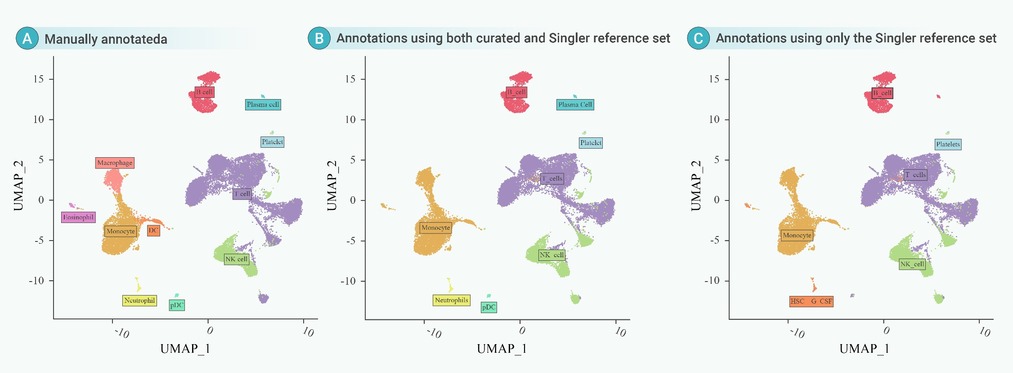
Figure 4.
Higher-accuracy automated cell-type annotation using curated reference sets, with support for manual curation
-
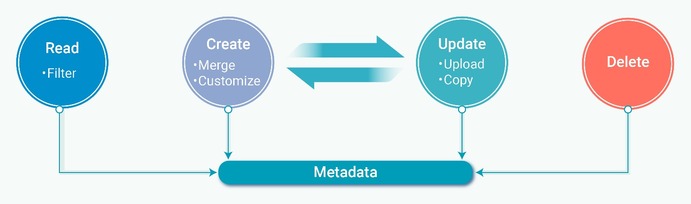
Figure 5.
Free configuration and consolidation of cell labels to improve single-cell analysis.
-
Figure 6.
Oesophageal squamous cell carcinoma (ESCC) case study and spatial examples from SeekSpace data
