
Sugarcane genomics: Origin, evolution, and domestication
-

-
REFERENCES
[1] Healey A. L., Garsmeur O., Lovell J. T., et al. (2024). The complex polyploid genome architecture of sugarcane. Nature 628:804−810. DOI:10.1038/s41586-024-07231-4 [2] Garsmeur O., Rio S., Pompidor N., et al. (2025). The genomic footprints of wild Saccharum species trace domestication, diversification, and modern breeding of sugarcane. Cell 188:1−15. DOI:10.1016/j.cell.2025.09.017 [3] Zhang J., Zhang X., Tang H., et al. (2018). Allele-defined genome of the autopolyploid sugarcane Saccharum spontaneum L. Nat. Genet. 50:1565−1573. DOI:10.1038/s41588-018-0237-2 [4] Klymiuk V., Yaniv E., Huang L., et al. (2018). Cloning of the wheat Yr15 resistance gene sheds light on the plant tandem kinase-pseudokinase family. Nat. Commun. 9:3735. DOI:10.1038/s41467-018-06138-9 [5] Zhu H., Li C., Gao C. (2020). Applications of CRISPR-Cas in agriculture and plant biotechnology. Nat. Rev. Mol. Cell Biol. 21:661−677. DOI:10.1038/s41580-020-00288-9 -
ABOUT THIS ARTICLE
Cite this article:
Zhang Z., Wu Q., Wang D., et al. (2025). Sugarcane genomics: Origin, evolution, and domestication. The Innovation Life 3:100175. https://doi.org/10.59717/j.xinn-life.2025.100175
Welcome!
To request copyright permission to republish or share portions of our works, please visit Copyright Clearance Center's (CCC) Marketplace website at marketplace.copyright.com.
Export File
Citation
Zhang Z., Wu Q., Wang D., et al. (2025). Sugarcane genomics: Origin, evolution, and domestication. The Innovation Life 3:100175. https://doi.org/10.59717/j.xinn-life.2025.100175

Format
Content
 DownLoad:
-
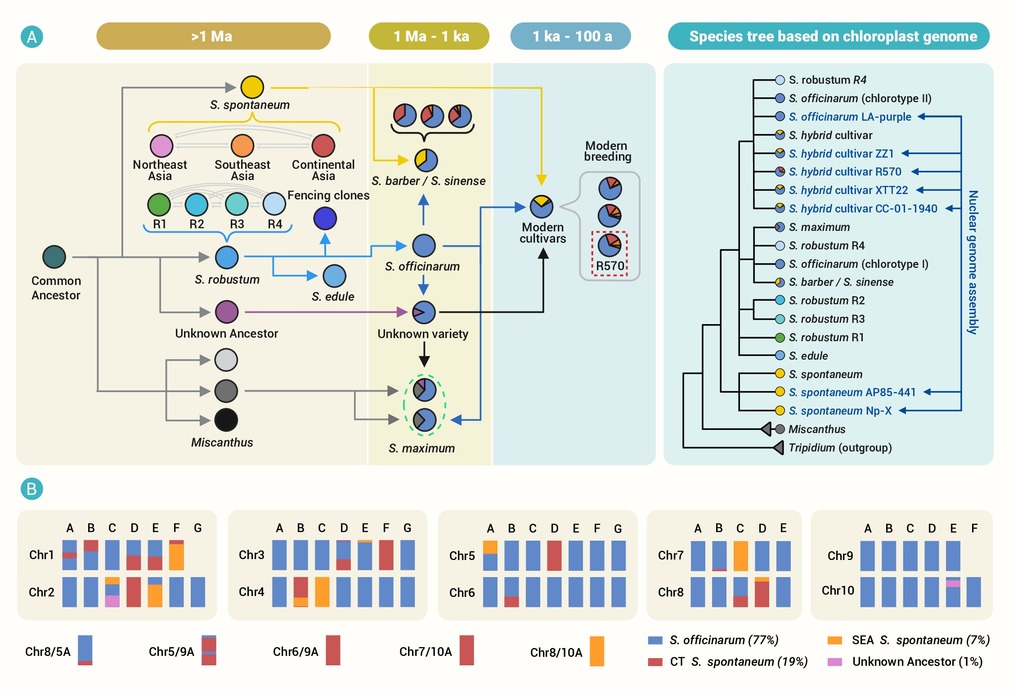
Figure 1.
Genomic insights into the origin and domestication of sugarcane
