
Engineering bacterial biocatalysts via directed evolution to deprive cancer cells of cyst(e)ine
-

-
REFERENCES
[1] Forbes N.S. (2010). Engineering the perfect (bacterial) cancer therapy. Nat. Rev. Cancer 10:785−794. DOI:10.1038/nrc2934 [2] Sznol M., Lin S.L., Bermudes D., et al. (2000). Use of preferentially replicating bacteria for the treatment of cancer. J Clin. Invest. 105:1027−1030. DOI:10.1172/JCI9818 [3] Wang Y.Z., Chen W.H., Han Z.Y., et al. (2025). Targeted tumor therapy with L-cyst(e)ine-addicted bacteria-nanodrug biohybrids. Cell Metab. 37:1277−1293. DOI:10.1016/j.cmet.2025.03.012 [4] Li Y., Li Z., Sun D., et al. (2024). Adaptation to cystine limitation stress promotes PDAC tumor growth and metastasis through translational upregulation of OxPPP. bioRxiv. DOI:10.1101/2024.12.12.628246 [5] Dixon S.J., Patel D.N., Welsch M., et al. (2014). Pharmacological inhibition of cystine-glutamate exchange induces endoplasmic reticulum stress and ferroptosis. Elife 3:e02523. DOI:10.7554/eLife.02523 -
ABOUT THIS ARTICLE
Cite this article:
Li Y., Li Q., Tan M., et al. (2026). Engineering bacterial biocatalysts via directed evolution to deprive cancer cells of cyst(e)ine. The Innovation Life 4:100189. https://doi.org/10.59717/j.xinn-life.2026.100189
Welcome!
To request copyright permission to republish or share portions of our works, please visit Copyright Clearance Center's (CCC) Marketplace website at marketplace.copyright.com.
Export File
Citation
Li Y., Li Q., Tan M., et al. (2026). Engineering bacterial biocatalysts via directed evolution to deprive cancer cells of cyst(e)ine. The Innovation Life 4:100189. https://doi.org/10.59717/j.xinn-life.2026.100189

Format
Content
 DownLoad:
-
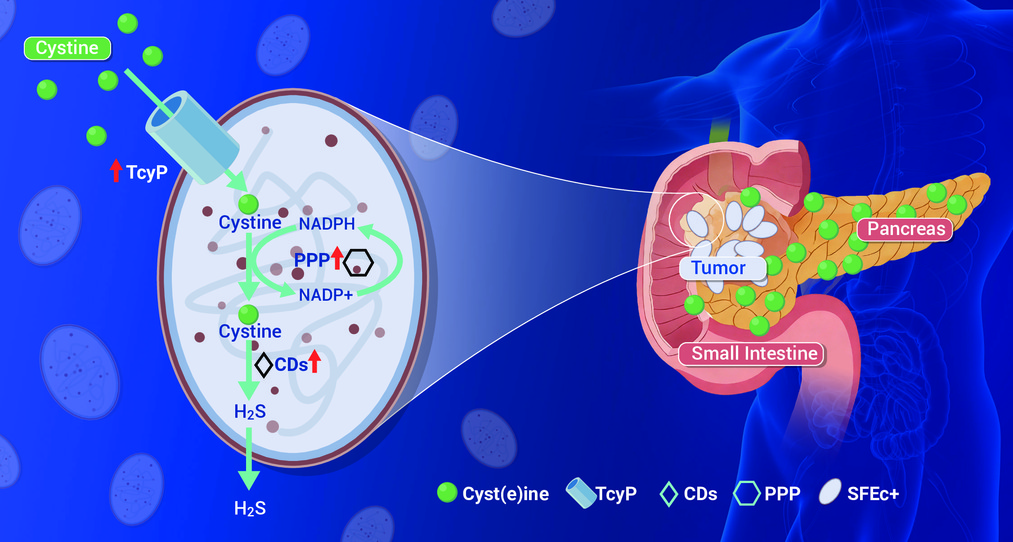
Figure 1.
SFEc+ bacteria selectively target tumor tissues for cyst(e)ine deprivation
