
A comprehensive survey on artificial intelligence for biomolecule design
-
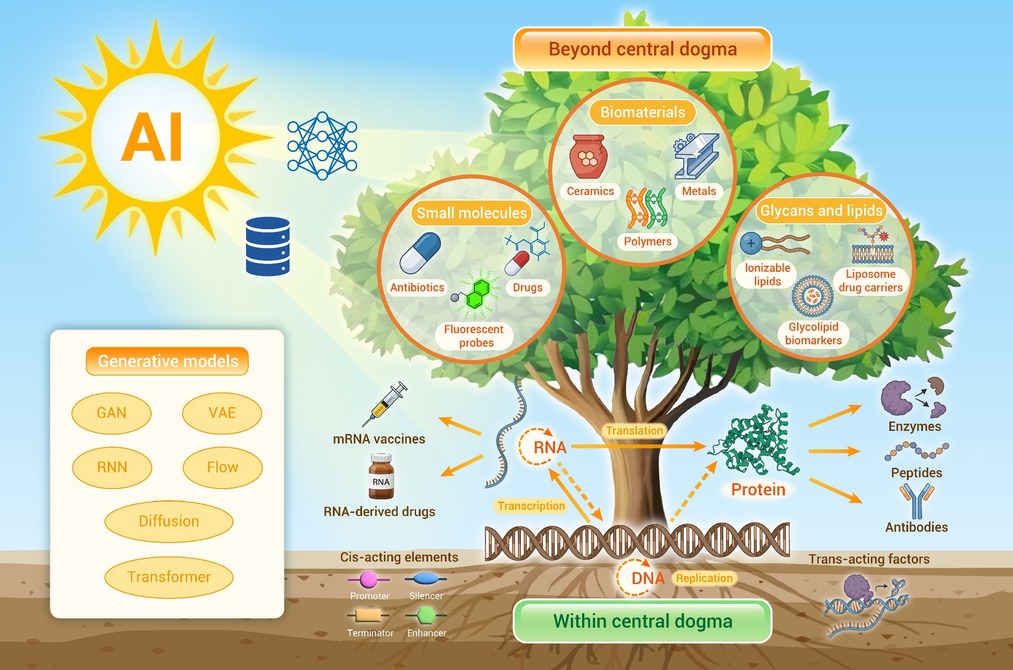
GRAPHICAL ABSTRACT
 DownLoad:
Full size image
DownLoad:
Full size image
-
PUBLIC SUMMARY
-
Generative AI is reshaping molecule design across drug discovery, materials science, and synthetic biology.
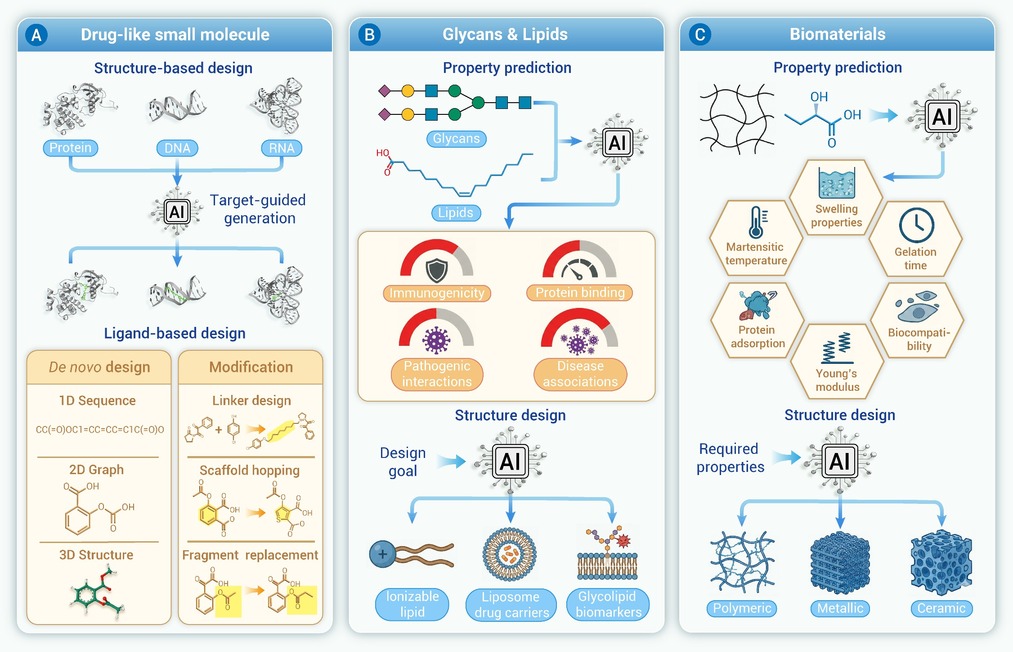
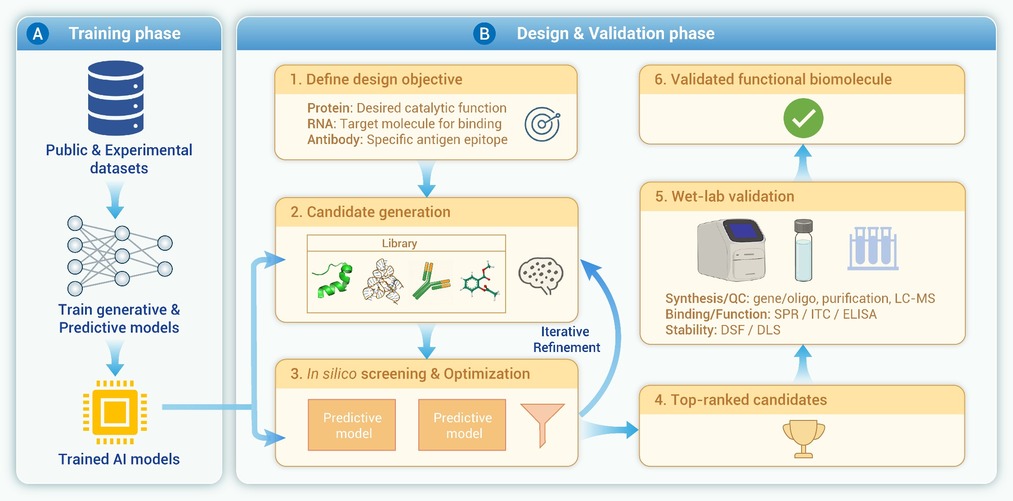
The central dogma framework organizes AI methods for DNA, RNA, proteins, drug-like small molecules, glycans, lipids, and biomaterials.
Key advances, challenges, and future directions in AI-driven molecular engineering are systematically reviewed.
-
-
ABSTRACT
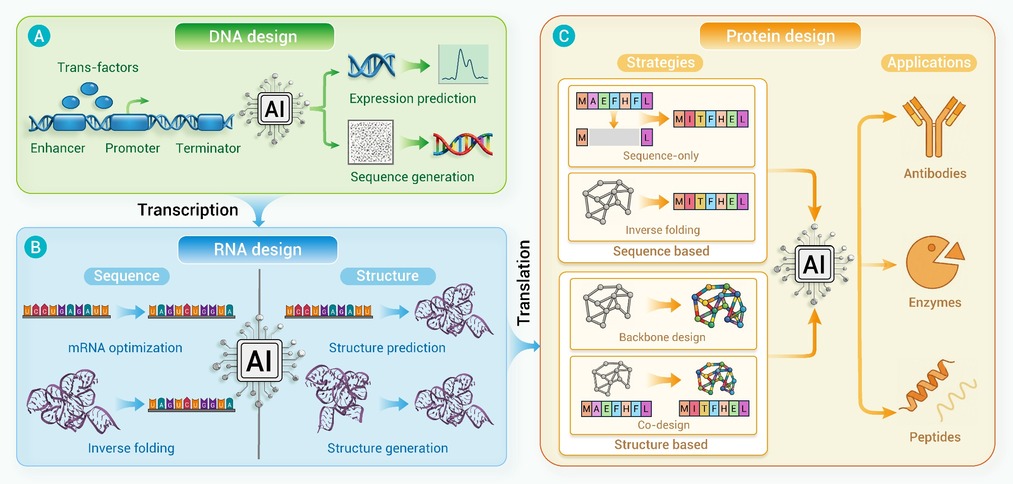
Artificial Intelligence (AI), particularly Generative AI (GenAI), has revolutionized molecule design by enabling the creation of novel and complex molecular structures, advancing drug discovery, materials science, and synthetic biology. This survey provides a comprehensive exploration of AI-driven molecule design, categorized within and beyond the central dogma of molecular biology. We first introduce the foundational concepts of GenAI, focusing on architectures such as Variational Autoencoders (VAEs), Generative Adversarial Networks (GANs), and Diffusion Models (DMs), which underpin molecular design applications. Then, we examine how GenAI facilitates molecule design within the central dogma, addressing DNA, RNA, and protein design. Beyond the central dogma, we explore applications in designing small molecules, lipids, glycans, and other biomaterials. Finally, we conclude by discussing current challenges, emerging trends, and potential future directions for GenAI in molecule design. Overall, this survey aims to equip researchers with a thorough understanding of this rapidly-evolving field and inspire novel developments and breakthroughs in GenAI for molecule design. -

-
REFERENCES
[1] Romanelli V., Cerchia C. and Lavecchia A. (2024). Unlocking the potential of generative artificial intelligence in drug discovery. Lyu Z. (ed.). Applications of Generative AI (Springer International Publishing), pp: 37–63. DOI:10.1007/978-3-031-46238-2_3 [2] Tang X., Dai H., Knight E., et al. (2024). A survey of generative AI for de novo drug design: New frontiers in molecule and protein generation. Brief. in Bioinform. 25:bbae338. DOI:10.1093/bib/bbae338 [3] Han S. and Wu J. (2024). Artificial intelligence (AI) meets biomaterials and biomedicine. Smart Mater. in Med. 5:251−255. DOI:10.1016/j.smaim.2024.03.001 [4] Goshisht M.K. (2024). Machine learning and deep learning in synthetic biology: Key architectures, applications, and challenges. ACS Omega 9:9921−9945. DOI:10.1021/acsomega.3c05913 [5] Shi Y., Zhen X., Zhang Y., et al. (2024). Chemically modified platforms for better RNA therapeutics. Chem. Rev. 124:929−1033. DOI:10.1021/acs.chemrev.3c00611 [6] Yi Y., An H.W. and Wang H. (2024). Intelligent biomaterialomics: Molecular design, manufacturing, and biomedical applications. Adv. Mater. 36:2305099. DOI:10.1002/adma.202305099 [7] Yang N., Kong B., Zhu Z., et al. (2024). Recent advances in targeted protein degraders as potential therapeutic agents. Mol. Diversity 28:309−333. DOI:10.1007/s11030-023-10606-w [8] Zhou Y., Qian M., Li J., et al. (2024). The role of tumor-associated macrophages in lung cancer: From mechanism to small molecule therapy. Biomedicine & Pharmacother. 170:116014. DOI:10.1016/j.biopha.2023.116014 [9] Somasundaram N., Vigneshkumar M., Pawar S.R., et al. (2024). AI-driven material design for tissue engineering a comprehensive approach integrating generative adversarial networks and high-throughput experimentation. The Sci. Temper 15:1576−1580. DOI:10.58414/scientifictemper.2024.15.1.02 [10] Liu M., Li C., Chen R., et al. (2024). Geometric deep learning for drug discovery. Expert Syst. with Appl. 240:122498. DOI:10.1016/j.eswa.2023.122498 [11] Bai Q., Xu T., Huang J., et al. (2024). Geometric deep learning methods and applications in 3D structure-based drug design. Drug Discov. Today 29:104024. DOI:10.1016/j.drudis.2024.104024 [12] Zheng S., He J., Liu C., et al. (2024). Predicting equilibrium distributions for molecular systems with deep learning. Nat. Mach. Intell. 6:558−567. DOI:10.1038/s42256-024-00837-3 [13] Guan X., Tang Q.Y., Ren W., et al. (2024). Predicting protein conformational motions using energetic frustration analysis and AlphaFold2. Proc. Natl. Acad. Sci. 121:e2410662121. DOI:10.1073/pnas.2410662121 [14] Notin P., Rollins N., Gal Y., et al. (2024). Machine learning for functional protein design. Nat. Biotechnol. 42:216−228. DOI:10.1038/s41587-024-02127-0 [15] Kortemme T. (2024). De novo protein design—From new structures to programmable functions. Cell 187:526−544. DOI:10.1016/j.cell.2023.12.028 [16] Zhung W., Kim H. and Kim W.Y. (2024). 3D molecular generative framework for interaction-guided drug design. Nat. Commun. 15. DOI:10.1038/s41467-024-47011-2 [17] Dauparas J., Anishchenko I., Bennett N., et al. (2022). Robust deep learning–based protein sequence design using ProteinMPNN. Science 378:49−56. DOI:10.1101/2022.06.03.494563 [18] Moret M., Friedrich L., Grisoni F., et al. (2020). Generative molecular design in low data regimes. Nat. Mach. Intell. 2:171−180. DOI:10.1038/s42256-020-0160-y [19] Anand N., Eguchi R., Mathews I.I., et al. (2022). Protein sequence design with a learned potential. Nat. Commun. 13:746. DOI:10.1038/s41467-022-28313-9 [20] Syrlybaeva R. and Strauch E.M. (2023). Deep learning of protein sequence design of protein–protein interactions. Bioinformatics 39:btac733. DOI:10.1093/bioinformatics/btac733 [21] Meyers J., Fabian B. and Brown N. (2021). De novo molecular design and generative models. Drug Discov. Today 26:2707−2715. DOI:10.1016/j.drudis.2021.05.019 [22] Luo S., Guan J., Ma J., et al. (2021). A 3D generative model for structure-based drug design. In Adv. Neural Inf. Process. Syst. 34: 6229–6239. https://proceedings.neurips.cc/paper_files/paper/2021/file/314450613369e0ee72d0da7f6fee773c-Paper.pdf [23] Jin W., Wohlwend J., Barzilay R., et al. (2021). Iterative refinement graph neural network for antibody sequence-structure co-design. arXiv abs/2110.04624. DOI:10.48550/arXiv.2110.04624 [24] Wu F. and Li S.Z. (2023). A hierarchical training paradigm for antibody structure-sequence co-design. Adv. in Neural Inf. Processing Syst. 36:31140−31157. DOI:10.1101/2022.11.14.516404 [25] Elton D.C., Boukouvalas Z., Fuge M.D., et al. (2019). Deep learning for molecular design—A review of the state of the art. Mol. Syst. Des. & Eng. 4:828−849. DOI:10.1039/c9me00039a [26] Shen J. and Nicolaou C.A. (2019). Molecular property prediction: Recent trends in the era of artificial intelligence. Drug Discov. Today: Technol. 32:29−36. DOI:10.1016/j.ddtec.2020.05.001 [27] Zhang J., Lei Y.K., Zhang Z., et al. (2020). A perspective on deep learning for molecular modeling and simulations. The J. of Phys. Chem. A 124:6745−6763. DOI:10.1021/acs.jpcb.0c04473 [28] Preuer K., Klambauer G., Rippmann F., et al. (2019). Interpretable deep learning in drug discovery. Samek W., Montavon G., Vedaldi A., et al. (eds.). Explainable AI: Interpreting, explaining and visualizing deep learning (Springer), pp: 331–345. DOI:10.1007/978-3-030-28954-6_18 [29] Li Y., Zhang L. and Liu Z. (2018). Multi-objective de novo drug design with conditional graph generative model. J. of Cheminformatics 10:1−24. DOI:10.1186/s13321-018-0287-6 [30] Dash T., Srinivasan A., Vig L., et al. (2022). Using domain-knowledge to assist lead discovery in early-stage drug design. Katzouris N. and Artikis A. (eds.). International Conference on Inductive Logic Programming (Springer International Publishing), pp: 78–94. DOI:10.1007/978-3-030-97454-1_6 [31] Chu A.E., Lu T. and Huang P.S. (2024). Sparks of function by de novo protein design. Nat. Biotechnol. 42:203−215. DOI:10.1038/s41587-024-02133-2 [32] Li G., Chen C., Li Y., et al. (2024). DNA-origami-based precise molecule assembly and their biological applications. Nano Lett. 24:11335−11348. DOI:10.1021/acs.nanolett.4c03297 [33] Cao X., Zhang Y., Ding Y., et al. (2024). Identification of RNA structures and their roles in RNA functions. Nat. Rev. Mol. Cell Biol. 25:784−801. DOI:10.1038/s41580-024-00748-6 [34] Zhou J. and Huang M. (2024). Navigating the landscape of enzyme design: From molecular simulations to machine learning. Chem. Soc. Rev. 53:8202−8239. DOI:10.1039/d4cs00196f [35] Frappier V. and Keating A.E. (2021). Data-driven computational protein design. Curr. Opin. in Struct. Biol. 69:63−69. DOI:10.1016/j.sbi.2021.03.009 [36] Martinelli D.D. (2022). Generative machine learning for de novo drug discovery: A systematic review. Computers in Biol. and Med. 145:105403. DOI:10.1016/j.compbiomed.2022.105403 [37] Cheng Y., Gong Y., Liu Y., et al. (2021). Molecular design in drug discovery: A comprehensive review of deep generative models. Brief. in Bioinform. 22:bbab344. DOI:10.1093/bib/bbab344 [38] Zeng X., Wang F., Luo Y., et al. (2022). Deep generative molecular design reshapes drug discovery. Cell Rep. Med. 3:100794. DOI:10.1016/j.xcrm.2022.100794 [39] Zhang S., Fan R., Liu Y., et al. (2023). Applications of transformer-based language models in bioinformatics: A survey. Bioinform. Adv. 3:vbad001. DOI:10.1093/bioadv/vbad001 [40] Guo Z., Liu J., Wang Y., et al. (2024). Diffusion models in bioinformatics and computational biology. Nat. Rev. Bioeng. 2:136−154. DOI:10.1038/s44222-023-00114-9 [41] Lan L., You L., Zhang Z., et al. (2020). Generative adversarial networks and its applications in biomedical informatics. Front. in Public Health 8:164. DOI:10.3389/fpubh.2020.00164 [42] Wei R. and Mahmood A. (2020). Recent advances in variational autoencoders with representation learning for biomedical informatics: A survey. IEEE Access 9:4939−4956. DOI:10.1109/access.2020.3048309 [43] Sankaran K. and Holmes S.P. (2023). Generative models: An interdisciplinary perspective. Annu. Rev. of Stat. and Its Appl. 10:325−352. DOI:10.1146/annurev-statistics-033121-110134 [44] Rombach R., Blattmann A., Lorenz D., et al. (2022). High-resolution image synthesis with latent diffusion models. IEEE/CVF Conference on Computer Vision and Pattern Recognition (CVPR) 10684–10695. DOI:10.1109/cvpr52688.2022.01042 [45] Radford A., Wu J., Child R., et al. (2019). Language models are unsupervised multitask learners. OpenAI Technical Report. URL https://openai.com/index/better-language-models [46] Liao R., Li Y., Song Y., et al. (2019). Efficient graph generation with graph recurrent attention networks. In Adv. Neural Inf. Process. Syst. 32. https://proceedings.neurips.cc/paper_files/paper/2019/file/d0921d442ee91b896ad95059d13df618-Paper.pdf [47] Huang R., Cui C., Chen F., et al. (2022). Singgan: Generative adversarial network for high-fidelity singing voice generation. In Proceedings of the 30th ACM International Conference on Multimedia 2525–2535. DOI:10.1145/3503161.3547854 [48] Wang D., Xiao M., Wu M., et al. (2023). Reinforcement-enhanced autoregressive feature transformation: Gradient-steered search in continuous space for postfix expressions. In Adv. Neural Inf. Process. Syst. 36: 43563–43578. https://proceedings.neurips.cc/paper_files/paper/2023/file/8797d13e5998acfab387d4bf0a5b9b00-Paper-Conference.pdf [49] Wang H., Zhang Z., Wang T., et al. (2023). PrivTrace: Differentially private trajectory synthesis by adaptive Markov models. In 32nd USENIX Security Symposium (USENIX Security 23) 1649–1666. https://www.usenix.org/conference/usenixsecurity23/presentation/wang-haiming [50] Bourou S., El Saer A., Velivassaki T.H., et al. (2021). A review of tabular data synthesis using GANs on an IDS dataset. Inf. 12:375. DOI:10.3390/info12090375 [51] LeCun Y., Chopra S., Hadsell R., et al. (2006). A tutorial on energy-based learning. Predicting Structured Data. http://yann.lecun.com/exdb/publis/pdf/lecun-06.pdf [52] Fischer A. and Igel C. (2012). An introduction to restricted Boltzmann machines. In Progress in Pattern Recognition, Image Analysis, Computer Vision, and Applications 14–36. DOI:10.1007/978-3-642-33275-3_2 [53] Hinton G.E. (2009). Deep belief networks. Scholarpedia 4:5947. DOI:10.4249/scholarpedia.5947 [54] Ngiam J., Chen Z., Koh P.W., et al. (2011). Learning deep energy models. In International Conference on Machine Learning 1105–1112. https://icml.cc/2011/papers/557_icmlpaper.pdf [55] Zhai S., Cheng Y., Lu W., et al. (2016). Deep structured energy based models for anomaly detection. In International Conference on Machine Learning 48: 1100–1109. https://proceedings.mlr.press/v48/zhai16.html [56] Du Y. and Mordatch I. (2019). Implicit generation and modeling with energy based models. In Advances in Neural Information Processing Systems 32. https://proceedings.neurips.cc/paper_files/paper/2019/file/378a063b8fdb1db941e34f4bde584c7d-Paper.pdf [57] Liu M., Yan K., Oztekin B., et al. (2021). GraphEBM: Molecular graph generation with energy-based models. In Energy Based Models Workshop - ICLR 2021 URL https://openreview.net/forum?id=Gc51PtL_zYw [58] Kong D., Pang B., Han T., et al. (2023). Molecule design by latent space energy-based modeling and gradual distribution shifting. In Proceedings of the Thirty-Ninth Conference on Uncertainty in Artificial Intelligence 216: 1109–1120. https://proceedings.mlr.press/v216/kong23a.html [59] Bengio Y., Courville A. and Vincent P. (2013). Representation learning: A review and new perspectives. IEEE Trans. on Pattern Anal. and Mach. Intell. 35:1798−1828. DOI:10.1109/tpami.2013.50 [60] Hinton G.E. and Salakhutdinov R.R. (2006). Reducing the dimensionality of data with neural networks. Science 313:504−507. DOI:10.1126/Science.1127647 [61] Kingma D.P. (2013). Auto-encoding variational bayes. arXiv abs/1312.6114. DOI:10.48550/arXiv.1312.6114 [62] Kingma D.P., Rezende D.J., Mohamed S., et al. (2014). Semi-supervised learning with deep generative models. Adv. in Neural Inf. Processing Syst. 27. https://proceedings.neurips.cc/paper_files/paper/2014/file/6d42b1217a6996997ead5a8398c1f944-Paper.pdf [63] Sønderby C.K., Raiko T., Maaløe L., et al. (2016). Ladder variational autoencoders. In Adv. Neural Inf. Process. Syst. 29. https://proceedings.neurips.cc/paper_files/paper/2016/file/6ae07dcb33ec3b7c814df797cbda0f87-Paper.pdf [64] Higgins I., Matthey L., Pal A., et al. (2017). β-VAE: Learning basic visual concepts with a constrained variational framework. In International conference on learning representations https://openreview.net/forum?id=Sy2fzU9gl [65] Hong S.H., Ryu S., Lim J., et al. (2019). Molecular generative model based on an adversarially regularized autoencoder. J. of Chem. Inf. and Model. 60:29−36. DOI:10.1021/acs.jcim.9b00694 [66] Nash C. and Williams C.K. (2017). The shape variational autoencoder: A deep generative model of part-segmented 3D objects. Comput. Graph. Forum 36:1−12. DOI:10.1111/cgf.13240 [67] Gómez-Bombarelli R., Wei J.N., Duvenaud D., et al. (2018). Automatic chemical design using a data-driven continuous representation of molecules. ACS Central Sci. 4:268−276. DOI:10.1021/acscentsci.7b00572 [68] Kusner M.J., Paige B. and Hernández-Lobato J.M. (2017). Grammar variational autoencoder. In International Conference on Machine Learning 70: 1945–1954. https://proceedings.mlr.press/v70/kusner17a.html [69] Dinh L., Sohl-Dickstein J. and Bengio S. (2016). Density estimation using Real NVP. arXiv abs/1605.08803. DOI:10.48550/arXiv.1605.08803 [70] Kingma D.P. and Dhariwal P. (2018). Glow: Generative flow with invertible 1x1 convolutions. In Adv. Neural Inf. Process. Syst. 31. https://proceedings.neurips.cc/paper_files/paper/2018/file/d139db6a236200b21cc7f752979132d0-Paper.pdf [71] Grathwohl W., Chen R.T., Bettencourt J., et al. (2018). FFJORD: Free-form continuous dynamics for scalable reversible generative models. In International Conference on Learning Representations https://openreview.net/forum?id=rJxgknCcK7 [72] Madhawa K., Ishiguro K., Nakago K., et al. (2019). GraphNVP: An invertible flow model for generating molecular graphs. arXiv abs/1905.11600. DOI:10.48550/arXiv.1905.11600 [73] Geffner T., Didi K., Zhang Z., et al. (2025). Proteina: Scaling flow-based protein structure generative models. In The Thirteenth International Conference on Learning Representations https://openreview.net/forum?id=TVQLu34bdw [74] Creswell A., White T., Dumoulin V., et al. (2018). Generative adversarial networks: An overview. IEEE Signal Processing Mag. 35:53−65. DOI:10.1109/msp.2017.2765202 [75] Goodfellow I., Pouget-Abadie J., Mirza M., et al. (2014). Generative adversarial nets. In Adv. Neural Inf. Process. Syst. 27. https://proceedings.neurips.cc/paper_files/paper/2014/file/f033ed80deb0234979a61f95710dbe25-Paper.pdf [76] Mirza M. and Osindero S. (2014). Conditional generative adversarial nets. arXiv abs/1411.1784. DOI:10.48550/arXiv.1411.1784 [77] Lai W.S., Huang J.B., Ahuja N., et al. (2017). Deep laplacian pyramid networks for fast and accurate super-resolution. In 2017 IEEE Conference on Computer Vision and Pattern Recognition (CVPR) 5835–5843. DOI:10.1109/cvpr.2017.618 [78] Lin J., Zhang R., Ganz F., et al. (2021). Anycost GANs for interactive image synthesis and editing. In 2021 IEEE/CVF Conference on Computer Vision and Pattern Recognition (CVPR) 14986–14996. DOI:10.1109/cvpr46437.2021.01474 [79] Karras T., Laine S., Aittala M., et al. (2020). Analyzing and improving the image quality of stylegan. In 2020 IEEE/CVF Conference on Computer Vision and Pattern Recognition (CVPR) 8107–8116. DOI:10.1109/cvpr42600.2020.00813 [80] Cao N.D. and Kipf T. (2018). MolGAN: An implicit generative model for small molecular graphs. arXiv abs/1805.11973. DOI:10.48550/arXiv.1805.11973 [81] Repecka D., Jauniskis V., Karpus L., et al. (2021). Expanding functional protein sequence spaces using generative adversarial networks. Nat. Mach. Intell. 3:324−333. DOI:10.1038/s42256-021-00310-5 [82] Xing Z., Feng Q., Chen H., et al. (2024). A survey on video diffusion models. ACM Comput. Surv. 57. DOI:10.1145/3696415 DOI:10.1145/3696415 [83] Ho J., Jain A. and Abbeel P. (2020). Denoising diffusion probabilistic models. Adv. in Neural Inf. Processing Syst. 33: 6840–6851. https://proceedings.neurips.cc/paper_files/paper/2020/file/4c5bcfec8584af0d967f1ab10179ca4b-Paper.pdf [84] Song Y., Sohl-Dickstein J., Kingma D.P., et al. (2021). Score-based generative modeling through stochastic differential equations. In International Conference on Learning Representations https://openreview.net/forum?id=PxTIG12RRHS [85] Oksendal B. (2013). Stochastic differential equations. Stochastic differential equations: An introduction with applications (Springer Science & Business Media), pp: 65–84. DOI:10.1007/978-3-642-14394-6 [86] Rombach R., Blattmann A., Lorenz D., et al. (2022). High-resolution image synthesis with latent diffusion models. In 2022 IEEE/CVF Conference on Computer Vision and Pattern Recognition (CVPR) 10674–10685. DOI:10.1109/cvpr52688.2022.01042 [87] Esser P., Kulal S., Blattmann A., et al. (2024). Scaling rectified flow transformers for high-resolution image synthesis. In International Conference on Machine Learning 235: 12606–12633. URL https://proceedings.mlr.press/v235/esser24a.html [88] Niu C., Song Y., Song J., et al. (2020). Permutation invariant graph generation via score-based generative modeling. In International Conference on Artificial Intelligence and Statistics 108: 4474–4484. https://proceedings.mlr.press/v108/niu20a.html [89] Hoogeboom E., Satorras V.G., Vignac C., et al. (2022). Equivariant diffusion for molecule generation in 3D. In Proceedings of the 39th International Conference on Machine Learning 162: 8867–8887. https://proceedings.mlr.press/v162/hoogeboom22a.html [90] Zhao W.X., Zhou K., Li J., et al. (2023). A survey of large language models. arXiv abs/2303.18223. DOI:10.48550/arXiv.2303.18223 [91] Zhou C., Li Q., Li C., et al. (2024). A comprehensive survey on pretrained foundation models: A history from bert to chatgpt. Int. J. of Mach. Learn. and Cybernetics 16:9851−9915. DOI:10.1007/s13042-024-02443-6 [92] Vaswani A., Shazeer N., Parmar N., et al. (2017). Attention is all you need. In Advances in Neural Information Processing Systems 30. https://proceedings.neurips.cc/paper_files/paper/2017/file/3f5ee243547dee91fbd053c1c4a845aa-Paper.pdf [93] Radford A., Narasimhan K., Salimans T., et al. (2018). Improving language understanding by generative pre-training. OpenAI Technical Report. https://openai.com/index/language-unsupervised/ [94] Devlin J., Chang M.W., Lee K., et al. (2019). BERT: Pre-training of deep bidirectional Transformers for language understanding. arXiv abs/1810.04805. DOI:10.48550/arXiv.1810.04805 [95] Brown T., Mann B., Ryder N., et al. (2020). Language models are few-shot learners. In Advances in Neural Information Processing Systems 33: 1877–1901. https://proceedings.neurips.cc/paper_files/paper/2020/file/1457c0d6bfcb4967418bfb8ac142f64a-Paper.pdf [96] Achiam J., Adler S., Agarwal S., et al. (2023). GPT-4 technical report. arXiv abs/2303.08774. DOI:10.48550/arXiv.2303.08774 [97] OpenAI (2024). GPT-4o. OpenAI Technical Report. https://openai.com/index/hello-gpt-4o/ [98] Yang Z., Dai Z., Yang Y., et al. (2019). XLNet: Generalized autoregressive pretraining for language understanding. In Adv. Neural Inf. Process. Syst. 32. https://proceedings.neurips.cc/paper_files/paper/2019/file/dc6a7e655d7e5840e66733e9ee67cc69-Paper.pdf [99] Du Z., Qian Y., Liu X., et al. (2022). GLM: General language model pretraining with autoregressive blank infilling. In Proceedings of the 60th Annual Meeting of the Association for Computational Linguistics 1: 320–335. DOI:10.18653/v1/2022.acl-long.26 [100] Zhang S., Roller S., Goyal N., et al. (2022). OPT: Open pre-trained transformer language models. arXiv abs/2205.01068. DOI:10.48550/arXiv.2205.01068 [101] Touvron H., Lavril T., Izacard G., et al. (2023). LLaMA: Open and efficient foundation language models. arXiv abs/2302.13971. DOI:10.48550/arXiv.2302.13971 [102] Grattafiori A., Dubey A., Jauhri A., et al. (2024). The LLaMA 3 herd of models. arXiv abs/2407.21783. DOI:10.48550/arXiv.2407.21783 [103] Sarkar A., Kang Y., Somia N., et al. (2024). Designing DNA with tunable regulatory activity using score-entropy discrete diffusion. bioRxiv DOI:10.1101/2024.05.23.595630 [104] Wu W., Li Q., Li M., et al. (2025). GENERator: A long-context generative genomic foundation model. arXiv abs/2502.07272. DOI:10.48550/arXiv.2502.07272 [105] Iñiguez-Muñoz S., Llinàs-Arias P., Ensenyat-Mendez M., et al. (2024). Hidden secrets of the cancer genome: Unlocking the impact of non-coding mutations in gene regulatory elements. Cell. and Mol. Life Sci. 81:274. DOI:10.1007/s00018-024-05314-z [106] Wang Y., Wang H., Wei L., et al. (2020). Synthetic promoter design in Escherichia coli based on a deep generative network. Nucleic Acids Res. 48:6403−6412. DOI:10.1093/nar/gkaa325 [107] Cheng Y., Zhang X., Liu F., et al. (2024). PromoterDiff: De novo design approach for Escherichia coli promoters based on a diffusion model. In 2024 27th International Conference on Computer Supported Cooperative Work in Design (CSCWD) 2381–2387. DOI:10.1109/cscwd61410.2024.10580553 [108] Wang H., Du Q., Wang Y., et al. (2024). GPro: Generative AI-empowered toolkit for promoter design. Bioinformatics 40:btae123. DOI:10.1093/bioinformatics/btae123 [109] Yang G., Li J., Hu J., et al. (2024). Recognition of cyanobacteria promoters via Siamese network-based contrastive learning under novel non-promoter generation. Brief. in Bioinform. 25:bbae193. DOI:10.1093/bib/bbae193 [110] Zhang P., Wang H., Xu H., et al. (2023). Deep flanking sequence engineering for efficient promoter design using DeepSEED. Nat. Commun. 14:6309. DOI:10.1038/s41467-023-41899-y [111] Seo E., Choi Y.N., Shin Y.R., et al. (2023). Design of synthetic promoters for cyanobacteria with generative deep-learning model. Nucleic Acids Res. 51:7071−7082. DOI:10.1093/nar/gkad451 [112] Lin J., Wang X., Liu T., et al. (2024). Diffusion-based generative network for de novo synthetic promoter design. ACS Synth. Biol. 13:1513−1522. DOI:10.1021/acssynbio.4c00041 [113] Xia Y., Du X., Liu B., et al. (2024). Species-specific design of artificial promoters by transfer-learning based generative deep-learning model. Nucleic Acids Res. 52:6145−6157. DOI:10.1101/2023.12.27.573416 [114] Wang X., Xu K., Tan Y., et al. (2023). Deep learning-assisted design of novel promoters in Escherichia coli. Adv. Genet. 4:2300184. DOI:10.1002/ggn2.202300184 [115] Almeida B.P., Reiter F., Pagani M., et al. (2022). DeepSTARR predicts enhancer activity from DNA sequence and enables the de novo design of synthetic enhancers. Nat. Genet. 54:613−624. DOI:10.1038/s41588-022-01048-5 [116] Li Z., Zhang Y., Peng B., et al. (2024). A novel interpretable deep learning-based computational framework designed synthetic enhancers with broad cross-species activity. Nucleic Acids Res. 52:13447−13468. DOI:10.1093/nar/gkae912 [117] Yin C., Castillo-Hair S., Byeon G.W., et al. (2025). Iterative deep learning design of human enhancers exploits condensed sequence grammar to achieve cell-type specificity. Cell Syst. 16. DOI:10.1101/2024.06.14.599076 DOI:10.1101/2024.06.14.599076 [118] Yang Z., Su B., Cao C., et al. (2025). Regulatory DNA sequence design with reinforcement learning. arXiv abs/2503.07981. DOI:10.48550/arXiv.2503.07981 [119] Wang C., Uehara M., He Y., et al. (2024). Fine-tuning discrete diffusion models via reward optimization with applications to DNA and protein design. arXiv abs/2410.13643. DOI:10.48550/arXiv.2410.13643 [120] Feng C.Q., Zhang Z.Y., Zhu X.J., et al. (2019). iTerm-PseKNC: A sequence-based tool for predicting bacterial transcriptional terminators. Bioinformatics 35:1469−1477. DOI:10.1093/bioinformatics/bty827 [121] Cui W., Lin Q., Hu R., et al. (2021). Data-driven and in silico-assisted design of broad host-range minimal intrinsic terminators adapted for bacteria. ACS Synth. Biol. 10:1438−1450. DOI:10.1021/acssynbio.1c00050 [122] Li J., Wu L.F., Liu K., et al. (2025). Intelligent design of Escherichia coli terminators by coupling prediction and generation models. ACS Synth. Biol. 14:3744−3752. DOI:10.1021/acssynbio.5c00429 [123] Zeng W., Chen S., Cui X., et al. (2021). SilencerDB: A comprehensive database of silencers. Nucleic Acids Res. 49:D221−D228. DOI:10.1093/nar/gkaa839 [124] Pan J.H. and Du P.F. (2024). SilenceREIN: Seeking silencers on anchors of chromatin loops by deep graph neural networks. Brief. in Bioinform. 25:bbad494. DOI:10.1093/bib/bbad494 [125] Kim G.B., Gao Y., Palsson B.O., et al. (2021). DeepTFactor: A deep learning-based tool for the prediction of transcription factors. Proc. Natl. Acad. Sci. 118:e2021171118. DOI:10.1073/pnas.2021171118 [126] Liu J., Dong C., Jiang G., et al. (2020). Transcription factor expression as a predictor of colon cancer prognosis: A machine learning practice. BMC Med. Genomics 13:1−10. DOI:10.1186/s12920-020-00775-0 [127] Zhang Y., Liu T., Hu X., et al. (2021). CellCall: Integrating paired ligand–receptor and transcription factor activities for cell–cell communication. Nucleic Acids Res. 49:8520−8534. DOI:10.1093/nar/gkab638 [128] Alerasool N., Leng H., Lin Z.Y., et al. (2022). Identification and functional characterization of transcriptional activators in human cells. Mol. Cell 82:677−695. DOI:10.1016/j.molcel.2021.12.008 [129] Joshi C.K., Jamasb A.R., Viñas R., et al. (2024). gRNAde: Geometric deep learning for 3D RNA inverse design. bioRxiv DOI:10.1101/2024.03.31.587283 [130] Wong F., He D., Krishnan A., et al. (2024). Deep generative design of RNA aptamers using structural predictions. Nat. Comput. Sci. 4:829−839. DOI:10.1038/s43588-024-00720-6 [131] Li Y., Pan X., Shen H., et al. (2025). DRAG: Design RNAs as hierarchical graphs with reinforcement learning. Brief. in Bioinform. 26:bbaf106. DOI:10.1093/bib/bbaf106 [132] Runge F., Franke J., Fertmann D., et al. (2024). Partial RNA design. Bioinformatics 40:i437−i445. DOI:10.1093/bioinformatics/btae222 [133] Huang H., Lin Z., He D., et al. (2024). RiboDiffusion: Tertiary structure-based RNA inverse folding with generative diffusion models. bioRxiv DOI:10.1101/2024.04.18.590187 [134] Zhang H., Liu H., Xu Y., et al. (2025). Deep generative models design mRNA sequences with enhanced translational capacity and stability. Science 390:eadr8470. DOI:10.1126/Science.adr8470 [135] Zhao Y., Oono K., Takizawa H., et al. (2024). GenerRNA: A generative pre-trained language model for de novo RNA design. PLoS One 19:e0310814. DOI:10.1371/journal.pone.0310814 [136] Shukueian Tabrizi S., Barazandeh S., Hashemi Aghdam H., et al. (2025). RNAtranslator: Modeling protein-conditional RNA design as sequence-to-sequence natural language translation. PLoS Comput. Biol. 21:e1013541. DOI:10.1371/journal.pcbi.1013541 [137] Klypa R., Bietti A. and Grudinin S. (2025). BAnG: Bidirectional anchored generation for conditional RNA design. arXiv abs/2502.21274. DOI:10.48550/arXiv.2502.21274 [138] Patel S., Peng F.Z., Fraser K., et al. (2025). EvoFlow-RNA: Generating and representing non-coding RNA with a language model. bioRxiv DOI:10.1101/2025.02.25.639942 [139] Gao L. and Lu Z.J. (2024). RNACG: A universal RNA sequence conditional generation model based on flow-matching. arXiv abs/2407.19838. DOI:10.48550/arXiv.2407.19838 [140] Castillo-Hair S.M. and Seelig G. (2021). Machine learning for designing next-generation mRNA therapeutics. Accounts of Chem. Res. 55:24−34. DOI:10.1021/acs.accounts.1c00621 [141] Baek M., McHugh R., Anishchenko I., et al. (2024). Accurate prediction of protein–nucleic acid complexes using RoseTTAFoldNA. Nat. Methods 21:117−121. DOI:10.1101/2022.09.09.507333 [142] Hie B.L., Shanker V.R., Xu D., et al. (2024). Efficient evolution of human antibodies from general protein language models. Nat. Biotechnol. 42:275−283. DOI:10.1038/s41587-023-01763-2 [143] Bennett N.R., Watson J.L., Ragotte R.J., et al. (2026). Atomically accurate de novo design of antibodies with RFdiffusion. Nature 649:183−193. DOI:10.1038/s41586-025-09721-5 [144] Parkinson J., Hard R. and Wang W. (2023). The RESP AI model accelerates the identification of tight-binding antibodies. Nat. Commun. 14:454. DOI:10.1038/s41467-023-36028-8 [145] Mason D.M., Friedensohn S., Weber C.R., et al. (2021). Optimization of therapeutic antibodies by predicting antigen specificity from antibody sequence via deep learning. Nat. Biomed. Eng. 5:600−612. DOI:10.1038/s41551-021-00699-9 [146] Makowski E.K., Kinnunen P.C., Huang J., et al. (2022). Co-optimization of therapeutic antibody affinity and specificity using machine learning models that generalize to novel mutational space. Nat. Commun. 13:3788. DOI:10.1038/s41467-022-31457-3 [147] Shanehsazzadeh A., Bachas S., McPartlon M., et al. (2023). Unlocking de novo antibody design with generative artificial intelligence. bioRxiv DOI:10.1101/2023.01.08.523187 [148] Shanker V.R., Bruun T.U., Hie B.L., et al. (2024). Unsupervised evolution of protein and antibody complexes with a structure-informed language model. Science 385:46−53. DOI:10.1126/Science.adk8946 [149] Desautels T.A., Arrildt K.T., Zemla A.T., et al. (2024). Computationally restoring the potency of a clinical antibody against omicron. Nature 629:878−885. DOI:10.1038/s41586-024-07385-1 [150] He H., He B., Guan L., et al. (2024). De novo generation of SARS-CoV-2 antibody CDRH3 with a pre-trained generative large language model. Nat. Commun. 15:6867. DOI:10.1038/s41467-024-50903-y [151] Eguchi R.R., Choe C.A. and Huang P.S. (2022). Ig-VAE: Generative modeling of protein structure by direct 3D coordinate generation. PLoS Comput. Biol. 18:e1010271. DOI:10.1371/journal.pcbi.1010271 [152] Li C., Sutherland D., Hammond S.A., et al. (2022). AMPlify: Attentive deep learning model for discovery of novel antimicrobial peptides effective against WHO priority pathogens. BMC Genomics 23:77. DOI:10.1101/2020.06.16.155705 [153] Lee H., Lee S., Lee I., et al. (2023). AMP-BERT: Prediction of antimicrobial peptide function based on a BERT model. Protein Sci. 32:e4529. DOI:10.1002/pro.4529 [154] Losin L. and Veltri D. (2021). Exploring target specificity of antimicrobial peptides through deep learning embeddings. In Proceedings of the 12th ACM Conference on Bioinformatics, Computational Biology, and Health Informatics DOI:10.1145/3459930.3469506 [155] Sharma R., Shrivastava S., Singh S.K., et al. (2023). Artificial intelligence-based model for predicting the minimum inhibitory concentration of antibacterial peptides against ESKAPEE pathogens. IEEE J. of Biomed. and Health Inform. 28:1949−1958. DOI:10.1109/jbhi.2023.3271611 [156] Sharma R., Shrivastava S., Singh S.K., et al. (2023). EnDL-HemoLyt: Ensemble deep learning-based tool for identifying therapeutic peptides with low hemolytic activity. IEEE J. of Biomed. and Health Inform. 28:1896−1905. DOI:10.1109/jbhi.2023.3264941 [157] Teimouri H., Medvedeva A. and Kolomeisky A.B. (2023). Bacteria-specific feature selection for enhanced antimicrobial peptide activity predictions using machine-learning methods. J. of Chem. Inf. and Model. 63:1723−1733. DOI:10.1021/acs.jcim.2c01551 [158] Vishnepolsky B., Grigolava M., Managadze G., et al. (2022). Comparative analysis of machine learning algorithms on the microbial strain-specific AMP prediction. Brief. in Bioinform. 23:bbac233. DOI:10.1101/2022.01.28.478081 [159] Salem M., Keshavarzi Arshadi A. and Yuan J.S. (2022). AMPDeep: Hemolytic activity prediction of antimicrobial peptides using transfer learning. BMC Bioinform. 23:389. DOI:10.21203/rs.3.rs-1615895/v1 [160] Ansari M. and White A.D. (2023). Serverless prediction of peptide properties with recurrent neural networks. J. of Chem. Inf. and Model. 63:2546−2553. DOI:10.1101/2022.05.18.492545 [161] Ansari M. and White A.D. (2024). Learning peptide properties with positive examples only. Digital Discov. 3:977−986. DOI:10.1039/d3dd00218g [162] Ferrell J.B., Remington J.M., Van Oort C.M., et al. (2020). A generative approach toward precision antimicrobial peptide design. bioRxiv DOI:10.1101/2020.10.02.324087 [163] Van Oort C.M., Ferrell J.B., Remington J.M., et al. (2021). AMPGAN v2: Machine learning-guided design of antimicrobial peptides. J. Chem. Inf. Model. 61:2198−2207. DOI:10.1101/2020.11.18.388843 [164] Buehler M.J. (2023). Generative pretrained autoregressive transformer graph neural network applied to the analysis and discovery of novel proteins. J. Appl. Phys. 134. DOI:10.1063/5.0157367 DOI:10.1063/5.0157367 [165] Olsen T.H., Yesiltas B., Marin F.I., et al. (2020). Anoxpepred: Using deep learning for the prediction of antioxidative properties of peptides. Sci. Rep. 10:21471. DOI:10.1038/s41598-020-78319-w [166] Das P., Sercu T., Wadhawan K., et al. (2021). Accelerated antimicrobial discovery via deep generative models and molecular dynamics simulations. Nat. Biomed. Eng. 5:613−623. DOI:10.1038/s41551-021-00689-x [167] Hoffman S.C., Chenthamarakshan V., Wadhawan K., et al. (2022). Optimizing molecules using efficient queries from property evaluations. Nat. Mach. Intell. 4:21−31. DOI:10.1038/s42256-021-00422-y [168] Qin D., Jiao L., Wang R., et al. (2023). Prediction of antioxidant peptides using a quantitative structure- activity relationship predictor (AnOxPP) based on bidirectional long short-term memory neural network and interpretable amino acid descriptors. Computers in Biol. and Med. 154:106591. DOI:10.1016/j.compbiomed.2023.106591 [169] Szymczak P., Możejko M., Grzegorzek T., et al.(2023). Discovering highly potent antimicrobial peptides with deep generative model HydrAMP. Nat. Commun. 14:1453. DOI:10.1038/s41467-023-36994-z [170] Murakami Y., Ishida S., Demizu Y., et al. (2023). Design of antimicrobial peptides containing non-proteinogenic amino acids using multi-objective Bayesian optimisation. Digital Discov. 2:1347−1353. DOI:10.26434/chemrxiv-2023-cbrjc [171] Liu Y., Zhang X., Liu Y., et al. (2023). Evolutionary multi-objective optimization in searching for various antimicrobial peptides[feature]. IEEE Comput. Intell. Mag. 18:31−45. DOI:10.1109/mci.2023.3245731 [172] Tucs A., Berenger F., Yumoto A., et al. (2023). Quantum annealing designs nonhemolytic antimicrobial peptides in a discrete latent space. ACS Med. Chem. Lett. 14:577−582. DOI:10.1021/acsmedchemlett.2c00487 [173] Jain M., Bengio E., Hernandez-Garcia A., et al. (2022). Biological sequence design with GFlowNets. In Proceedings of the 39th International Conference on Machine Learning 162: 9786–9801. https://proceedings.mlr.press/v162/jain22a.html [174] Hesamzadeh P., Seif A., Mahmoudzadeh K., et al. (2024). De novo antioxidant peptide design via machine learning and DFT studies. Sci. Rep. 14:6473. DOI:10.1038/s41598-024-57247-z [175] Tyagi A., Kapoor P., Kumar R., et al. (2013). In silico models for designing and discovering novel anticancer peptides. Sci. Rep. 3:2984. DOI:10.1038/srep02984 [176] Yi H.C., You Z.H., Zhou X., et al. (2019). ACP-DL: A deep learning long short-term memory model to predict anticancer peptides using high-efficiency feature representation. Mol. Ther. Nucleic Acids 17:1−9. DOI:10.1016/j.omtn.2019.04.025 [177] He W., Wang Y., Cui L., et al. (2021). Learning embedding features based on multisense-scaled attention architecture to improve the predictive performance of anticancer peptides. Bioinformatics 37:4684−4693. DOI:10.1093/bioinformatics/btab560 [178] Chen J., Cheong H.H. and Siu S.W. (2021). xDeep-AcPEP: Deep learning method for anticancer peptide activity prediction based on convolutional neural network and multitask learning. J. of Chem. Inf. and Model. 61:3789−3803. DOI:10.1021/acs.jcim.1c00181 [179] Deng H., Ding M., Wang Y., et al. (2023). ACP-MLC: A two-level prediction engine for identification of anticancer peptides and multi-label classification of their functional types. Computers in Biol. and Med. 158:106844. DOI:10.1016/j.compbiomed.2023.106844 [180] Zhong G. and Deng L. (2024). ACPScanner: Prediction of anticancer peptides by integrated machine learning methodologies. J. of Chem. Inf. and Model. 64:1092−1104. DOI:10.1021/acs.jcim.3c01860 [181] Wang S. and Ma B. (2025). Anti-cancer peptides identification and activity type classification with protein sequence pre-training. IEEE J. of Biomed. and Health Inform. 29:1692−1701. DOI:10.1109/JBHI.2024.3358632 [182] Grisoni F., Neuhaus C.S., Gabernet G., et al. (2018). Designing anticancer peptides by constructive machine learning. ChemMedChem 13:1300−1302. DOI:10.1002/cmdc.201800204 [183] Rossetto A. and Zhou W. (2020). GANDALF: Peptide generation for drug design using sequential and structural generative adversarial networks. In Proceedings of the 11th ACM International Conference on Bioinformatics, Computational Biology and Health Informatics 1–10. DOI:10.1145/3388440.3412487 [184] Dou J., Vorobieva A.A., Sheffler W., et al. (2018). De novo design of a fluorescence-activating β-barrel. Nature 561:485−491. DOI:10.2210/pdb6d0t/pdb [185] Russ W.P., Figliuzzi M., Stocker C., et al. (2020). An evolution-based model for designing chorismate mutase enzymes. Science 369:440−445. DOI:10.1126/Science.aba3304 [186] Yeh A.H.W., Norn C., Kipnis Y., et al. (2023). De novo design of luciferases using deep learning. Nature 614:774−780. DOI:10.1038/s41586-023-05696-3 [187] Zhou B., Zheng L., Wu B., et al. (2024). A conditional protein diffusion model generates artificial programmable endonuclease sequences with enhanced activity. Cell Discov. 10:95. DOI:10.1101/2023.08.10.552783 [188] Cui Y., Chen Y., Sun J., et al. (2024). Computational redesign of a hydrolase for nearly complete PET depolymerization at industrially relevant high-solids loading. Nat. Commun. 15:1417. DOI:10.1038/s41467-024-45662-9 [189] Crawshaw R., Crossley A.E., Johannissen L., et al. (2022). Engineering an efficient and enantioselective enzyme for the Morita–Baylis–Hillman reaction. Nat. Chem. 14:313−320. DOI:10.1038/s41557-021-00833-9 [190] Lu H., Diaz D.J., Czarnecki N.J., et al. (2022). Machine learning-aided engineering of hydrolases for PET depolymerization. Nature 604:662−667. DOI:10.1038/s41586-022-04599-z [191] Lauko A., Pellock S.J., Sumida K.H., et al. (2025). Computational design of serine hydrolases. Science 388:eadu2454. DOI:10.1101/2024.08.29.610411 [192] Grechishnikova D. (2021). Transformer neural network for protein-specific de novo drug generation as a machine translation problem. Sci. Rep. 11:321. DOI:10.1101/863415 [193] Qian H., Lin C., Zhao D., et al. (2022). AlphaDrug: Protein target specific de novo molecular generation. PNAS Nexus 1:pgac227. DOI:10.1093/pnasnexus/pgac227 [194] Chen Y., Wang Z., Wang L., et al. (2023). Deep generative model for drug design from protein target sequence. J. of Cheminform. 15:38. DOI:10.1186/s13321-023-00702-2 [195] Mallick S. and Bhadra S. (2023). CDGCN: Conditional de novo drug generative model using graph convolution networks. In International Conference on Research in Computational Molecular Biology 104–119. DOI:10.1007/978-3-031-29119-7_7 [196] Bernatavicius A., Šícho M., Janssen A.P., et al. (2024). AlphaFold meets de novo drug design: Leveraging structural protein information in multitarget molecular generative models. J. of Chem. Inf. and Model. 64:8113−8122. DOI:10.1021/acs.jcim.4c00309 [197] Skalic M., Sabbadin D., Sattarov B., et al. (2019). From target to drug: Generative modeling for the multimodal structure-based ligand design. Mol. Pharm. 16:4282−4291. DOI:10.1021/acs.molpharmaceut.9b00634 [198] Long S., Zhou Y., Dai X., et al. (2022). Zero-shot 3D drug design by sketching and generating. In Advances in Neural Information Processing Systems 35: 23894–23907. https://proceedings.neurips.cc/paper_files/paper/2022/file/96ddbf813f042e8ff891b4d6f7149bb6-Paper-Conference.pdf [199] Xu M., Ran T. and Chen H.(2021). De novo molecule design through the molecular generative model conditioned by 3D information of protein binding sites. J. of Chem. Inf. and Model. 61:3240−3254. DOI:10.26434/chemrxiv.13498332.v1 [200] Krishnan S.R., Bung N., Vangala S.R., et al. (2021). De novo structure-based drug design using deep learning. J. of Chem. Inf. and Model. 62:5100−5109. DOI:10.1021/acs.jcim.1c01319 [201] Li J.N., Yang G., Zhao P.C., et al. (2023). CProMG: Controllable protein-oriented molecule generation with desired binding affinity and drug-like properties. Bioinformatics 39:i326−i336. DOI:10.1093/bioinformatics/btad222 [202] Zhang Z., Min Y., Zheng S., et al. (2023). Molecule generation for target protein binding with structural motifs. In The Eleventh International Conference on Learning Representations URL https://openreview.net/forum?id=Rq13idF0F73 [203] Zhang Z. and Liu Q. (2023). Learning subpocket prototypes for generalizable structure-based drug design. In Proceedings of the 40th International Conference on Machine Learning 202: 41382–41398. https://proceedings.mlr.press/v202/zhang23z.html [204] Guan J., Qian W.W., Peng X., et al. (2023). 3D equivariant diffusion for target-aware molecule generation and affinity prediction. arXiv abs/2303.03543. DOI:10.48550/arXiv.2303.03543 [205] Guan J., Zhou X., Yang Y., et al. (2024). DecompDiff: Diffusion models with decomposed priors for structure-based drug design. arXiv abs/2403.07902. DOI:10.48550/arXiv.2403.07902 [206] Lee J., Zhung W. and Kim W.Y. (2024). NCIDiff: Non-covalent interaction-generative diffusion model for improving reliability of 3D molecule generation inside protein pocket. arXiv abs/2405.16861. DOI:10.48550/arXiv.2405.16861 [207] Chhabra S., Xie J. and Frank A.T. (2020). RNAPosers: Machine learning classifiers for ribonucleic acid–ligand poses. The J. of Phys. Chem. B 124:4436−4445. DOI:10.1021/acs.jpcb.0c02322 [208] Stefaniak F. and Bujnicki J.M. (2021). AnnapuRNA: A scoring function for predicting RNA-small molecule binding poses. PLoS Comput. Biol. 17:e1008309. DOI:10.1371/journal.pcbi.1008309 [209] Haga C.L., Yang X.D., Gheit I.S., et al. (2023). Graph neural networks for the identification of novel inhibitors of a small RNA. SLAS Discov. 28:402−409. DOI:10.1016/j.slasd.2023.10.002 [210] Szulc N.A., Mackiewicz Z., Bujnicki J.M., et al. (2023). Structural interaction fingerprints and machine learning for predicting and explaining binding of small molecule ligands to RNA. Brief. in Bioinform. 24:bbad187. DOI:10.1093/bib/bbad187 [211] Krishnan S.R., Roy A. and Gromiha M.M. (2024). Reliable method for predicting the binding affinity of RNA-small molecule interactions using machine learning. Brief. in Bioinform. 25:bbae002. DOI:10.1093/bib/bbae002 [212] Grimberg H., Tiwari V.S., Tam B., et al. (2022). Machine learning approaches to optimize small-molecule inhibitors for RNA targeting. J. of Cheminform. 14:4. DOI:10.1186/s13321-022-00583-x [213] Segler M.H., Kogej T., Tyrchan C., et al.(2018). Generating focused molecule libraries for drug discovery with recurrent neural networks. ACS Central Sci. 4:120−131. DOI:10.1021/acscentsci.7b00512 [214] Zhou P., Wang J., Li C., et al.(2025). Instruction multi-constraint molecular generation using a teacher-student large language model. BMC Biol. 23:105. DOI:10.21203/rs.3.rs-3845824/v1 [215] Wang J., Luo H., Qin R., et al. (2025). 3DSMILES-GPT: 3D molecular pocket-based generation with token-only large language model. Chem. Sci. 16:637−648. DOI:10.1039/d4sc06864e [216] Liao Z., Xie L., Mamitsuka H., et al. (2023). Sc2Mol: A scaffold-based two-step molecule generator with variational autoencoder and transformer. Bioinformatics 39:btac814. DOI:10.1093/bioinformatics/btac814 [217] Gong H., Liu Q., Wu S., et al. (2024). Text-guided molecule generation with diffusion language model. Proc. AAAI Conf. Artif. Intell. 38: 109–117. DOI:10.1609/aaai.v38i1.27761 [218] Jin W., Barzilay R. and Jaakkola T. (2018). Junction tree variational autoencoder for molecular graph generation. In International conference on machine learning 80: 2323–2332. https://proceedings.mlr.press/v80/jin18a.html [219] Shi C., Xu M., Zhu Z., et al. (2020). GraphAF: A flow-based autoregressive model for molecular graph generation. arXiv abs/2001.09382. DOI:10.48550/arXiv.2001.09382 [220] Pirnay J., Rittig J.G., Wolf A.B., et al. (2025). GraphXForm: Graph transformer for computer-aided molecular design. Digital Discov. 4:1052−1065. DOI:10.1039/d4dd00339j [221] Vignac C., Krawczuk I., Siraudin A., et al. (2022). Digress: Discrete denoising diffusion for graph generation. arXiv abs/2209.14734. DOI:10.48550/arXiv.2209.14734 [222] Bian T., Niu Y., Chang H., et al. (2024). Hierarchical graph latent diffusion model for conditional molecule generation. In Proceedings of the 33rd ACM International Conference on Information and Knowledge Management 130–140. DOI:10.1145/3627673.3679547 [223] Ketata M.A., Gao N., Sommer J., et al. (2024). Lift your molecules: Molecular graph generation in latent euclidean space. arXiv abs/2406.10513. DOI:10.48550/arXiv.2406.10513 [224] Xu M., Powers A.S., Dror R.O., et al. (2023). Geometric latent diffusion models for 3D molecule generation. In Proceedings of the 40th International Conference on Machine Learning 202: 38592–38610. https://proceedings.mlr.press/v202/xu23n.html [225] Peng X., Guan J., Liu Q., et al. (2023). MolDiff: Addressing the atom-bond inconsistency problem in 3D molecule diffusion generation. arXiv abs/2305.07508. DOI:10.48550/arXiv.2305.07508 [226] Chen L., Li Y., Ma Y., et al. (2025). Multiscale graph equivariant diffusion model for 3D molecule design. Sci. Adv. 11:eadv0778. DOI:10.1126/sciadv.adv0778 [227] Liu Y., Yang J., Ren X., et al. (2025). Multi-objective molecular design through learning latent Pareto set. In Proceedings of the AAAI Conference on Artificial Intelligence 39: 19006–19014. DOI:10.1609/aaai.v39i18.34092 [228] Wang J., Hsieh C.Y., Wang M., et al. (2021). Multi-constraint molecular generation based on conditional transformer, knowledge distillation and reinforcement learning. Nat. Mach. Intell. 3:914−922. DOI:10.1038/s42256-021-00403-1 [229] Guo J. and Schwaller P. (2024). It takes two to tango: Directly optimizing for constrained synthesizability in generative molecular design. arXiv abs/2410.11527. DOI:10.48550/arXiv.2410.11527 [230] Yang Y., Wu Z., Yao X., et al. (2022). Exploring low-toxicity chemical space with deep learning for molecular generation. J. of Chem. Inf. and Model. 62:3191−3199. DOI:10.1021/acs.jcim.2c00671 [231] Imrie F., Bradley A.R., Schaar M., et al. (2020). Deep generative models for 3D linker design. J. of Chem. Inf. and Model. 60:1983−1995. DOI:10.1021/acs.jcim.9b01120 [232] Yang Y., Zheng S., Su S., et al. (2020). SyntaLinker: Automatic fragment linking with deep conditional transformer neural networks. Chem. Sci. 11:8312−8322. DOI:10.26434/chemrxiv.12271508.v5 [233] Feng Y., Yang Y., Deng W., et al. (2022). SyntaLinker-Hybrid: A deep learning approach for target specific drug design. Artif. Intell. in the Life Sci. 2:100035. DOI:10.1016/j.ailsci.2022.100035 [234] Huang Y., Peng X., Ma J., et al. (2022). 3DLinker: An E(3) equivariant variational autoencoder for molecular linker design. arXiv abs/2205.07309. DOI:10.48550/arXiv.2205.07309 [235] Yu Y., Xu T., Li J., et al. (2021). A novel scalarized scaffold hopping algorithm with graph-based variational autoencoder for discovery of JAK1 inhibitors. ACS Omega 6:22945−22954. DOI:10.1021/acsomega.1c03613 [236] Zheng S., Lei Z., Ai H., et al. (2021). Deep scaffold hopping with multimodal transformer neural networks. J. of Cheminform. 13:1−15. DOI:10.1186/s13321-021-00565-5 [237] Torge J., Harris C., Mathis S.V., et al. (2023). DiffHopp: A graph diffusion model for novel drug design via scaffold hopping. arXiv abs/2308.07416. DOI:10.48550/arXiv.2308.07416 [238] Green H., Koes D.R. and Durrant J.D. (2021). DeepFrag: A deep convolutional neural network for fragment-based lead optimization. Chem. Sci. 12:8036−8047. DOI:10.1101/2021.01.07.425790 [239] Imrie F., Hadfield T.E., Bradley A.R., et al. (2021). Deep generative design with 3D pharmacophoric constraints. Chem. Sci. 12:14577−14589. DOI:10.1039/d1sc02436a [240] Hadfield T.E., Imrie F., Merritt A., et al. (2022). Incorporating target-specific pharmacophoric information into deep generative models for fragment elaboration. J. of Chem. Inf. and Model. 62:2280−2292. DOI:10.1101/2021.10.21.465268 [241] Lin H., Huang Y., Zhang O., et al. (2023). Functional-group-based diffusion for pocket-specific molecule generation and elaboration. Adv. Neural Inf. Process. Syst. 36: 34603–34626. https://proceedings.neurips.cc/paper_files/paper/2023/file/6cdd4ce9330025967dd1ed0bed3010f5-Paper-Conference.pdf [242] Zang C. and Wang F. (2020). MoFlow: An invertible flow model for generating molecular graphs. In Proceedings of the 26th ACM SIGKDD International Conference on Knowledge Discovery & Data Mining 617–626. DOI:10.1145/3394486.3403104 [243] You J., Liu B., Ying Z., et al. (2018). Graph convolutional policy network for goal-directed molecular graph generation. Adv. Neural Inf. Process. Syst. 31. https://proceedings.neurips.cc/paper_files/paper/2018/file/d60678e8f2ba9c540798ebbde31177e8-Paper.pdf [244] Nigam A., Friederich P., Krenn M., et al. (2019). Augmenting genetic algorithms with deep neural networks for exploring the chemical space. arXiv abs/1909.11655. DOI:10.48550/arXiv.1909.11655 [245] Carpenter E.J., Seth S., Yue N., et al. (2022). GlyNet: A multi-task neural network for predicting protein–glycan interactions. Chem. Sci. 13:6669−6686. DOI:10.1101/2021.05.28.446094 [246] Bojar D., Powers R.K., Camacho D.M., et al. (2021). Deep-learning resources for studying glycan-mediated host-microbe interactions. Cell Host & Microbe 29:132−144. DOI:10.1016/j.chom.2020.10.004 [247] Dai B., Mattox D.E. and Bailey-Kellogg C. (2021). Attention please: Modeling global and local context in glycan structure-function relationships. bioRxiv DOI:10.1101/2021.10.15.464532 [248] Burkholz R., Quackenbush J. and Bojar D. (2021). Using graph convolutional neural networks to learn a representation for glycans. Cell Rep. 35:109251. DOI:10.1101/2021.03.01.433491 [249] Yang Y. and Fang Q.(2024). Prediction of glycopeptide fragment mass spectra by deep learning. Nat. Commun. 15:2448. DOI:10.1038/s41467-024-46771-1 [250] Urban J., Jin C., Thomsson K.A., et al. (2024). Predicting glycan structure from tandem mass spectrometry via deep learning. Nat. Methods 21:1206−1215. DOI:10.1038/s41592-024-02314-6 [251] Han R., Ren Z., Wang Q., et al. (2024). Synthetic biomimetic liposomes harness efferocytosis machinery for highly efficient macrophages-targeted drug delivery to alleviate inflammation. Adv. Sci. 11:2308325. DOI:10.1002/advs.202308325 [252] Mak H.Y., Ouyang Q., Tumanov S., et al.(2021). AGPAT2 interaction with CDP-diacylglycerol synthases promotes the flux of fatty acids through the CDP-diacylglycerol pathway. Nat. Commun. 12:6877. DOI:10.1038/s41467-021-27279-4 [253] Zhou Z., Tu J., Xiong X., et al. (2017). LipidCCS: Prediction of collision cross-section values for lipids with high precision to support ion mobility–mass spectrometry-based lipidomics. Anal. Chem. 89:9559−9566. DOI:10.1021/acs.analchem.7b02625 [254] Ou Y., Zhao J., Tripp A., et al. (2024). A deep generative model for the design of synthesizable ionizable lipids. arXiv abs/2412.00928. DOI:10.48550/arXiv.2412.00928 [255] Soleimani S., Heydari A. and Fattahi M. (2023). Swelling prediction of calcium alginate/cellulose nanocrystal hydrogels using response surface methodology and artificial neural network. Ind. Crops and Products 192:116094. DOI:10.1016/j.indcrop.2022.116094 [256] Karaoglu I.C., Kebabci A.O. and Kizilel S. (2023). Optimization of gelatin methacryloyl hydrogel properties through an artificial neural network model. ACS Appl. Mater. & Interfaces 15:44796−44808. DOI:10.1021/acsami.3c12207 [257] Wang Y., Wallmersperger T. and Ehrenhofer A.(2023). Application of back propagation neural networks and random forest algorithms in material research of hydrogels. PAMM 23:e202200278. DOI:10.1002/pamm.202200278 [258] Wang Y., Wallmersperger T. and Ehrenhofer A.(2024). Prediction of hydrogel swelling states using machine learning methods. Eng. Rep. 6:e12893. DOI:10.1002/eng2.12893 [259] Khalvandi A., Tayebi L., Kamarian S., et al. (2023). Data-driven supervised machine learning to predict the compressive response of porous PVA/gelatin hydrogels and in-vitro assessments: Employing design of experiments. Int. J. of Biol. Macromol. 253:126906. DOI:10.1016/j.ijbiomac.2023.126906 [260] Zheng S., You H., Lam K., et al. (2024). Fracture prediction of hydrogel using machine learning and inhomogeneous multiscale network. Adv. Theory and Simul. 7:2300776. DOI:10.1002/adts.202300776 [261] Islamkulov M., Karakuş S. and Özeroğlu C. (2023). Design artificial intelligence-based optimization and swelling behavior of novel crosslinked polymeric network hydrogels based on acrylamide-2-hydroxyethyl methacrylate and acrylamide-N-isopropylacrylamide. Colloid and Polym. Sci. 301:259−272. DOI:10.1007/s00396-023-05064-7 [262] Boztepe C., Künkül A. and Yüceer M. (2020). Application of artificial intelligence in modeling of the doxorubicin release behavior of pH and temperature responsive poly (NIPAAm-co-AAc)-PEG IPN hydrogel. J. of Drug Deliv. Sci. and Technol. 57:101603. DOI:10.1016/j.jddst.2020.101603 [263] Chen B., Dong J., Ruelas M., et al. (2022). Artificial intelligence-assisted high-throughput screening of printing conditions of hydrogel architectures for accelerated diabetic wound healing. Adv. Funct. Mater. 32:2201843. DOI:10.1002/adfm.202201843 [264] Liu C., Zhang X., Liu X., et al. (2024). Mechanical field guiding structure design strategy for meta-fiber reinforced hydrogel composites by deep learning. Adv. Sci. 11:2310141. DOI:10.1002/advs.202310141 [265] Umar M., Khan H., Hussain S., et al. (2024). Integrating DFT and machine learning for the design and optimization of sodium alginate-based hydrogel adsorbents: Efficient removal of pollutants from wastewater. Environ. Res. 247:118219. DOI:10.1016/j.envres.2024.118219 [266] Qiu Y., Ye H., Zhang H., et al. (2024). Machine learning-driven optimization design of hydrogel-based negative hydration expansion metamaterials. Comput.-Aided Des. 166:103631. DOI:10.1016/j.cad.2023.103631 [267] Cadamuro F., Piazzoni M., Gamba E., et al. (2025). Artificial intelligence tool for prediction of ECM mimics hydrogel formulations via click chemistry. Biomater. Adv. 175:214323. DOI:10.1016/j.bioadv.2025.214323 [268] Epa V.C., Yang J., Mei Y., et al. (2012). Modelling human embryoid body cell adhesion to a combinatorial library of polymer surfaces. J. of Mater. Chem. 22:20902−20906. DOI:10.1039/c2jm34782b [269] Kwaria R.J., Mondarte E.A.Q., Tahara H., et al. (2020). Data-driven prediction of protein adsorption on self-assembled monolayers toward material screening and design. ACS Biomater. Sci. & Eng. 6:4949−4956. DOI:10.1021/acsbiomaterials.0c01008 [270] Rostam H.M., Fisher L.E., Hook A.L., et al. (2020). Immune-instructive polymers control macrophage phenotype and modulate the foreign body response in vivo. Matter 2:1564−1581. DOI:10.1016/j.matt.2020.03.018 [271] Wu C.T., Chang H.T., Wu C.Y., et al. (2020). Machine learning recommends affordable new Ti alloy with bone-like modulus. Mater. Today 34:41−50. DOI:10.1016/j.mattod.2019.08.008 [272] Chang Y.J., Jui C.Y., Lee W.J., et al. (2019). Prediction of the composition and hardness of high-entropy alloys by machine learning. JOM 71:3433−3442. DOI:10.1007/s11837-019-03704-4 [273] Spurrell C.H., Barozzi I., Kosicki M., et al. (2022). Genome-wide fetalization of enhancer architecture in heart disease. Cell Rep. 40. DOI:10.1016/j.celrep.2022.111400 [274] Taskiran I.I., Spanier K.I., Dickmänken H., et al. (2024). Cell-type-directed design of synthetic enhancers. Nature 626:212−220. DOI:10.1101/2022.07.26.501466 [275] Stark H., Jing B., Wang C., et al. (2024). Dirichlet flow matching with applications to DNA sequence design. arXiv abs/2402.05841. DOI:10.48550/arXiv.2402.05841 [276] Huang D., Petrykowska H.M., Miller B.F., et al. (2019). Identification of human silencers by correlating cross-tissue epigenetic profiles and gene expression. Genome Res. 29:657−667. DOI:10.1101/gr.247007.118 [277] Doni Jayavelu N., Jajodia A., Mishra A., et al. (2020). Candidate silencer elements for the human and mouse genomes. Nat. Commun. 11:1061. DOI:10.1038/s41467-020-14853-5 [278] Santos A.M., Hogan M.S., Luther R.D., et al. (2022). Genomic context sensitivity of insulator function. Genome Res. 32:425−436. DOI:10.1101/2021.05.16.444030 [279] De Goede O., Ferraro N., Nachun D., et al. (2019). Long non-coding RNA gene regulation and trait associations across human tissues. bioRxiv DOI:10.1101/793091 [280] Gracia B. and Russell R. (2014). RNA catalytic activity as a probe of chaperone-mediated RNA folding. Waldsich C. (ed.). RNA Folding: Methods and Protocols (Humana Press), pp: 225–237. DOI:10.1007/978-1-62703-667-2_13 [281] Maas S. and Rich A. (2000). Changing genetic information through RNA editing. Bioessays 22:790−802. DOI:3.3.co;2-s">10.1002/1521-1878(200009)22:9<790::aid-bies4>3.3.co;2-s [282] Ching T., Himmelstein D.S., Beaulieu-Jones B.K., et al. (2018). Opportunities and obstacles for deep learning in biology and medicine. J. of the R. Soc. Interface 15:20170387. DOI:10.1098/rsif.2017.0387 [283] Eraslan G., Avsec Ž., Gagneur J., et al. (2019). Deep learning: New computational modelling techniques for genomics. Nat. Rev. Genet. 20:389−403. DOI:10.1038/s41576-019-0122-6 [284] Alipanahi B., Delong A., Weirauch M.T., et al. (2015). Predicting the sequence specificities of DNA-and RNA-binding proteins by deep learning. Nat. Biotechnol. 33:831−838. DOI:10.1038/nbt.3300 [285] Senior A.W., Evans R., Jumper J., et al. (2020). Improved protein structure prediction using potentials from deep learning. Nature 577:706−710. DOI:10.1038/s41586-019-1923-7 [286] Calonaci N., Jones A., Cuturello F., et al. (2020). Machine learning a model for RNA structure prediction. NAR Genomics and Bioinform. 2:lqaa090. DOI:10.1093/nargab/lqaa090 [287] Chuai G., Ma H., Yan J., et al. (2018). DeepCRISPR: Optimized CRISPR guide RNA design by deep learning. Genome Biol. 19:1−18. DOI:10.1186/s13059-018-1459-4 [288] Zhou T., Dai N., Li S., et al. (2023). RNA design via structure-aware multifrontier ensemble optimization. Bioinformatics 39:i563−i571. DOI:10.1093/bioinformatics/btad252 [289] Costa F., Kohvaei P. and Kleinkauf R. (2016). RNAsynth: Constraints learning for RNA inverse folding. In European Symposium on Artificial Neural Networks https://www.esann.org/sites/default/files/proceedings/legacy/es2016-137.pdf [290] Zhang H., Zhang L., Lin A., et al. (2023). Algorithm for optimized mRNA design improves stability and immunogenicity. Nature 621:396−403. DOI:10.1038/s41586-023-06127-z [291] Tang X., Huo M., Chen Y., et al. (2024). A novel deep generative model for mRNA vaccine development: Designing 5’ UTRs with n1-methyl-pseudouridine modification. Acta Pharm. Sin. B. 14:1814−1826. DOI:10.1016/j.apsb.2023.11.003 [292] Hofacker I.L., Fontana W., Stadler P.F., et al. (1994). Fast folding and comparison of RNA secondary structures. Monatsh. für Chem. 125:167−167. DOI:10.1007/bf00818163 [293] Busch A. and Backofen R. (2006). INFO-RNA—a fast approach to inverse RNA folding. Bioinformatics 22:1823−1831. DOI:10.1093/bioinformatics/btl194 [294] Nomura Y. and Yokobayashi Y. (2019). Systematic minimization of RNA ligase ribozyme through large-scale design-synthesis-sequence cycles. Nucleic Acids Res. 47:8950−8960. DOI:10.1093/nar/gkz729 [295] Ning H., Liu G., Li L., et al. (2023). Rational design of microRNA-responsive switch for programmable translational control in mammalian cells. Nat. Commun. 14:7193. DOI:10.1038/s41467-023-43065-w [296] Nieuwkoop T., Terlouw B.R., Stevens K.G., et al. (2023). Revealing determinants of translation efficiency via whole-gene codon randomization and machine learning. Nucleic Acids Res. 51:2363−2376. DOI:10.1093/nar/gkad035 [297] Castillo-Hair S., Fedak S., Wang B., et al. (2024). Optimizing 5’UTRs for mRNA-delivered gene editing using deep learning. Nat. Commun. 15:5284. DOI:10.1038/s41467-024-49508-2 [298] Ren Z., Jiang L., Di Y., et al. (2024). CodonBERT: A BERT-based architecture tailored for codon optimization using the cross-attention mechanism. Bioinformatics 40:btae330. DOI:10.1093/bioinformatics/btae330 [299] Constant D.A., Gutierrez J.M., Sastry A.V., et al. (2023). Deep learning-based codon optimization with large-scale synonymous variant datasets enables generalized tunable protein expression. bioRxiv DOI:10.1101/2023.02.11.528149 [300] Gong H., Wen J., Luo R., et al. (2023). Integrated mRNA sequence optimization using deep learning. Brief. in Bioinform. 24:bbad001. DOI:10.1093/bib/bbad001 [301] Sumi S., Hamada M. and Saito H. (2024). Deep generative design of RNA family sequences. Nat. Methods 21:435−443. DOI:10.1038/s41592-023-02148-8 [302] Zuker M. (2003). Mfold web server for nucleic acid folding and hybridization prediction. Nucleic Acids Res. 31:3406−3415. DOI:10.1093/nar/gkg595 [303] Markham N.R. and Zuker M. (2008). UNAFold: Software for nucleic acid folding and hybridization. Keith J.M. (ed.). Bioinformatics: Structure, function and applications (Humana Press), pp: 3–31. DOI:10.1007/978-1-60327-429-6_1 [304] Sato K., Akiyama M. and Sakakibara Y. (2021). RNA secondary structure prediction using deep learning with thermodynamic integration. Nat. Commun. 12:941. DOI:10.1101/2020.08.10.244442 [305] Fu L., Cao Y., Wu J., et al. (2022). UFold: Fast and accurate RNA secondary structure prediction with deep learning. Nucleic Acids Res. 50:e14−e14. DOI:10.1101/2020.08.17.254896 [306] Shen T., Hu Z., Peng Z., et al. (2022). E2Efold-3D: End-to-end deep learning method for accurate de novo RNA 3D structure prediction. arXiv abs/2207.01586. DOI:10.48550/arXiv.2207.01586 [307] Justyna M., Zirbel C., Antczak M., et al. (2025). Graph neural network and diffusion model for modeling rna interatomic interactions. Bioinformatics 41:btaf515. DOI:10.1093/bioinformatics/btaf515 [308] Nori D. and Jin W. (2024). RNAFlow: RNA structure & sequence design via inverse folding-based flow matching. arXiv abs/2405.18768. DOI:10.48550/arXiv.2405.18768 [309] Xia Y., Liang Z., Du X., et al. (2025). Design of function-regulating RNA via deep learning and AlphaFold 3. Brief. in Bioinform. 26:bbaf419. DOI:10.1093/bib/bbaf419 [310] Ghosh A., Larrondo-Petrie M.M. and Pavlovic M. (2023). Revolutionizing vaccine development for COVID-19: A review of AI-based approaches. Information. 14:665. DOI:10.20944/preprints202311.0656.v1 [311] Imani S., Li X., Chen K., et al. (2025). Computational biology and artificial intelligence in mRNA vaccine design for cancer immunotherapy. Front. in Cell. and Infect. Microbiol. 14:1501010. DOI:10.3389/fcimb.2024.1501010 [312] Zhu Y., Zhu L., Wang X., et al. (2022). RNA-based therapeutics: An overview and prospectus. Cell Death & Disease 13:644. DOI:10.1038/s41419-022-05075-2 [313] Paunovska K., Loughrey D. and Dahlman J.E. (2022). Drug delivery systems for RNA therapeutics. Nat. Rev. Genet. 23:265−280. DOI:10.1038/s41576-021-00439-4 [314] Murdoch B. (2021). Privacy and artificial intelligence: Challenges for protecting health information in a new era. BMC Med. Ethics 22:122. DOI:10.1186/s12910-021-00687-3 [315] Norori N., Hu Q., Aellen F.M., et al. (2021). Addressing bias in big data and AI for health care: A call for open science. Patterns 2:100347. DOI:10.1016/j.patter.2021.100347 DOI:10.1016/j.patter.2021.100347 [316] Pannu J., Bloomfield D., MacKnight R., et al. (2025). Dual-use capabilities of concern of biological AI models. PLoS Comput. Biol. 21:e1012975. DOI:10.1371/journal.pcbi.1012975 [317] Ferruz N. and Höcker B. (2022). Controllable protein design with language models. Nat. Mach. Intell. 4:521−532. DOI:10.1038/s42256-022-00499-z [318] Yang C., Sesterhenn F., Bonet J., et al. (2021). Bottom-up de novo design of functional proteins with complex structural features. Nat. Chem. Biol. 17:492−500. DOI:10.1038/s41589-020-00699-x [319] Sesterhenn F., Yang C., Bonet J., et al. (2020). De novo protein design enables the precise induction of RSV-neutralizing antibodies. Science 368:eaay5051. DOI:10.1126/Science.aay5051 [320] Zhu J., Avakyan N., Kakkis A., et al. (2021). Protein assembly by design. Chem. Rev. 121:13701−13796. DOI:10.1021/acs.chemrev.1c00308 [321] Miserez A., Yu J. and Mohammadi P. (2023). Protein-based biological materials: Molecular design and artificial production. Chem. Rev. 123:2049−2111. DOI:10.1021/acs.chemrev.2c00621 [322] Linsky T.W., Vergara R., Codina N., et al. (2020). De novo design of potent and resilient hACE2 decoys to neutralize SARS-CoV-2. Science 370:1208−1214. DOI:10.1126/Science.abe0075 [323] Anand N. and Achim T. (2022). Protein structure and sequence generation with equivariant denoising diffusion probabilistic models. arXiv abs/2205.15019. DOI:10.48550/arXiv.2205.15019 [324] Luo S., Su Y., Peng X., et al. (2022). Antigen-specific antibody design and optimization with diffusion-based generative models for protein structures. Adv. Neural Inf. Process. Syst. 35: 9754–9767. DOI:10.1101/2022.07.10.499510 [325] Yim J., Trippe B.L., De Bortoli V., et al. (2023). Se(3) diffusion model with application to protein backbone generation. arXiv abs/2302.02277. DOI:10.48550/arXiv.2302.02277 [326] Fu C., Yan K., Wang L., et al. (2024). A latent diffusion model for protein structure generation. In Proceedings of the Second Learning on Graphs Conference 231: 29: 1–29: 17. https://proceedings.mlr.press/v231/fu24a.html [327] Wu L., Trippe B., Naesseth C., et al. (2023). Practical and asymptotically exact conditional sampling in diffusion models. Adv. Neural Inf. Process. Syst. 36: 31372–31403. https://proceedings.neurips.cc/paper_files/paper/2023/file/63e8bc7bbf1cfea36d1d1b6538aecce5-Paper-Conference.pdf [328] Alamdari S., Thakkar N., Berg R., et al. (2023). Protein generation with evolutionary diffusion: Sequence is all you need. bioRxiv DOI:10.1101/2023.09.11.556673 [329] Janson G., Valdes-Garcia G., Heo L., et al. (2023). Direct generation of protein conformational ensembles via machine learning. Nat. Commun. 14:774. DOI:10.1038/s41467-023-36443-x [330] Lee J.S., Kim J. and Kim P.M. (2023). Score-based generative modeling for de novo protein design. Nat. Comput. Sci. 3:382−392. DOI:10.1038/s43588-023-00440-3 [331] Trippe B.L., Yim J., Tischer D., et al. (2022). Diffusion probabilistic modeling of protein backbones in 3d for the motif-scaffolding problem. arXiv abs/2206.04119. DOI:10.48550/arXiv.2206.04119 [332] Wu K.E., Yang K.K., Berg R., et al. (2024). Protein structure generation via folding diffusion. Nat. Commun. 15:1059. DOI:10.1038/s41467-024-45051-2 [333] Lin Y. and AlQuraishi M. (2023). Generating novel, designable, and diverse protein structures by equivariantly diffusing oriented residue clouds. arXiv abs/2301.12485. DOI:10.48550/arXiv.2301.12485 [334] Frentzas S., Ahern E.S., Weickhardt A.J., et al. (2023). A phase 1/2 study of AU-007, a monoclonal antibody (mAb) that binds to IL-2 and inhibits CD25 binding, in patients with advanced solid tumors: Interim results. J. of Clin. Oncol. 41:e14507−e14507. DOI:10.1200/JCO.2023.41.16_suppl.e14507 [335] Rasco D.W., McKean M., Haydon A.M., et al. (2024). Updated results of a phase 1/2 study of AU-007, a monoclonal antibody (mAb) that binds to IL-2 and inhibits CD25 binding, in patients with advanced solid tumors. J. of Clin. Oncol. 42:2527−2527. DOI:10.1200/JCO.2024.42.16_suppl.2527 [336] Fjell C.D., Hiss J.A., Hancock R.E., et al. (2012). Designing antimicrobial peptides: Form follows function. Nat. Rev. Drug Discov. 11:37−51. DOI:10.1038/nrd3591 [337] Yan J., Cai J., Zhang B., et al. (2022). Recent progress in the discovery and design of antimicrobial peptides using traditional machine learning and deep learning. Antibiotics 11:1451. DOI:10.3390/antibiotics11101451 [338] Silva O.N., Torres M.D., Cao J., et al. (2020). Repurposing a peptide toxin from wasp venom into antiinfectives with dual antimicrobial and immunomodulatory properties. Proc. Natl. Acad. Sci. 117:26936−26945. DOI:10.1073/pnas.2012379117 [339] Johnson S.R., Fu X., Viknander S., et al. (2025). Computational scoring and experimental evaluation of enzymes generated by neural networks. Nat. Biotechnol. 43:396−405. DOI:10.1101/2023.03.04.531015 [340] Munsamy G., Illanes-Vicioso R., Funcillo S., et al. (2024). Conditional language models enable the efficient design of proficient enzymes. bioRxiv DOI:10.1101/2024.05.03.592223 [341] Barghout R.A., Xu Z., Betala S., et al. (2023). Advances in generative modeling methods and datasets to design novel enzymes for renewable chemicals and fuels. Curr. Opin. in Biotechnol. 84:103007. DOI:10.1016/j.copbio.2023.103007 [342] Zimmerman L., Alon N., Levin I., et al. (2024). Context-dependent design of induced-fit enzymes using deep learning generates well-expressed, thermally stable and active enzymes. Proc. Natl. Acad. Sci. 121:e2313809121. DOI:10.1101/2023.07.27.550799 [343] Wang Q., Liu X., Zhang H., et al. (2024). Cytochrome P450 enzyme design by constraining the catalytic pocket in a diffusion model. Res. 7:0413. DOI:10.1101/2024.01.08.574609 [344] Cao L., Coventry B., Goreshnik I., et al. (2022). Design of protein-binding proteins from the target structure alone. Nature 605:551−560. DOI:10.1038/s41586-022-04654-9 [345] Jansen R., Schumann G., Baadenhuijsen H., et al. (2006). Trueness verification and traceability assessment of results from commercial systems for measurement of six enzyme activities in serum: An international study in the EC4 framework of the Calibration 2000 project. Clinica Chimica Acta 368:160−167. DOI:10.1016/j.cca.2005.12.033 [346] Broom A., Rakotoharisoa R.V., Thompson M.C., et al. (2020). Ensemble-based enzyme design can recapitulate the effects of laboratory directed evolution in silico. Nat. Commun. 11:4808. DOI:10.1038/s41467-020-18619-x [347] Wang Z., Xie D., Wu D., et al. (2025). Robust enzyme discovery and engineering with deep learning using CataPro. Nat. Commun. 16:2736. DOI:10.1038/s41467-025-58038-4 [348] Hunter P. (2024). Security challenges by AI-assisted protein design: The ability to design proteins in silico could pose a new threat for biosecurity and biosafety. EMBO Rep. 25:2168−2171. DOI:10.1038/s44319-024-00124-7 [349] Stuart L.M., Bright R.A. and Horvitz E. (2024). AI-enabled protein design: A strategic asset for global health and biosecurity. NAM Perspect. 2024:10–31478. DOI:10.31478/202410d [350] Baker D. and Church G. (2024). Protein design meets biosecurity. Science 383:349−349. DOI:10.1126/science.ado1671 [351] Fischer T., Gazzola S. and Riedl R. (2019). Approaching target selectivity by de novo drug design. Expert Opin. on Drug Discov. 14:791−803. DOI:10.1080/17460441.2019.1615435 [352] Schneider G. and Fechner U. (2005). Computer-based de novo design of drug-like molecules. Nat. Rev. Drug Discov. 4:649−663. DOI:10.1038/nrd1799 [353] Wu K., Karapetyan E., Schloss J., et al. (2023). Advancements in small molecule drug design: A structural perspective. Drug Discov. Today 28:103730. DOI:10.1016/j.drudis.2023.103730 [354] Thomas M., Bender A. and Graaf C. (2023). Integrating structure-based approaches in generative molecular design. Curr. Opin. in Struct. Biol. 79:102559. DOI:10.1016/j.sbi.2023.102559 [355] Yu A.M., Choi Y.H. and Tu M.J. (2020). RNA drugs and RNA targets for small molecules: Principles, progress, and challenges. Pharmacol. Rev. 72:862−898. DOI:10.1124/pr.120.019554 [356] Santos R., Ursu O., Gaulton A., et al. (2017). A comprehensive map of molecular drug targets. Nat. Rev. Drug Discov. 16:19−34. DOI:10.1038/nrd.2016.230 [357] Usmani S.S., Bedi G., Samuel J.S., et al. (2017). THPdb: Database of FDA-approved peptide and protein therapeutics. PLoS One 12:e0181748. DOI:10.1371/journal.pone.0181748 [358] Rock B.M. and Foti R.S. (2019). Pharmacokinetic and drug metabolism properties of novel therapeutic modalities. Drug Metab. and Disposition 47:1097−1099. DOI:10.1124/dmd.119.088708 [359] Yin W. and Rogge M. (2019). Targeting RNA: A transformative therapeutic strategy. Clin. and Transl. Sci. 12:98−112. DOI:10.1111/cts.12624 [360] Sheng J., Gan J. and Huang Z. (2013). Structure-based DNA-targeting strategies with small molecule ligands for drug discovery. Med. Res. Rev. 33:1119−1173. DOI:10.1002/med.21278 [361] Xu Z., Ren F., Wang P., et al. (2025). A generative AI-discovered TNIK inhibitor for idiopathic pulmonary fibrosis: A randomized phase 2a trial. Nat. Med. 31:2602−2610. DOI:10.1038/s41591-025-03743-2 [362] Warner K.D., Hajdin C.E. and Weeks K.M. (2018). Principles for targeting RNA with drug-like small molecules. Nat. Rev. Drug Discov. 17:547−558. DOI:10.1038/nrd.2018.93 [363] Childs-Disney J.L., Yang X., Gibaut Q.M., et al. (2022). Targeting RNA structures with small molecules. Nat. Rev. Drug Discov. 21:736−762. DOI:10.1038/s41573-022-00521-4 [364] Watanabe K. and Seki N. (2024). Biology and development of DNA-targeted drugs, focusing on synthetic lethality, DNA repair, and epigenetic modifications for cancer: A review. Int. J. Mol. Sci. 25:752. DOI:10.3390/ijms25020752 [365] Morishita E.C. and Nakamura S. (2024). Recent applications of artificial intelligence in RNA-targeted small molecule drug discovery. Expert Opin. on Drug Discov. 19:415−431. DOI:10.1080/17460441.2024.2313455 [366] Rizvi N.F., Santa Maria Jr J.P., Nahvi A., et al. (2020). Targeting RNA with small molecules: Identification of selective, RNA-binding small molecules occupying drug-like chemical space. SLAS Discov.: Advancing the Sci. of Drug Discov. 25:384−396. DOI:10.1177/2472555219885373 [367] Zhang O., Lin H., Zhang H., et al. (2024). Deep lead optimization: Leveraging generative AI for structural modification. J. of the Am. Chem. Soc. 146:31357−31370. DOI:10.1021/jacs.4c11686 [368] Mészáros B., Járvás G., Kun R., et al. (2020). Machine learning based analysis of human serum n-glycome alterations to follow up lung tumor surgery. Cancers 12:3700. DOI:10.3390/cancers12123700 [369] Huang C., Fang M., Feng H., et al. (2021). N-glycan fingerprint predicts alpha-fetoprotein negative hepatocellular carcinoma: A large-scale multicenter study. Int. J. of Cancer 149:717−727. DOI:10.1002/ijc.33564 [370] Remo E., Markus O., Giorgio B., et al. (2024). Leveraging machine learning to streamline the development of liposomal drug delivery systems. J. of Controlled Release 376:1−12. DOI:10.1016/j.jconrel.2024.10.065 [371] Zhu X., et al. (2025). Machine learning-based glycolipid metabolism gene signature predicts prognosis and immune landscape in oesophageal squamous cell carcinoma. J. of Cell. and Mol. Med. 29:e70434. DOI:10.1111/jcmm.70434 [372] Ratner B.D. (2019). Biomaterials: Been there, done that, and evolving into the future. Annu. Rev. of Biomed. Eng. 21:171−191. DOI:10.1146/annurev-bioeng-062117-120940 [373] Li J. and Mooney D.J. (2016). Designing hydrogels for controlled drug delivery. Nat. Rev. Mater. 1:1−17. DOI:10.1038/natrevmats.2016.71 [374] Suwardi A., Wang F., Xue K., et al. (2022). Machine learning-driven biomaterials evolution. Adv. Mater. 34:2102703. DOI:10.1002/adma.202102703 [375] Negut I. and Bita B. (2023). Exploring the potential of artificial intelligence for hydrogel development—a short review. Gels 9:845. DOI:10.3390/gels9110845 [376] Xu J., Cao B., Yang H., et al. (2024). Machine learning-assisted design of low elastic modulus β-type medical titanium alloys and experimental validation. Comput. Mater. Sci. 238:112927. DOI:10.1016/j.commatsci.2024.112902 [377] Horikawa S., Suzuki K., Motojima K., et al. (2024). Material design of porous hydroxyapatite ceramics via inverse analysis of an estimation model for bone-forming ability based on machine learning and experimental validation of biological hard tissue responses. Mater. 17:571. DOI:10.3390/ma17030571 [378] Gangwal A., Ansari A., Ahmad I., et al. (2024). Current strategies to address data scarcity in artificial intelligence-based drug discovery: A comprehensive review. Computers in Biol. and Med. 179:108734. DOI:10.1016/j.compbiomed.2024.108734 [379] Wu T., Zhou M., Zou J., et al. (2024). AI-guided few-shot inverse design of HDP-mimicking polymers against drug-resistant bacteria. Nat. Commun. 15:6288. DOI:10.1038/s41467-024-50533-4 [380] Cai F., Hanna K., Zhu T., et al. (2024). A foundation model for chemical design and property prediction. arXiv abs/2410.21422. DOI:10.48550/arXiv.2410.21422 [381] Ross J., Belgodere B., Chenthamarakshan V., et al. (2022). Large-scale chemical language representations capture molecular structure and properties. Nat. Mach. Intell. 4:1256−1264. DOI:10.1038/s42256-022-00580-7 [382] Kim S., Nam J., Yu S., et al. (2024). Data-efficient molecular generation with hierarchical textual inversion. arXiv abs/2405.02845. DOI:10.48550/arXiv.2405.02845 [383] Méndez-Lucio O., Nicolaou C.A. and Earnshaw B. (2024). MolE: A foundation model for molecular graphs using disentangled attention. Nat. Commun. 15:9431. DOI:10.1038/s41467-024-53751-y -
ABOUT THIS ARTICLE
Cite this article:
Yang G., Li J., Wang Q., et al. (2026). A comprehensive survey on artificial intelligence for biomolecule design. The Innovation Life 4:100196. https://doi.org/10.59717/j.xinn-life.2026.100196
Welcome!
To request copyright permission to republish or share portions of our works, please visit Copyright Clearance Center's (CCC) Marketplace website at marketplace.copyright.com.
Export File
Citation
Yang G., Li J., Wang Q., et al. (2026). A comprehensive survey on artificial intelligence for biomolecule design. The Innovation Life 4:100196. https://doi.org/10.59717/j.xinn-life.2026.100196

Format
Content
-
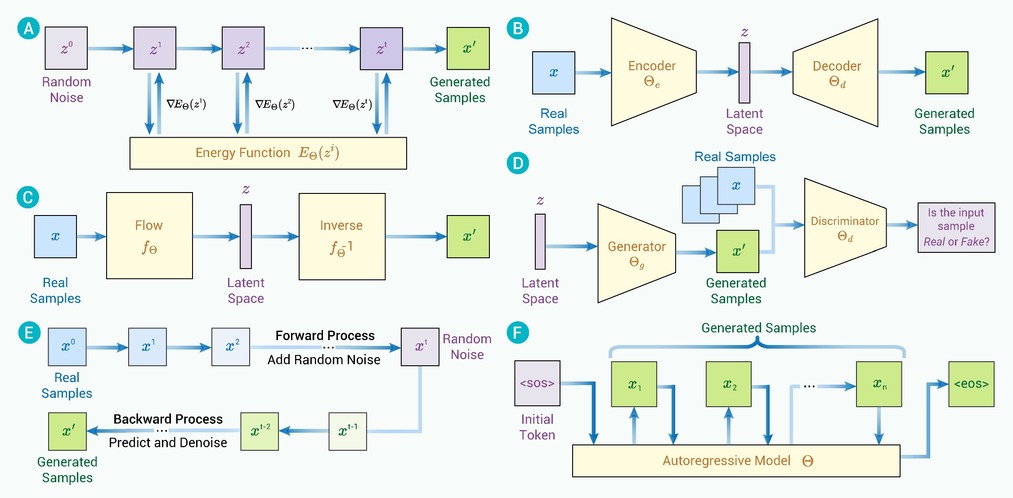
Figure 1.
Landscape of GenAI Methodologies.
-
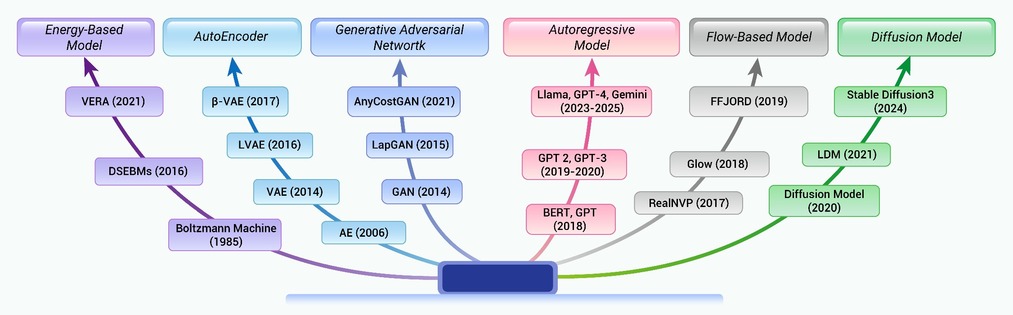
Figure 2.
Taxonomy of GenAI Models
-
Figure 3.
Design of biomolecules within the central dogma
-
Figure 4.
Design of biomolecules beyond the central dogma
-
Figure 5.
A general workflow for designing functional biomolecules using GenAI models.
