
Mass production of microbial protein using low-value materials
-
ABSTRACT
Global demand for protein now exceeds 200 million tonnes annually and is projected to rise to around 280 million tonnes by 2050. Meeting this demand requires diversifying protein sources beyond conventional animal- and plant-based products. Microbial proteins offer a promising alternative to traditional food and feed sources by reducing dependence on conventional agricultural systems and mitigating the environmental impacts of livestock farming. However, large-scale production of microbial proteins is currently hindered by the scarcity of cost-effective raw materials and the lack of efficient bioconversion technologies. This paper outlines strategies to accelerate the near-term scale-up of microbial proteins using low-value carbon sources. These include establishing feedstock databases, engineering robust strains for crude substrate utilization, and integrating advances in metabolic and process engineering. We further emphasize the importance of pilot- and demo-scale validation, regulatory streamlining, and cross-sector collaboration to enable sustainable and economically viable industrial deployment. -

-
REFERENCES
[1] Sollai S., Porcu A., Tola V., et al. (2023). Renewable methanol production from green hydrogen and captured CO2: A techno-economic assessment. J. CO2 Util. 68:10234. DOI:10.1016/j.jcou.2022.102345 [2] Cotton R., Claassens J., Benito-Vaquerizo S., et al. (2020). Renewable methanol and formate as microbial feedstocks. Curr. Opin. Biotech. 62:168−180. DOI:10.1016/j.copbio.2019.10.002 [3] Sarantou S., Stoforos N., Kalantzi O., et al. (2021). Biotechnological valorization of biodiesel-derived glycerol: Trials with the non-conventional yeasts Yarrowia lipolytica and Rhodosporidium sp. Carbon Resour. Convers. 4:61−75. DOI:10.1016/j.crcon.2020.12.006 [4] Humpenöder F., Bodirsky L., Weindl I., et al. (2022). Projected environmental benefits of replacing beef with microbial protein. Nature 605:90−96. DOI:10.1038/s41586-022-04629-w [5] Hartner S. and Glieder A. (2006). Regulation of methanol utilisation pathway genes in yeasts. Microb. Cell Fact. 5:39. DOI:10.1186/1475-2859-5-39 [6] Wang S., Wang Y., Yuan Q., et al. (2023). Development of high methanol-tolerance based on iterative adaptive laboratory evolution. Green Chem. 25:8845−8857. DOI:10.1039/D3GC02874G [7] Schulz-Mirbach H., Dronsella B., He H., et al. (2024). Creating new-to-nature carbon fixation: A guide. Metab. Eng. 82:12−28. DOI:10.1016/j.ymben.2023.12.012 [8] Xu J., Liu N., Qiao K., et al. (2017). Application of metabolic controls for the maximization of lipid production in semicontinuous fermentation. Proc. Natl. Acad. Sci. USA 114:E5308−E5316. DOI:10.1073/pnas.1703321114 [9] Mahmud N., Taiwo K. and Usack J. (2024). Decarbonizing the food system with microbes and carbon-neutral feedstocks. Annu. Rev. Food Sci. Technol. 16:81−104. DOI:10.1146/annurev-food-111523-121717 [10] Meng J., Liu S., Gao L., et al. (2023). Economical production of Pichia pastoris single cell protein from methanol at industrial pilot scale. Microb. Cell Fact. 22:198. DOI:10.1186/s12934-023-02198-9 -
ABOUT THIS ARTICLE
Cite this article:
Chen Z., Deng J., Han P., et al. (2026). Mass production of microbial protein using low-value materials. The Innovation Life 4:100200. https://doi.org/10.59717/j.xinn-life.2026.100200
Welcome!
To request copyright permission to republish or share portions of our works, please visit Copyright Clearance Center's (CCC) Marketplace website at marketplace.copyright.com.
Export File
Citation
Chen Z., Deng J., Han P., et al. (2026). Mass production of microbial protein using low-value materials. The Innovation Life 4:100200. https://doi.org/10.59717/j.xinn-life.2026.100200

Format
Content
 DownLoad:
-
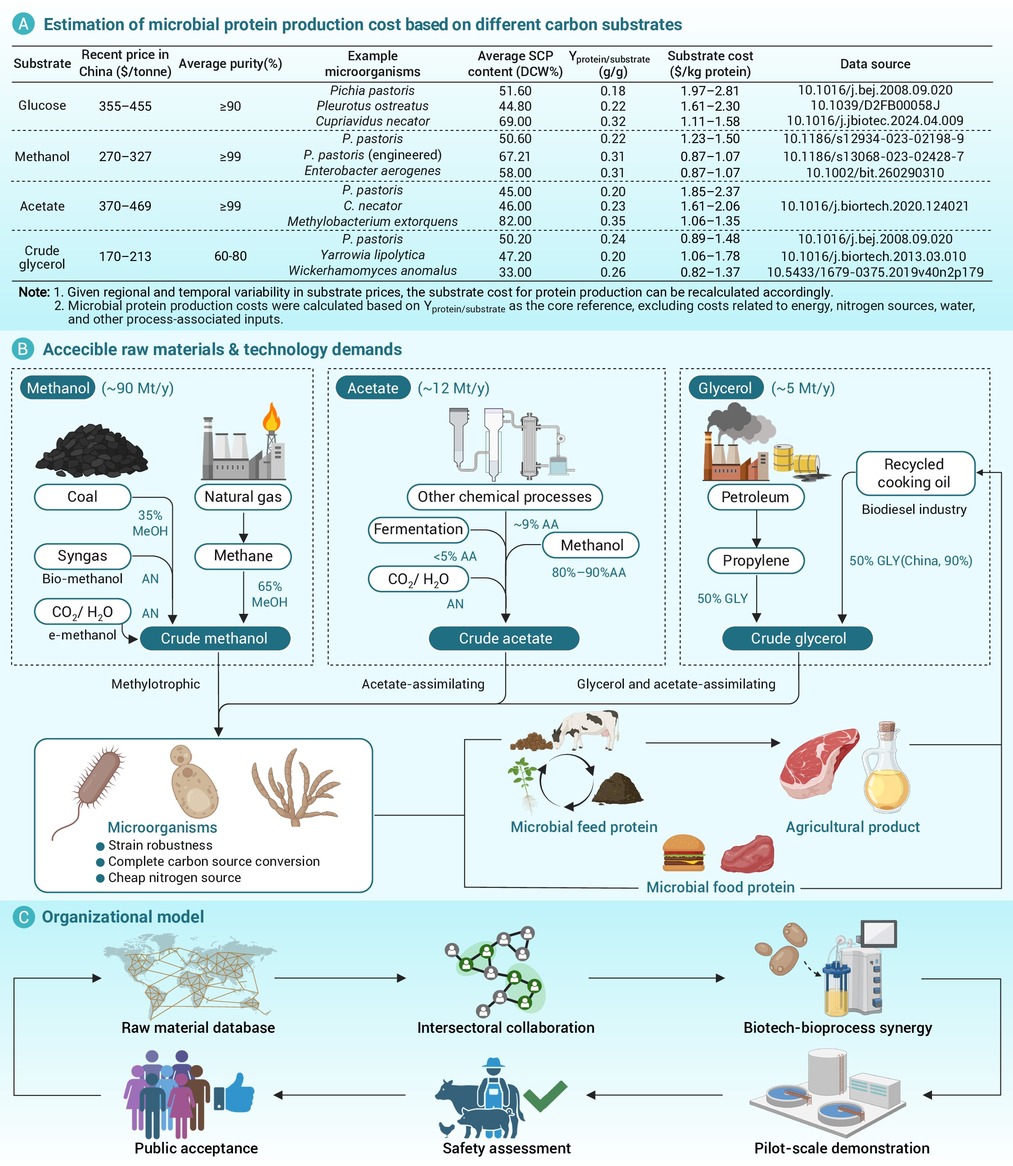
Figure 1.
Strategy for mass production of microbial protein using low-value materials
