
Physiological-cell-density 3D bioprinting: Advancing tissue constructs for near-native function
-

-
REFERENCES
[1] Liu K., Fang X., Aazmi A., et al. (2024). Organoids: Principle, application and perspective. Innov. Life 2:100088. DOI:10.59717/j.xinn-life.2024.100088 [2] Zhang Y. S., Dolatshahi-Pirouz A. and Orive G. (2024). Regenerative cell therapy with 3D bioprinting. Science 385:604−606. DOI:10.1126/science.add8593 [3] You S. T., Xiang Y., Hwang H. H., et al. (2023). High cell density and high-resolution 3D bioprinting for fabricating vascularized tissues. Sci. Adv. 9:eade7923. DOI:10.1126/sciadv.ade7923 [4] Wang M., Li W., Hao J., et al. (2025). Biomaterial-minimalistic photoactivated bioprinting of cell-dense tissues. Cell 189:106−122.e26. DOI:10.1016/j.cell.2025.11.012 [5] Xuan L., Hou Y., Liang L., et al. (2024). Microgels for cell delivery in tissue engineering and regenerative medicine. Nano-micro Lett. 16:218. DOI:10.1007/s40820-024-01421-5 -
ABOUT THIS ARTICLE
Cite this article:
Xuan L., Li J., Zhan B., et al. (2026). Physiological-cell-density 3D bioprinting: Advancing tissue constructs for near-native function. The Innovation Life 4:100202. https://doi.org/10.59717/j.xinn-life.2026.100202
Welcome!
To request copyright permission to republish or share portions of our works, please visit Copyright Clearance Center's (CCC) Marketplace website at marketplace.copyright.com.
Export File
Citation
Xuan L., Li J., Zhan B., et al. (2026). Physiological-cell-density 3D bioprinting: Advancing tissue constructs for near-native function. The Innovation Life 4:100202. https://doi.org/10.59717/j.xinn-life.2026.100202

Format
Content
 DownLoad:
-
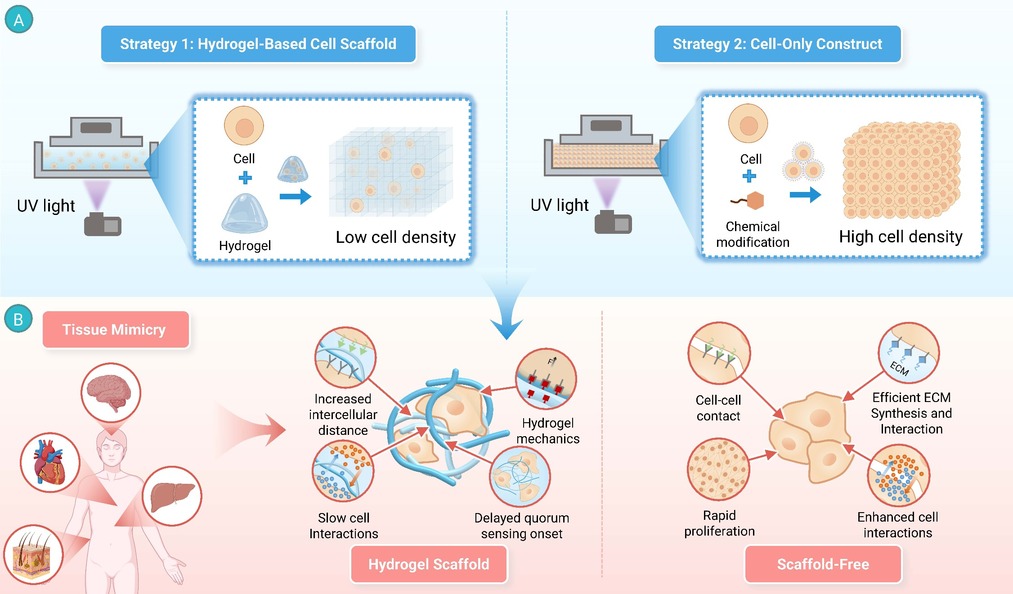
Figure 1.
Illustration of the hydrogel-based cell scaffold and cell-only construct.
