
-

-
REFERENCES
[1] D'Hont A. (2025). The genomic footprints of wild Saccharum species trace domestication, diversification, and modern breeding of sugarcane. Cell 188:7252−7266.e15. DOI:10.1016/j.cell.2025.09.017 [2] Wang P., Si H., Li C., et al. (2025). Plant genetic transformation: achievements, current status and future prospects. Plant Biotechnol. J. 23:2034−2058. DOI:10.1111/pbi.70028 [3] Lu G., Liu P., Wu Q., et al. (2025). Sugarcane breeding: a fantastic past and promising future driven by technology and methods. Front Plant Sci. 15:1375934. DOI:10.3389/fpls.2024.1375934 [4] Wang D., Gou Y., Yi C., et al. (2025b). ScWRKY2: A key regulator for smut resistance in sugarcane. Plant Biotechnol. J. 23:3667−3681. DOI:10.1111/pbi.70186 [5] Wang W., Wang D., Zhao W., et al. (2025c). Highly efficient and genotype-Independent genetic transformation system in sugarcane. Plant Biotechnol. J. DOI:10.1111/pbi.70486 -
ABOUT THIS ARTICLE
Cite this article:
Wang P., Wu Q., Wang W., et al. (2026). Three-chain empowered sugarcane bio-breeding in China. The Innovation Life 4:100207. https://doi.org/10.59717/j.xinn-life.2026.100207
Welcome!
To request copyright permission to republish or share portions of our works, please visit Copyright Clearance Center's (CCC) Marketplace website at marketplace.copyright.com.
Export File
Citation
Wang P., Wu Q., Wang W., et al. (2026). Three-chain empowered sugarcane bio-breeding in China. The Innovation Life 4:100207. https://doi.org/10.59717/j.xinn-life.2026.100207

Format
Content
 DownLoad:
-
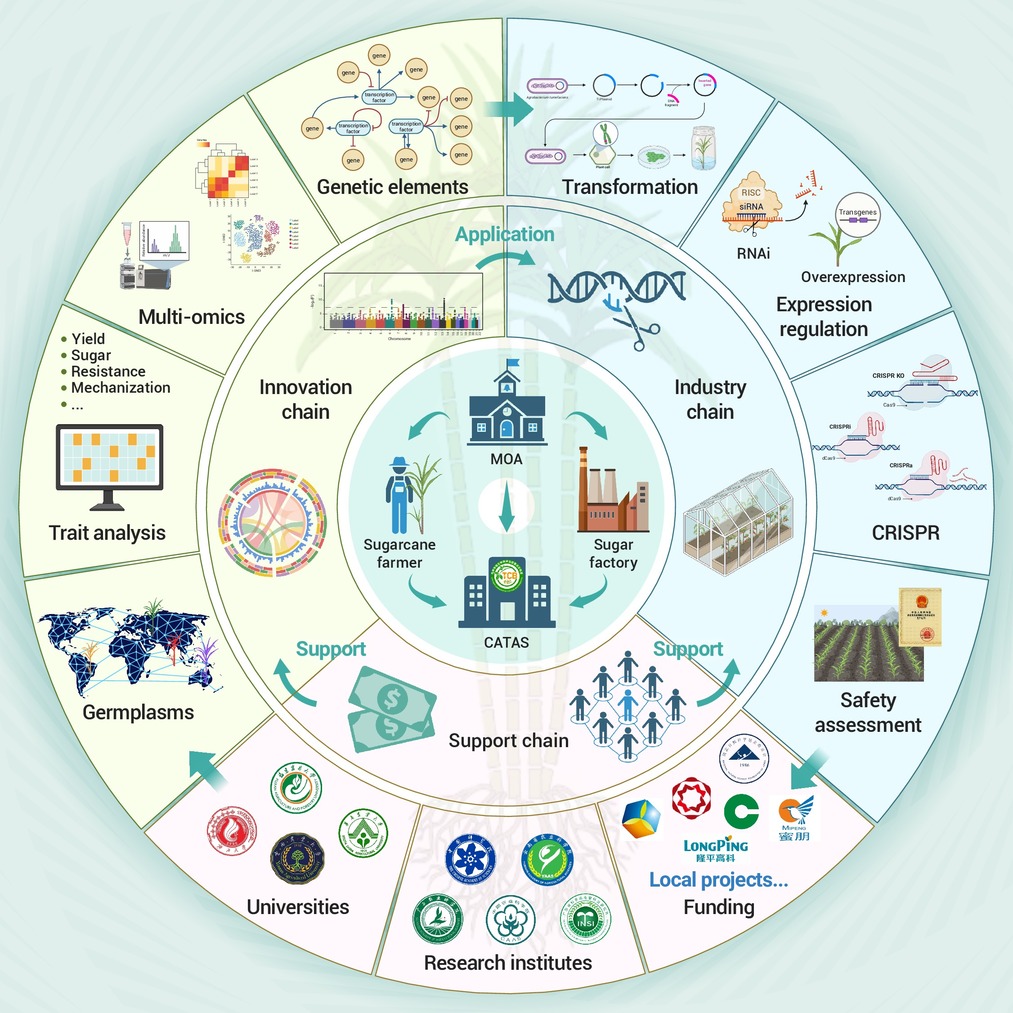
Figure 1.
Three-chain collaborative framework for sugarcane biotechnological breeding innovation and industrial application
