
MOFs: From programmable porous crystals to precision biomedicine
-

-
REFERENCES
[1] Jin K., Moon D., Chen Y.-P., et al. (2024). Comprehensive qualitative and quantitative colorimetric sensing of volatile organic compounds using monolayered metal-organic framework films. Adv. Mater. 36:2309570. DOI:10.1002/adma.202309570 [2] Zhang S.-Y., Wang Z.-Y., Gao J., et al. (2019). A gadolinium (III) zeolite-like metal-organic-framework-based magnetic resonance thermometer. Chem 5:1609−1618. DOI:10.1016/j.chempr.2019.04.010 [3] Shao Y., Liu B., Di Z., et al. (2020). Engineering of upconverted metal–organic frameworks for near-infrared light-triggered combinational photodynamic/chemo-/immunotherapy against hypoxic tumors. J. Am. Chem. Soc. 142:3939−3946. DOI:10.1021/jacs.9b12788 [4] Yao X., Yan Z., Liu A., et al. (2023). Metal organic framework-modified bioadaptable implant potentiates the reconstruction of nerve microenvironment via immunometabolism reprogramming. Nano Today 49:101814. DOI:10.1016/j.nantod.2023.101814 [5] Ge X., Liu Y., Zhao X, et al. (2025). Advances in metal-organic frameworks for cardiovascular therapy: From structural design to preclinical applications. Coord. Chem. Rev. 544:216971. DOI:10.1016/j.ccr.2025.216971 -
ABOUT THIS ARTICLE
Cite this article:
Zhao Y., Chu P. and Wang H. (2026). MOFs: From programmable porous crystals to precision biomedicine. The Innovation Life 4:100211. https://doi.org/10.59717/j.xinn-life.2026.100211
Welcome!
To request copyright permission to republish or share portions of our works, please visit Copyright Clearance Center's (CCC) Marketplace website at marketplace.copyright.com.
Export File
Citation
Zhao Y., Chu P. and Wang H. (2026). MOFs: From programmable porous crystals to precision biomedicine. The Innovation Life 4:100211. https://doi.org/10.59717/j.xinn-life.2026.100211

Format
Content
 DownLoad:
-
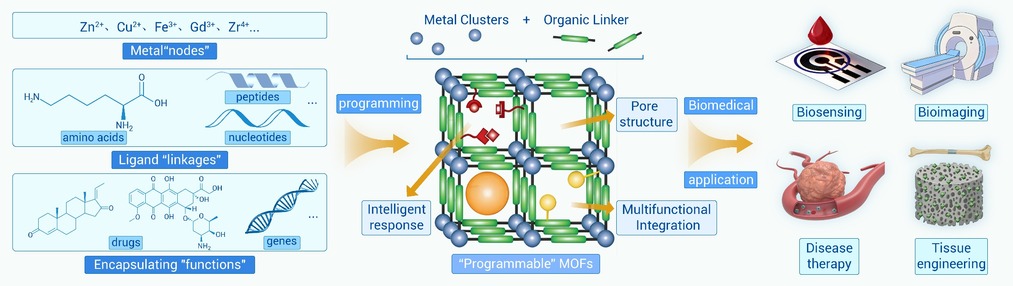
Figure 1.
Programmability and application of MOFs.
