
Toward an integrated framework to assess climate vulnerabilities: Beyond the thermal tolerance in tropical insects
-

-
REFERENCES
[1] Holzmann K.L., Schmitzer T., Abels A., et al., (2026). Limited thermal tolerance in tropical insects and its genomic signature. Nature 651:672‒678. DOI: 10.1038/s41586-026-10155-w [2] Sun B.-J., Lu H.-L., Cheng K.-M., et al., (2025). The semi‐natural climate chambers across latitudes: A broadly applicable husbandry and experimental system for terrestrial ectotherms under climate change. Adv. Sci. 12:2414185. DOI:10.1002/advs.202414185 [3] Chen J. and Lewis O.T. (2024). Limits to species distributions on tropical mountains shift from high temperature to competition as elevation increases. Ecol. Monogr. 94:e1597. DOI:10.1002/ecm.1597 [4] Sunday J.M., Bates A.E., Kearney M.R., et al., (2014). Thermal-safety margins and the necessity of thermoregulatory behavior across latitude and elevation. Proc. Natl. Acad. Sci. USA 111:5610–5615. DOI: 10.1073/pnas.1316145111 [5] Chen J. and Lewis O.T. (2025). A cryptic host–parasitoid interaction reduces the impact of heatwaves on Drosophila host populations. Proc. Biol. Sci. 292:20251527. DOI:10.1098/rspb.2025.1527 -
ABOUT THIS ARTICLE
Cite this article:
Jiang Z.-W., Zhang L., Sun B.-J., et al. (2026). Toward an integrated framework to assess climate vulnerabilities: Beyond the thermal tolerance in tropical insects. The Innovation Life 4:100217. https://doi.org/10.59717/j.xinn-life.2026.100217
Welcome!
To request copyright permission to republish or share portions of our works, please visit Copyright Clearance Center's (CCC) Marketplace website at marketplace.copyright.com.
Export File
Citation
Jiang Z.-W., Zhang L., Sun B.-J., et al. (2026). Toward an integrated framework to assess climate vulnerabilities: Beyond the thermal tolerance in tropical insects. The Innovation Life 4:100217. https://doi.org/10.59717/j.xinn-life.2026.100217

Format
Content
 DownLoad:
-
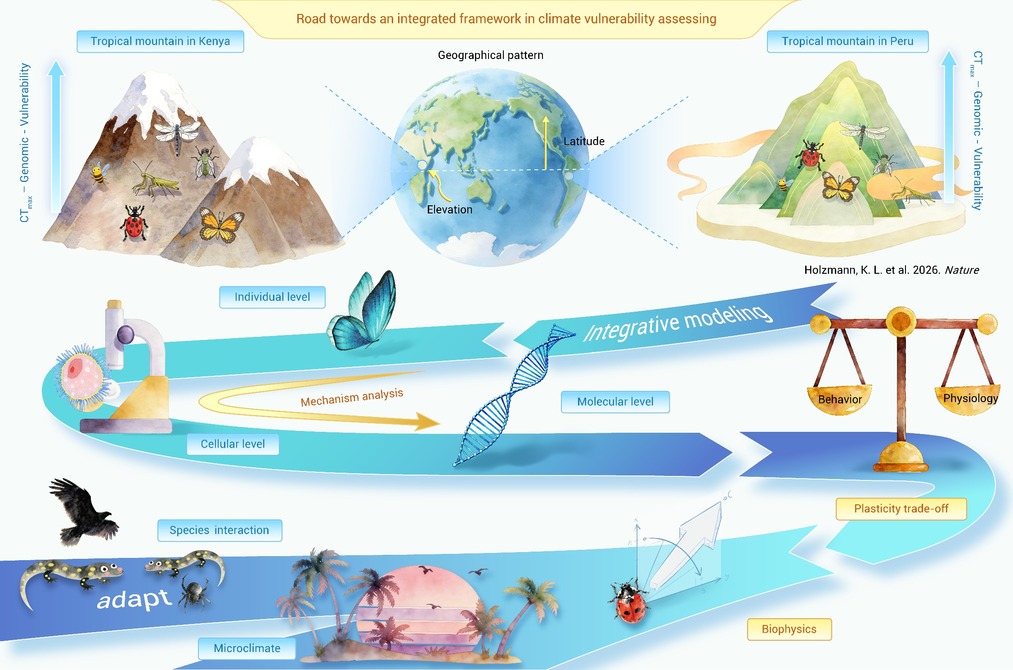
Figure 1.
Road toward an integrated framework in climate vulnerability assessing
