
From transcriptome reversal to network reprogramming: A new paradigm for drug screening driven by deep learning
-

-
REFERENCES
[1] Xing J., Tan M., Leshchiner D., et al. (2026). Deep-learning-based de novo discovery and design of therapeutics that reverse disease-associated transcriptional phenotypes. Cell 189:2556−2572.e19. DOI:10.1016/j.cell.2026.02.016 [2] Su Y., Liu D., Menon V., et al. (2026). pertTF: Context-aware AI modeling for genome-scale and cross-system perturbation prediction. bioRxiv. DOI:10.64898/2026.03.12.711379 [3] Wang T., Pan Y., Ju F., et al. (2025). CellNavi predicts genes directing cellular transitions by learning a gene graph-enhanced cell state manifold. Nat. Cell Biol. 27:1863−1874. DOI:10.1038/s41556-025-01755-1 [4] Hegde A. and Cheng J. (2026). GRNFormer: Accurate gene regulatory network inference using graph transformer. Bioinformatics 42:btag144. DOI:10.1093/bioinformatics/btag144 [5] Dai X., Shan C., Zheng J., et al. (2023). Biological factor regulatory neural network. arXiv. DOI:10.48550/arXiv.2304.04982 -
ABOUT THIS ARTICLE
Cite this article:
Yang Y., Zhang H., Li Y., et al. (2026). From transcriptome reversal to network reprogramming: A new paradigm for drug screening driven by deep learning. The Innovation Life 4:100220. https://doi.org/10.59717/j.xinn-life.2026.100220
Welcome!
To request copyright permission to republish or share portions of our works, please visit Copyright Clearance Center's (CCC) Marketplace website at marketplace.copyright.com.
Export File
Citation
Yang Y., Zhang H., Li Y., et al. (2026). From transcriptome reversal to network reprogramming: A new paradigm for drug screening driven by deep learning. The Innovation Life 4:100220. https://doi.org/10.59717/j.xinn-life.2026.100220

Format
Content
 DownLoad:
-
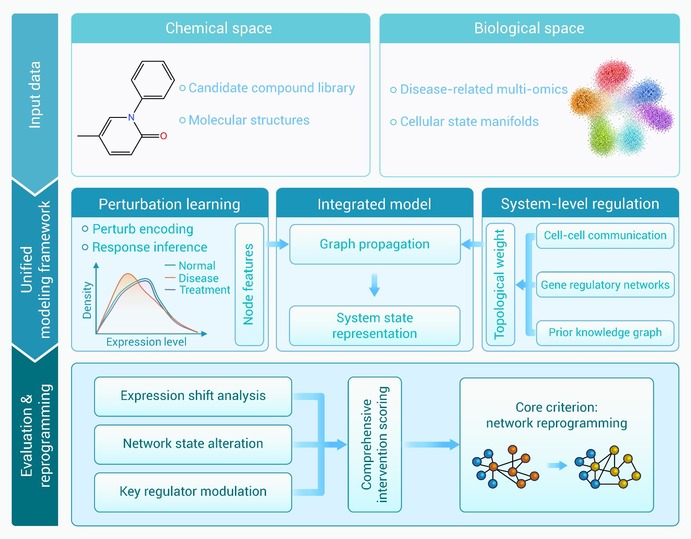
Figure 1.
From expression reversal to network reprogramming in drug screening
