
From gene editing to cell editing: An emerging technology for synthetic biology
-
ABSTRACT
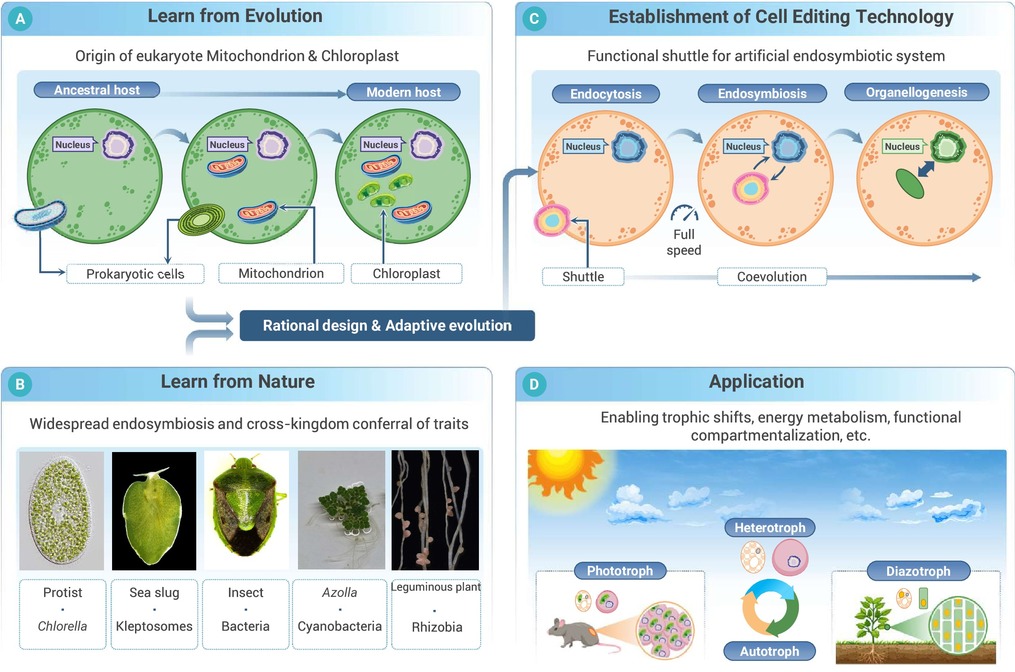
With the rapid advancement of synthetic biology, there is a growing need to engineer increasingly complex genetic traits involving multiple, poorly understood genetic networks or functions. However, current gene-editing technologies in synthetic biology remain applicable only to relatively well-understood and simple metabolic pathways. Here, we propose cell editing—a technology inspired by endosymbiosis—for implementing complex functions into a host chassis that are currently difficult or impossible to achieve. Interkindom endosymbiosis, evolving at different stages, are widespread in nature. Understanding the principles of endosymbiosis can therefore provide a critical blueprint for cell editing. This foundational approach leverages engineered symbiotic interactions to reprogram cellular functions. Through rational design of engineered donor cells (or “functional shuttles”) combined with laboratory adaptive evolution, cell editing aims to achieve radical cellular reprogramming—including trophic shift, reconstruction of core energy metabolism, and even de novo functional compartmentalization. Ultimately, this endosymbiotic framework has the potential to pioneer new directions in synthetic biology and cell engineering, enabling modular acquisition of complex traits beyond the reach of current gene-editing tools. -

-
REFERENCES
[1] Guo K., Yang J., Yu N., et al. (2023). Biological nitrogen fixation in cereal crops: Progress, strategies, and perspectives. Plant Commun. 4:100499. DOI:10.1016/j.xplc.2022.100499 [2] Vosseberg J., van Hooff J. J. E., Kostlbacher S., et al. (2024). The emerging view on the origin and early evolution of eukaryotic cells. Nature 633:295−305. DOI:10.1038/s41586-024-07677-6 [3] Calatrava V., Stephens T. G., Gabr A., et al. (2022). Retrotransposition facilitated the establishment of a primary plastid in the thecate amoeba Paulinella. Proc. Natl. Acad. Sci. USA 119:e2121241119. DOI:10.1073/pnas.2121241119 [4] Allard C. A. H., Thies A. B., Mitra R., et al. (2025). A host organelle integrates stolen chloroplasts for animal photosynthesis. Cell 188:5266–5277 e5213. DOI:10.1016/j.cell.2025.06.003 [5] Massana R. (2024). The nitroplast: A nitrogen-fixing organelle. Science 384:160−161. DOI:10.1126/science.ado8571 [6] Husnik F., Tashyreva D., Boscaro V., et al. (2021). Bacterial and archaeal symbioses with protists. Curr Biol 31:R862−R877. DOI:10.1016/j.cub.2021.05.049 [7] Gao Y. L., Cournoyer J., De B. C., et al. (2024). Introducing carbon assimilation in yeasts using photosynthetic directed endosymbiosis. Nat. Commun. 15:5947. DOI:10.1038/s41467-024-49585-3 [8] Giger G. H., Ernst C., Richter I., et al. (2024). Inducing novel endosymbioses by implanting bacteria in fungi. Nature 635:415−422. DOI:10.1038/s41586-024-08010-x [9] Koga R., Moriyama M., Onodera-Tanifuji N., et al. (2022). Single mutation makes Escherichia coli an insect mutualist. Nat. Microbiol. 7:1141−1150. DOI:10.1038/s41564-022-01179-9 [10] Ivanov S., Fedorova E. E., Limpens E., et al. (2012). Rhizobium-legume symbiosis shares an exocytotic pathway required for arbuscule formation. Proc. Natl. Acad. Sci. USA 109:8316−8321. DOI:10.1073/pnas.1200407109 -
ABOUT THIS ARTICLE
Cite this article:
Deng Y., Xiong J., Huang K., et al. (2026). From gene editing to cell editing: An emerging technology for synthetic biology. The Innovation Life 4:100225. https://doi.org/10.59717/j.xinn-life.2026.100225
Welcome!
To request copyright permission to republish or share portions of our works, please visit Copyright Clearance Center's (CCC) Marketplace website at marketplace.copyright.com.
Export File
Citation
Deng Y., Xiong J., Huang K., et al. (2026). From gene editing to cell editing: An emerging technology for synthetic biology. The Innovation Life 4:100225. https://doi.org/10.59717/j.xinn-life.2026.100225

Format
Content
 DownLoad:
-
Figure 1.
Development of cell editing technology
