
Biosynthesis and characterization of poly(3-hydroxybutyrate-co-lactate-co-3-hydroxyvalerate) by engineered Halomonas bluephagenesis
-
GRAPHICAL ABSTRACT
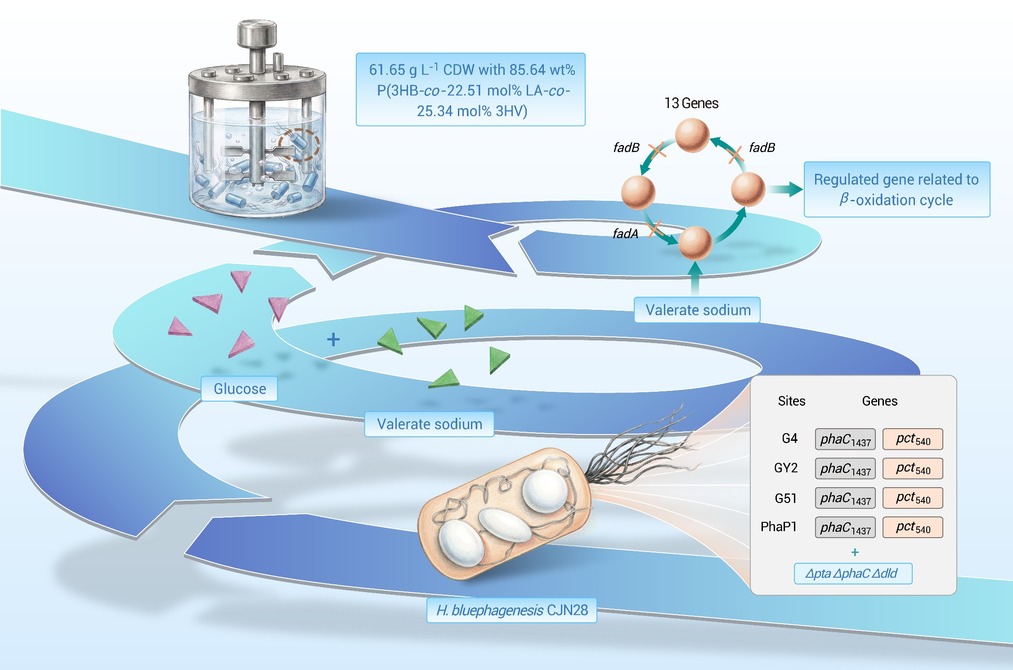
 DownLoad:
Full size image
DownLoad:
Full size image
-
PUBLIC SUMMARY
-
Biosynthesis of P(3HB-co-LA-co-3HV) was achieved in recombinant Halomonas.
Various P(3HB-co-LA-co-3HV) were produced from glucose and valerate.
Halomonas CJN28 was grown to 62 g L−1 CDW containing 86wt% P(3HB-23 mol% LA-25 mol% 3HV).
Thermal and mechanical properties of various P(3HB-co-LA-co-3HV) were characterized.
-
-
ABSTRACT
Halomonas bluephagenesis (H. bluephagenesis) was metabolically engineered to efficiently synthesize a biopolymer composed of three monomers—3-hydroxybutyrate (3HB), lactate (LA), and 3-hydroxyvalerate (3HV)—using glucose as the carbon source. In shake-flask cultures with glucose-sodium valerate as the carbon source, the recombinant strain produced 9.48 g L-1 of P(3HB-co-12.92 mol% LA-co-40.48 mol% 3HV). By knocking down 11 genes related to the β-oxidation cycle, the composition of the terpolymer was controllable. In a 7-L bioreactor, H. bluephagenesis CJN28 reached 61.65 g L-1 cell dry weight (CDW containing 85.64 wt% P(3HB-co-22.51 mol% LA-co-25.34 mol% 3HV). Both H. bluephagenesis CJN28 and its cytoskeletal protein MreB-knockdown mutant H. bluephagenesis CJN28△mreB (exhibiting significant cell enlargement) demonstrated better capability to synthesize P(3HB-co-LA-co-3HV) when cultured with glucose and gradient concentrations of sodium valerate. Thermal and mechanical studies revealed that the terpolymer exhibited higher ductility compared to P3HB and PLA. This study marks the first attempt of microbial production of P(3HB-co-LA-co-3HV) with enhanced efficiency for scale up.-
Keywords:
- PHB /
- Lactide /
- Terpolymer /
- PHA /
- Halomonas /
- Metabolic engineering
-

-
REFERENCES
[1] Owusu P. A. and Asumadu-Sarkodie S. (2016). A review of renewable energy sources, sustainability issues and climate change mitigation. Cogent. Eng. 3:1167990. DOI:10.1080/23311916.2016.1167990 [2] Wang M., Chen L., Zhang Z., et al. (2025). Recent advances in genome mining and synthetic biology for discovery and biosynthesis of natural products. Crit. Rev. Biotechnol. 45:236−256. DOI:10.1080/07388551.2024.2383754 [3] Del Hierro A. G., Moreno-Cid J. A. and Casey E. (2024). Continuous biomanufacturing for sustainable bioeconomy applications. EFB. Bioeconomy. J. 4:100071. DOI:10.1016/j.bioeco.2024.100071 [4] Neto A. S., Wainaina S., Chandolias K., et al. (2025). Exploring the potential of syngas fermentation for recovery of high-value resources: A comprehensive review. Curr. Pollut. Rep. 11:7. DOI:10.1007/s40726-024-00337-3 [5] Hwang S., Joung C., Kim W., et al. (2023). Recent advances in non-model bacterial chassis construction. Curr. Opin. Syst. Biol. 36:100471. DOI:10.1016/j.coisb.2023.100471 [6] Ye J. W. and Chen G. Q. (2021). Halomonas as a chassis. Essays Biochem. 65:393−403. DOI:10.1042/EBC20200159 [7] Dalton B., Bhagabati P., De Micco J., et al. (2022). A review on biological synthesis of the biodegradable polymers polyhydroxyalkanoates and the development of multiple applications. Catalysts 12:319. DOI:10.3390/catal12030319 [8] Fukala I. and Kučera I. (2024). Natural polyhydroxyalkanoates-An overview of bacterial production methods. Molecules 29:2293. DOI:10.3390/molecules29102293 [9] Chen X., Li M. and Chen G. Q. (2021). Thirty years of metabolic engineering for biosynthesis of polyhydroxyalkanoates. Chin. J. Biotechnol. 37:1794−1811. DOI:10.13345/j.cjb.200457 [10] Zhou W., Bergsma S., Colpa D. I., et al. (2023). Polyhydroxyalkanoates (PHAs) synthesis and degradation by microbes and applications towards a circular economy. J. Environ. Manage. 341:118033. DOI:10.1016/j.jenvman.2023.118033 [11] Yan X., Liu X., Yu L.P., et al. (2022). Biosynthesis of diverse α,ω-diol-derived polyhydroxyalkanoates by engineered Halomonas bluephagenesis. Metab. Eng. 72:275−288. DOI:10.1016/j.ymben.2022.04.001 [12] Jiang X.R. and Chen G.Q. (2016). Morphology engineering of bacteria for bio-production. Biotechnol. Adv. 34:435−440. DOI:10.1016/j.biotechadv.2015.12.007 [13] Wang H., Ouyang Y., Yang W., et al. (2025). Production and characterization of copolymers consisting of 3-hydroxybutyrate and increased 3-hydroxyvalerate by β-oxidation weakened Halomonas. Metab. Eng. 89:97−107. DOI:10.1016/j.ymben.2025.02.009 [14] Tang H. J., Neoh S. Z. and Sudesh K. (2022). A review on poly(3-hydroxybutyrate-co-3-hydroxyhexanoate) [P(3HB-co-3HHx)] and genetic modifications that affect its production. Front. Bioeng. Biotechnol. 10:1057067. DOI:10.3389/fbioe.2022.1057067 [15] Wen R., Chen Y., Wang J., et al. (2026). Pilot production of P(3HB-co-4HB) by engineered Halomonas bluephagenesis harboring an endogenous plasmid grown on glucose. Metab. Eng. 94:153−168. DOI:10.1016/j.ymben.2025.11.017 [16] Aversa C., Barletta M. and Koca N. (2023). Processing PLA/P(3HB)(4HB) blends for the manufacture of highly transparent, gas barrier and fully bio‐based films for compostable packaging applications. J. Appl. Polym. Sci. 140:e53669. DOI:10.1002/app.53669 [17] Râpă M., Stefan L. M., Seciu-Grama A.M., et al. (2022). Poly(3-hydroxybutyrate-co-3-hydroxyvalerate) (P(3HB-co-3HV))/bacterial cellulose (BC) biocomposites for potential use in biomedical applications. Polymers 14:5544. DOI:10.3390/polym14245544 [18] Turco R., Santagata G., Corrado I., et al. (2021). In vivo and post-synthesis strategies to enhance the properties of PHB-based materials: A review. Int. J. Biol. Macromol. 8:619266. DOI:10.3389/fbioe.2020.619266 [19] Farah S., Anderson D. G. and Langer R. (2016). Physical and mechanical properties of PLA, and their functions in widespread applications — A comprehensive review. Adv. Drug. Deliv. Rev. 107:367−392. DOI:10.1016/j.addr.2016.06.012 [20] Poltronieri P. and Kumar P. (2019). Polyhydroxyalkanoates (PHAs) in industrial applications. Handb. Ecomater. 14:2843−2872. DOI:10.1007/978-3-319-48281-1_70-1 [21] Suhazsini P., Keshav R., Narayanan S., et al. (2020). A study on the synthesis of poly (3-hydroxybutyrate-co-3-hydroxyvalerate) by bacillus megaterium utilizing cheese whey permeate. J. Polym. Environ. 28:1390−1405. DOI:10.1007/s10924-020-01687-x [22] Shozui F., Matsumoto K., Nakai T., et al. (2010). Biosynthesis of novel terpolymers poly(lactate-co-3-hydroxybutyrate-co-3-hydroxyvalerate)s in lactate-overproducing mutant Escherichia coli JW0885 by feeding propionate as a precursor of 3-hydroxyvalerate. Appl. Microbiol. Biotechnol. 85:949−954. DOI:10.1007/s00253-009-2100-y [23] Yang F., Wang H., Zhao C., et al. (2024). Metabolic engineering of Halomonas bluephagenesis for production of five carbon molecular chemicals derived from L-lysine. Metab. Eng. 81:227−237. DOI:10.1016/j.ymben.2023.12.001 [24] Tan D., Xue Y.-S., Aibaidula G., et al. (2011). Unsterile and continuous production of polyhydroxybutyrate by Halomonas TD01. Bioresour. Technol. 102:8130−8136. DOI:10.1016/j.biortech.2011.05.068 [25] Chen Y., Chen X.Y., Du H.T., et al. (2019). Chromosome engineering of the TCA cycle in Halomonas bluephagenesis for production of copolymers of 3-hydroxybutyrate and 3-hydroxyvalerate (PHBV). Metab. Eng. 54:69−82. DOI:10.1016/j.ymben.2019.03.006 [26] Ye J., Hu D., Yin J., et al. (2020). Stimulus response-based fine-tuning of polyhydroxyalkanoate pathway in Halomonas. Metab. Eng. 57:85−95. DOI:10.1016/j.ymben.2019.10.007 [27] Yan X., Liu X., Yu L. P., et al. (2022). Biosynthesis of diverse α,ω-diol-derived polyhydroxyalkanoates by engineered Halomonas bluephagenesis. Metab. Eng. 72:275−288. DOI:10.1016/j.ymben.2022.04.001 [28] Chen Y. L., Liu X., Zhang L. Z., et al. (2025). Cell sizes matter for industrial bioproduction, a case of polyhydroxybutyrate. Adv. Sc. 2025:2412256. DOI:10.1002/advs.202412256 [29] Wang H., Ye J.W., Chen X., et al. (2023). Production of PHA copolymers consisting of 3-hydroxybutyrate and 3-hydroxyhexanoate (PHBHHx) by recombinant Halomonas bluephagenesis. Chem. Eng. J. 466:143261. DOI:10.1016/j.cej.2023.143261 [30] Wang H., Ouyang Y., Yang W., et al. (2025). Production and characterization of copolymers consisting of 3-hydroxybutyrate and increased 3-hydroxyvalerate by β-oxidation weakened Halomonas. Metab. Eng. 89:97−103. DOI:10.1016/j.ymben.2025.02.009 [31] Gibson D. G., Young L., Chuang R.-Y., et al. (2009). Enzymatic assembly of DNA molecules up to several hundred kilobases. Nat. Methods 6:343−345. DOI:10.1038/nmeth.1318 [32] Qin Q., Ling C., Zhao Y., et al. (2018). CRISPR/Cas9 editing genome of extremophile Halomonas spp. Metab. Eng. 47:219−229. DOI:10.1016/j.ymben.2018.03.018 [33] Wang L.J., Jiang X.R., Hou J., et al. (2022). Engineering Halomonas bluephagenesis via small regulatory RNAs. Metab. Eng. 73:58−69. DOI:10.1016/j.ymben.2022.06.005 [34] Simon R., Priefer U. and Puhler A. (1983). A broad host mobilization system for in vivo genetic engineering: Transposon mutagenesis in Gram-negative bacteria. Bio/Technology 1:37−45. DOI:10.1038/nbt1183-784 [35] Zhao H., Zhang H. M., Chen X., et al. (2017). Novel T7-like expression systems used for Halomonas. Metab. Eng. 39:128−140. DOI:10.1016/j.ymben.2016.11.007 [36] Silva-Rocha R., Martínez-García E., Calles B., et al. (2013). The standard European vector architecture (SEVA): A coherent platform for the analysis and deployment of complex prokaryotic phenotypes. Nucleic Acids Res. 41:D666−D675. DOI:10.1093/nar/gks1119 [37] Steinbuchel A. and Lutke-Eversloh T. (2003). Metabolic engineering and pathway construction for biotechnological production of relevant polyhydroxyalkanoates in microorganisms. Biochem. Eng. J. 16:81–96. DOI 10.1016/S1369-703X(03)00036-6. [38] Chen G.Q. (2012). New challenges and opportunities for industrial biotechnology. Microb. Cell Fact. 11:111. DOI:10.1186/1475-2859-11-111 [39] Huo K., Zhao F., Zhang F., et al. (2020). Morphology engineering: A new strategy to construct microbial cell factories. World. J. Microbiol. Biotechnol. 36:127. DOI:10.1007/s11274-020-02903-5 [40] Kalia V. C., Patel S. K. S., Karthikeyan K. K., et al. (2024). Manipulating microbial cell morphology for the sustainable production of biopolymers. Polymers 16:410. DOI:10.3390/polym16030410 [41] Figge R. M., Divakaruni A. V. and Gober J. W. (2004). MreB, the cell shape-determining bacterial actin homologue, co-ordinates cell wall morphogenesis in Caulobacter crescentus. Mol. Microbiol. 51:1321−1332. DOI:10.1111/j.1365-2958.2003.03936.x [42] Reid A. J., Erickson K. M., Hazel J. M., et al. (2023). Chemoenzymatic preparation of a campylobacter jejuni lipid-linked heptasaccharide on an azide-linked polyisoprenoid. ACS Omega 8:15790−15798. DOI:10.1021/acs.biochem.6c00056 [43] Zheng S., Zhang Z., Jiang P., et al. (2024). A self-stimulating system based on a polyhydroxyalkanoates coupled induction mechanism and its applications for Halomonas. Chem. Eng. J. 489:151413. DOI:10.1016/j.cej.2024.151413 -
ABOUT THIS ARTICLE
Cite this article:
Chen J., Wang H., Xu Z., et al. (2026). Biosynthesis and characterization of poly(3-hydroxybutyrate-co-lactate-co-3-hydroxyvalerate) by engineered Halomonas bluephagenesis. The Innovation Life 4:100227. https://doi.org/10.59717/j.xinn-life.2026.100227
Welcome!
To request copyright permission to republish or share portions of our works, please visit Copyright Clearance Center's (CCC) Marketplace website at marketplace.copyright.com.
Export File
Citation
Chen J., Wang H., Xu Z., et al. (2026). Biosynthesis and characterization of poly(3-hydroxybutyrate-co-lactate-co-3-hydroxyvalerate) by engineered Halomonas bluephagenesis. The Innovation Life 4:100227. https://doi.org/10.59717/j.xinn-life.2026.100227

Format
Content
-
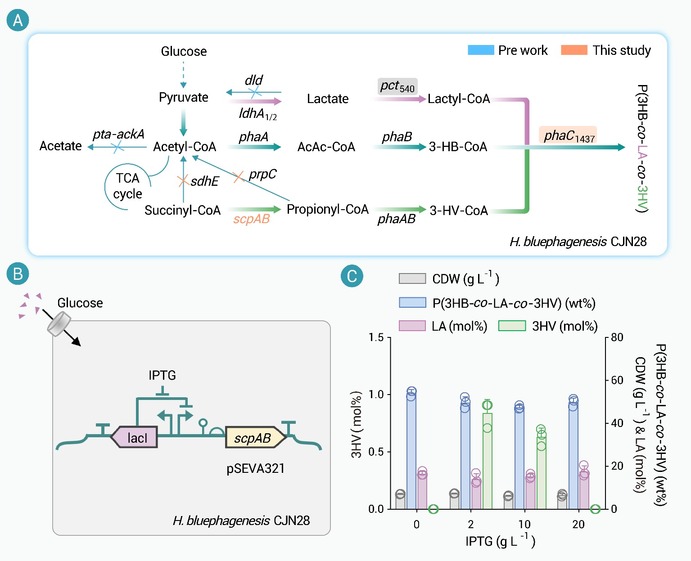
Figure 1.
De novo production of P(3HB-co-LA-co-3HV) by H. bluephagenesis CJN28△sdhE△prpC harboring pSEVA321-mmp1-scpAB grown on glucose
-
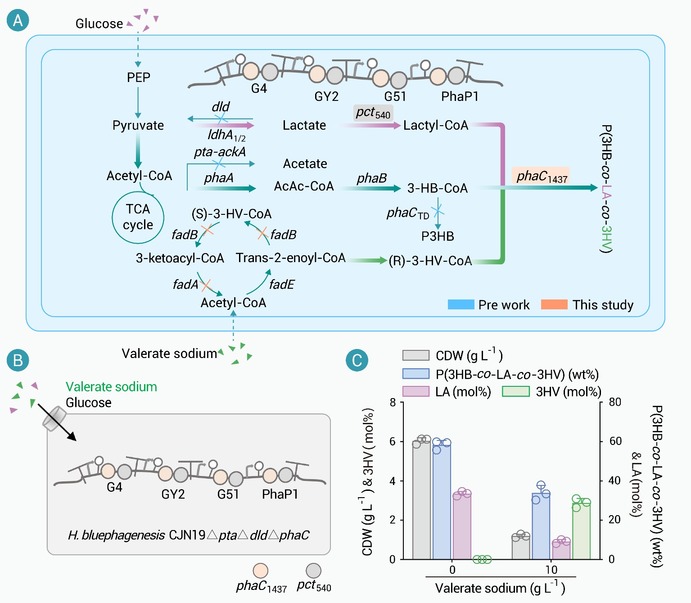
Figure 2.
P(3HB-co-LA-co-3HV) synthesis by engineered H. bluephagenesis grown on glucose and sodium valerate
-
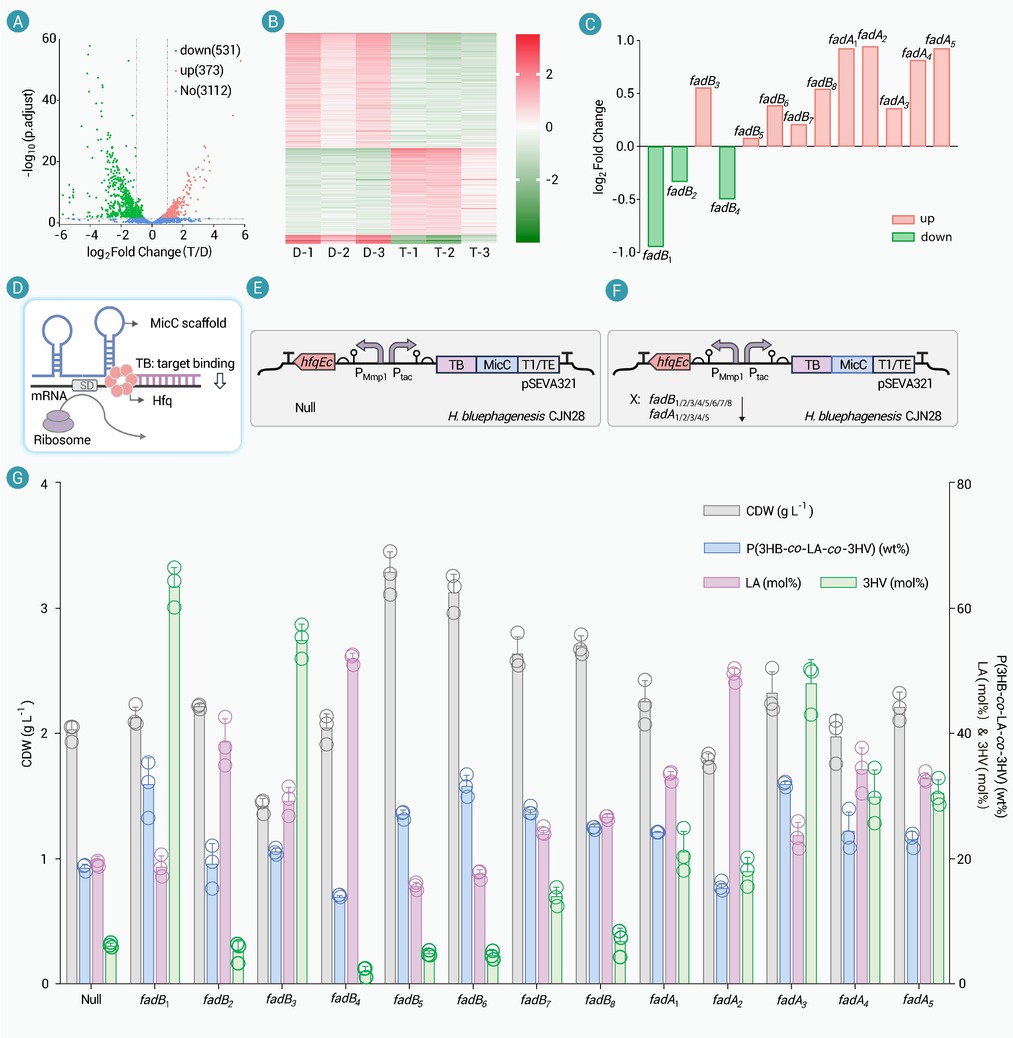
Figure 3.
Differentially regulated gene expressions related to the β-oxidation cycle in H. bluephagenesis CJN28 to produce P(3HB-co-LA-co-3HV) cultured with glucose and sodium valerate
-
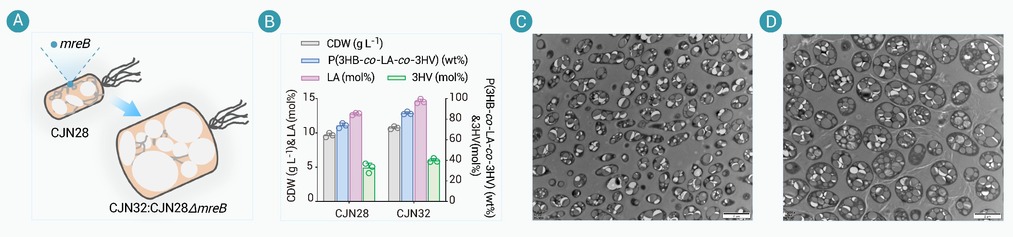
Figure 4.
Engineered H. bluephagenesis CJN32 with enlarged cellular sizes for enhanced P(3HB-co-LA-co-3HV) production
-
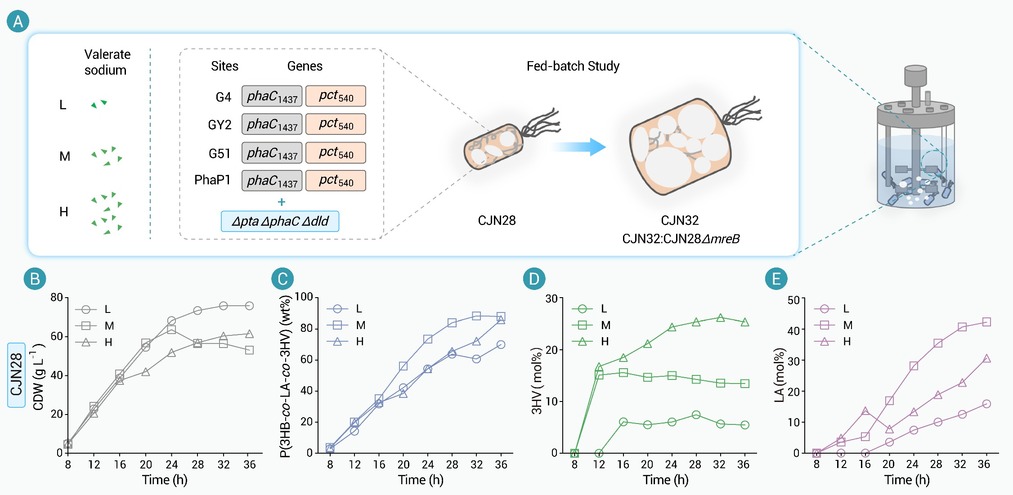
Figure 5.
P(3HB-co-LA-co-3HV) production by H. bluephagenesis CJN28 grown in bioreactors, respectively
-
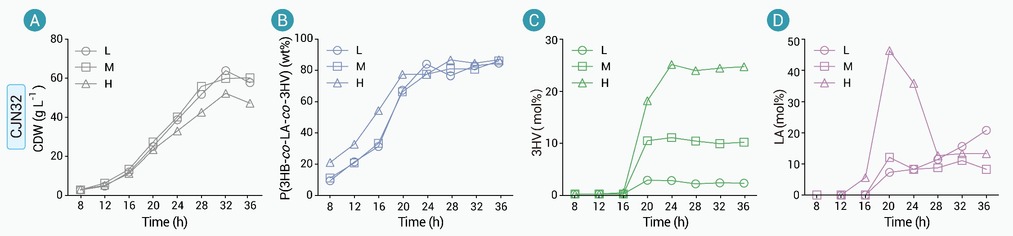
Figure 6.
P(3HB-co-LA-co-3HV) production by H. bluephagenesis CJN32 grown in bioreactors, respectively
-
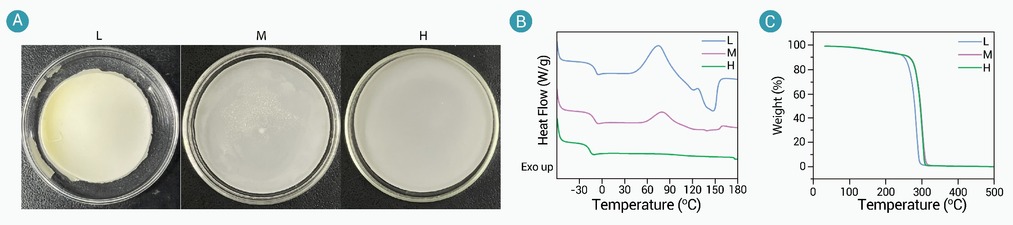
Figure 7.
Thermal and mechanical properties of P(3HB-co-LA-co-3HV) consisting of different LA and 3HV ratios, respectively
