
From virtual cells to virtual bacteria — Towards the era of evolvable micro-life digital twins
-
ABSTRACT
Life sciences are entering a stage where computational modeling and experimental biology are deeply intertwined, giving rise to the concept of digital twins in living systems. This perspective outlines the transition from virtual cells toward dynamic virtual bacteria—a new framework that seeks to reconstruct prokaryotic life in silico with evolutionary and adaptive capability. By integrating genomic, metabolic, and biophysical data, Virtual Bacteria models aim to replicate bacterial behavior, community interactions, and evolutionary dynamics at multiple scales. However, this transition requires addressing significant computational bottlenecks, data gaps in genetic understanding, and ethical governance. Such systems hold broad potential for synthetic biology, microbial ecology, antibiotic resistance research, and the study of host–microbiome relationships. Beyond their practical utility, they also offer a novel platform for exploring the origin and evolution of life from a computational standpoint. Establishing evolvable digital micro-life will not only deepen our understanding of biological complexity but may also reframe how science conceptualizes and experiments with living systems in the coming digital era. -

-
REFERENCES
[1] Cui T., Zhou Y. and Wang T. (2025). Recent advances in artificial intelligence-driven biomolecular dynamics simulations based on machine learning force fields. Curr. Opin. Struct. Biol. 95:103191. DOI:10.1016/j.sbi.2025.103191 [2] Bunne C., Roohani Y., Rosen Y., et al. (2024). How to build the virtual cell with artificial intelligence: Priorities and opportunities. Cell 187:7045−7063. DOI:10.1016/j.cell.2024.11.015 [3] Bai L. and Su J. (2026). Artificial intelligence virtual organoids (AIVOs). Bioact. Mater. 59:45−68. DOI:10.1016/j.bioactmat.2025.12.030 [4] Zhou L., Chen S., Liu J., et al. (2025). When artificial intelligence (AI) meets organoids and organs-on-chips (OoCs): Game-changer for drug discovery and development. Innov. Life 3:100115. DOI:10.59717/j.xinn-life.2024.100115 [5] Davín A. A., Woodcroft B. J., Soo R. M., et al. (2025). A geological timescale for bacterial evolution and oxygen adaptation. Science 388:6742. DOI:10.1126/science.adp1853 [6] Liu S., Feng X., Zhang H., et al. (2025). Decoding bacterial communication: Intracellular signal transduction, quorum sensing, and cross-kingdom interactions. Microbiol. Res. 292:127995. DOI:10.1016/j.micres.2024.127995 [7] GBD 2021 Antimicrobial Resistance Collaborators (2024). Global burden of bacterial antimicrobial resistance 1990-2021: A systematic analysis with forecasts to 2050. Lancet 404:1199–1226. DOI: 10.1016/S0140-6736(24)01867-1 -
ABOUT THIS ARTICLE
Cite this article:
Ni Z., Zhou W. and Gao Y. (2026). From virtual cells to virtual bacteria — Towards the era of evolvable micro-life digital twins. The Innovation Life 4:100246. https://doi.org/10.59717/j.xinn-life.2026.100246
Welcome!
To request copyright permission to republish or share portions of our works, please visit Copyright Clearance Center's (CCC) Marketplace website at marketplace.copyright.com.
Export File
Citation
Ni Z., Zhou W. and Gao Y. (2026). From virtual cells to virtual bacteria — Towards the era of evolvable micro-life digital twins. The Innovation Life 4:100246. https://doi.org/10.59717/j.xinn-life.2026.100246

Format
Content
 DownLoad:
-
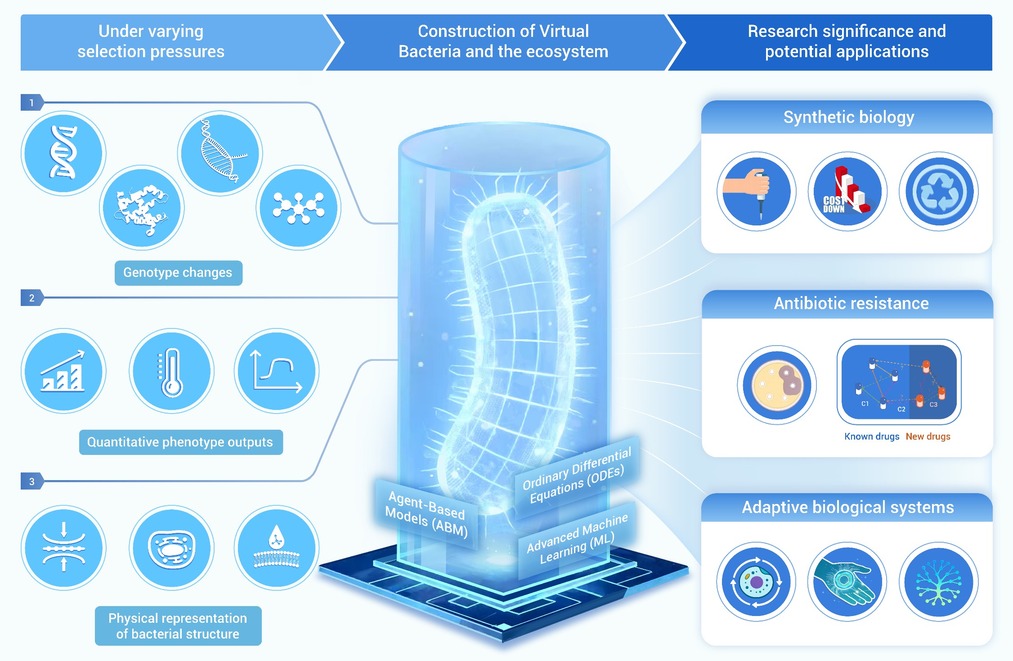
Figure 1.
Construction of virtual bacteria and associated ecosystem, with research significance and potential applications.
